Senator Garrett Davis
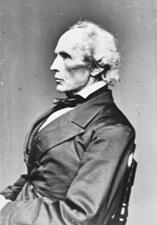
Here you will find contact information for Senator Garrett Davis, including email address, phone number, and mailing address.
| Name | Garrett Davis |
| Position | Senator |
| State | Kentucky |
| Party | Democratic |
| Status | Former Representative |
| Term Start | December 2, 1839 |
| Term End | March 3, 1873 |
| Terms Served | 6 |
| Born | September 10, 1801 |
| Gender | Male |
| Bioguide ID | D000099 |
About Senator Garrett Davis
Garrett Davis (September 10, 1801 – September 22, 1872) was an American attorney and politician who represented Kentucky in the United States House of Representatives from 1839 to 1847 and the United States Senate from 1861 until his death. Over the course of his long public career, he served during a significant period in American history, participating in the legislative process and representing the interests of his Kentucky constituents in both chambers of Congress.
Davis was born on September 10, 1801, in Mount Sterling, Montgomery County, Kentucky. He was the brother of Amos Davis, who also became active in public life. After completing preparatory studies, he entered public service at the local level, working in the office of the county clerk of Montgomery County, Kentucky, and later in the clerk’s office of Bourbon County, Kentucky. During this period he read law, preparing himself for admission to the bar. He was admitted to the bar in 1823 and commenced the private practice of law in Paris, Bourbon County, Kentucky. Like many Kentucky lawyers and landowners of his era, he owned slaves, a fact that placed him within the prevailing social and economic order of the antebellum border South.
Davis’s formal political career began in state government. He served in the Kentucky House of Representatives from 1833 to 1835, where he gained experience in legislative procedure and developed a reputation as a capable lawyer-legislator. Building on this state-level service, he was elected as a Whig to the United States House of Representatives and served there from March 4, 1839, to March 3, 1847. During his tenure in the House, he became chairman of the Committee on Territories, a key position at a time when questions of territorial organization, expansion, and the future status of slavery in new territories were central issues in national politics.
After four consecutive terms in the House, Davis declined to be a candidate for reelection in 1846. He returned to Kentucky, where he resumed the practice of law and engaged in agricultural pursuits. For the next fifteen years he refused to reenter active politics, despite repeated efforts to draw him back into public life. He declined the nomination for Lieutenant Governor of Kentucky in 1848, and later turned down the American Party’s nomination for Governor in 1855 as well as that party’s offer of its presidential nomination in 1856. During this period of political withdrawal, he remained a prominent figure in Kentucky’s legal and agricultural circles but stayed outside elective office.
On the eve of the Civil War, Davis’s Unionist convictions drew him back into the national political arena. He was opposed to secession and supported the Constitutional Union Party ticket of John Bell and Edward Everett in the 1860 presidential election, reflecting his desire to preserve the Union and avoid sectional conflict. Following the outbreak of the Civil War and the expulsion of Senator John C. Breckinridge from the United States Senate for supporting the Confederacy, the Kentucky General Assembly elected Davis in a special election in December 1861 to fill the vacant seat. He entered the Senate as a Union Democrat, aligning himself with those in the border states who supported the Union while often maintaining more conservative views on Reconstruction and federal authority. He was reelected as a Democrat in 1867, and he continued to serve until his death in 1872. During his Senate service, which spanned the Civil War and the early years of Reconstruction, he participated in debates over wartime measures, postwar readjustment, and the balance of power between the federal government and the states. At the time of his death, he was chairman of the Committee on Private Land Claims during the 42nd Congress.
Davis’s long tenure in Congress, encompassing service in the House from 1839 to 1847 and in the Senate from 1861 to 1872, placed him at the center of national affairs during some of the most turbulent decades in American history. Across these years he contributed to the legislative process as a member of the Whig Party in the antebellum period and later as a Union Democrat and Democrat in the Senate. His service in Congress, spanning more than three decades in two nonconsecutive phases, reflected both his initial reluctance and later determination to engage in national politics during crises that tested the durability of the Union.
In his personal life, Davis was married twice. His first marriage was to Rebecca Trimble, the daughter of Robert Trimble, an Associate Justice of the Supreme Court of the United States. After her death, he married Eliza J. Elliott. He was the father of four children: Rebecca, Robert, Carrie, and Garrett. His residence, known as Woodhome, near Paris, Kentucky, became a local landmark; after his death it was sold to George Edgar, who converted the property into a military academy. His prominence was further recognized in the naming of Davis County, Iowa, in his honor, reflecting his national reputation during his lifetime.
Garrett Davis died in office on September 22, 1872, while serving in the United States Senate. His death brought to a close a career that had begun in Kentucky’s state legislature in the 1830s and extended through service in both houses of Congress. He is listed among the members of the United States Congress who died in office between 1790 and 1899, and his life and public service were commemorated in formal memorial addresses delivered in the 42nd Congress and published by the Government Printing Office in 1873.