Representative Gary A. Condit
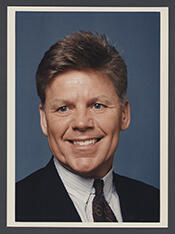
Here you will find contact information for Representative Gary A. Condit, including email address, phone number, and mailing address.
| Name | Gary A. Condit |
| Position | Representative |
| State | California |
| District | 18 |
| Party | Democratic |
| Status | Former Representative |
| Term Start | January 3, 1989 |
| Term End | January 3, 2003 |
| Terms Served | 7 |
| Born | April 21, 1948 |
| Gender | Male |
| Bioguide ID | C000670 |
About Representative Gary A. Condit
Gary Adrian Condit (born April 21, 1948) is an American former politician from California who served as a Democratic Representative in the United States House of Representatives from 1989 to 2003. He represented California’s 18th congressional district for seven terms, participating in the legislative process during a significant period in American history and representing the interests of his Central Valley constituents. Condit gained substantial national attention in 2001 after the disappearance and subsequent murder of Chandra Levy, a 23-year-old intern with the Federal Bureau of Prisons with whom he had been having an extramarital affair.
Condit was born in Salina, Oklahoma, the son of Velma Jean (Tidwell) Condit (1929–2017) and Adrian Burl Condit (1927–2021), a Baptist minister. Raised and educated in Oklahoma, he graduated from Nathan Hale High School in Tulsa, where he spent summers working as a roustabout in the state’s oil fields. In 1967, at age 18, he married his high school sweetheart, Carolyn Berry. Journalistic investigations in 2001 later revealed that he had given an inaccurate birth date on his marriage license, claiming to have been born in 1942 instead of 1948. At that time, Oklahoma law required males under 21 to obtain parental consent to marry, and the falsified date enabled him to evade that requirement.
In 1967, when his father accepted a pastorate at a Baptist church near Modesto, California, the Condit family relocated to the Central Valley. Gary Condit enrolled at Modesto Junior College, where he earned an Associate of Arts degree in 1970, and then attended California State University, Stanislaus, receiving a Bachelor of Arts degree in 1972. During his college years and at the outset of his working life, he held a variety of jobs, including employment at a tomato cannery, at a factory producing munitions during the Vietnam War, and in the paint department of a Montgomery Ward department store. These experiences preceded his rapid rise in local and then state politics in the Modesto–Ceres area.
Condit’s political career began at the municipal level in Ceres, California. He was elected to the Ceres City Council in 1972 and served until 1976. In 1975 and 1976 he was chosen by his colleagues as mayor, becoming the youngest mayor in the city’s history at age 25. He then advanced to county government, serving on the Stanislaus County Board of Supervisors from 1976 to 1982. In 1982, he was elected to the California State Assembly, where he represented a Central Valley district as a Democrat. During his tenure in the Assembly, he became part of the so‑called “Gang of Five” in 1988—along with Charles M. Calderon, Gerald R. Eaves, Rusty Areias, and Steve Peace—in an unsuccessful effort to unseat Willie Brown as Speaker by forging an alliance with Republicans. That same year, he made an uncredited, non-speaking cameo appearance in a fight sequence in the film “Return of the Killer Tomatoes,” which was co‑written and produced by his Assembly colleague Steve Peace.
Condit entered Congress in 1989 after winning a special election prompted by the resignation of House Democratic Whip Tony Coelho. He was elected to a full term in 1990 and was subsequently reelected five more times, generally without serious opposition; he faced no Republican challenger in the 1992 and 1998 general elections. As a member of the House of Representatives from California’s 18th congressional district, he was identified with the Blue Dog Democrats and was considered more conservative than many other California Democrats, frequently voting against President Bill Clinton’s positions. His most significant committee work was on the House Permanent Select Committee on Intelligence, where he served as a senior member in the years leading up to and following the September 11, 2001 terrorist attacks. He was among a relatively small number of members cleared to review the most sensitive intelligence related to 9/11. In legislative matters, Condit took several populist and progressive stances, including opposition to the North American Free Trade Agreement (NAFTA) despite strong support for the agreement from President Clinton and from the wine industry in his own district. He voted against the repeal of the Glass–Steagall banking protections, opposed U.S. military intervention in Kosovo, and voted against the Iraq War. In the aftermath of the Kosovo conflict, he was a persistent advocate for the prosecution of Slobodan Milošević. During the Monica Lewinsky scandal in 1998, Condit publicly urged President Clinton to “come clean” about his relationship with Lewinsky, a statement that was frequently replayed during Condit’s own later scandal.
In May 2001, Condit became the focus of intense national media scrutiny following the disappearance of Chandra Levy, a Washington, D.C., intern originally from his district who worked for the Federal Bureau of Prisons. Police questioned Condit twice, and he initially denied having an extramarital relationship with Levy. Her aunt later disclosed conversations in which Levy had confided about the affair, leading to a third police interview in which Condit admitted the relationship. At the time the affair began, Condit was 53 and Levy was 23. Although he was never named an official suspect in her disappearance, Levy’s family believed he was withholding important information, and his reputation suffered from the contrast between his “pro‑family” political image and his adultery, as well as from his efforts to mislead investigators about the affair. In July 2001, two months after Levy vanished, Condit allowed investigators to search his Washington apartment; hours before the search, police reported seeing him discard a gift box from another woman in a suburban dumpster, following news reports that he had also had an affair with a flight attendant. In an August 2001 televised interview with Connie Chung, Condit acknowledged a five‑month relationship with Levy but did not say whether it was sexual. He admitted that in 34 years of marriage he had not been “a perfect man” and had made his “fair share of mistakes,” while denying any involvement in Levy’s disappearance or death and denying that he had killed her or possessed relevant information.
Levy’s remains were not found during the extensive search that followed her disappearance. On May 22, 2002, they were discovered accidentally in a secluded area of Rock Creek Park in Washington, D.C., and her death was ruled a homicide. By that time, public interest in the case had diminished somewhat following the September 11 attacks, but the scandal had already severely damaged Condit’s political standing. Despite retaining his seat on the Intelligence Committee and his security clearance, he faced mounting political challenges. On December 7, 2001, he announced his intention to seek reelection. In March 2002, he lost the Democratic primary to his former aide, then–State Assemblyman Dennis Cardoza, and he left Congress at the end of his term in January 2003. One of his most notable final votes in Congress came on July 24, 2002, when he cast the lone “nay” in a 420–1 House vote to expel Representative James Traficant following Traficant’s conviction on corruption charges.
Following his departure from Congress, Condit pursued a series of legal actions related to the public commentary surrounding the Levy case. In late 2002, he filed an $11 million defamation lawsuit against writer Dominick Dunne of Vanity Fair, alleging that Dunne had falsely suggested that Condit had arranged for Levy’s murder and had frequented Middle Eastern embassies to engage in sexual activity with prostitutes, during which he allegedly indicated a desire to have Levy “gotten rid of.” Condit’s attorney argued that Dunne’s statements, made on national radio and television in December 2001, conveyed that Condit was involved in Levy’s kidnapping and murder, including claims that friends of Condit had her kidnapped, placed on an airplane, and dropped into the Atlantic Ocean. Dunne settled the suit in March 2005 for an undisclosed amount, later stating he had been “completely hoodwinked” by an unreliable informant. Condit filed a second lawsuit against Dunne in 2005, asserting that Dunne had “revivified” the alleged slander during a November 2005 appearance on CNN’s “Larry King Live”; a federal judge dismissed that suit in July 2008. In July 2006, Condit sued the Sonoran News, a free weekly newspaper, for defamation after it reported that he was the “main focus in the Chandra Levy case in 2001, after lying to investigators about his affair with Levy.” The case was dismissed in July 2007 when the judge ruled that Condit had not shown the statement to be false or that the paper had acted with malice. In later years, Condit publicly denied ever having had an affair with Levy, despite his earlier admissions to investigators and in media interviews.
The criminal investigation into Levy’s death continued for years after Condit left office. In March 2009, authorities obtained a warrant for the arrest of Ingmar Guandique, an undocumented immigrant from El Salvador who was already imprisoned for two other attacks on women in Rock Creek Park. Guandique was indicted for Levy’s murder and, on November 22, 2010, was found guilty of first-degree murder; in February 2011, he was sentenced to 60 years in prison. Condit’s attorney, Bert Fields, characterized the conviction as “a complete vindication” of Condit, while noting that it came too late to restore his political career. On June 4, 2015, however, D.C. Superior Court Judge Gerald Fisher granted a motion for a new trial after revelations that the prosecution’s key witness, jailhouse informant Armando Morales, had lied about prior testimony in another case. On July 28, 2016, prosecutors dropped all charges against Guandique after an associate of Morales produced secret recordings in which Morales admitted falsifying his testimony about Levy’s murder. As a result, Levy’s death remains officially unsolved.
In his post-congressional life, Condit moved to Arizona, where he and his family operated two Baskin-Robbins ice cream franchises. The business venture ultimately failed, and in a subsequent breach-of-contract proceeding he was ordered to pay the company $98,000. By 2012, he was reported to be serving as president of the Phoenix Institute of Desert Agriculture, an entity that later listed its corporate status as “Dissolved” in its last filing as of June 4, 2015. Condit eventually returned to California and became a registered lobbyist with the J. Blonien law firm in Sacramento, remaining connected to public affairs through advocacy work rather than elective office.
Condit’s family has remained active in Central Valley politics. His son, Chad Condit, announced a run for Congress in 2012 as an independent candidate in California’s redrawn 10th congressional district but lost in the top-two primary to incumbent Republican Jeff Denham and Democrat José M. Hernández. In 2022, Chad ran for the California State Assembly in the 22nd Assembly District, finishing third in the nonpartisan primary and failing to advance to the general election. Afterward, he worked on Marie Alvarado-Gil’s State Senate campaign and became her chief of staff following her election; in December 2023, he was fired from that position and later sued Alvarado-Gil, alleging sexual harassment. Condit’s daughter, Cadee Condit Gray, was previously married to Adam Gray, who served in the California State Assembly representing the 21st District from 2012 to 2022 and later became a member of Congress representing California’s 13th congressional district beginning in 2025.
Several of Condit’s other relatives have also held local office in Stanislaus County. His nephew, Buck Condit, was elected in 2020 to the Stanislaus County Board of Supervisors for District 1, defeating Modesto City Councilman Bill Zoslocki with 58.77 percent of the vote to Zoslocki’s 41.23 percent. In 2018, Condit’s grandson, Channce Condit, ran unopposed for a seat on the Ceres City Council. In 2020, Channce was elected to the Stanislaus County Board of Supervisors, defeating Tom Hallinan by a margin of 60 percent to 40 percent, thereby joining his cousin Buck on the board. Another grandson, Couper Condit, was appointed to the Ceres Planning Commission in 2015 but was denied reappointment by the city council in 2020. Later that year, he won election to the Ceres City Council, defeating incumbent Michael “Mike” Kline by 38.19 percent to 23.52 percent in a four-way race. After approximately ten months in office, he resigned without public explanation. Couper has also worked as district director for California Assemblymember Heath Flora. In 2023, yet another grandson, Gary M. Condit—named for his grandfather—was appointed to the Ceres Planning Commission. He ran for mayor of Ceres in 2024, narrowly losing to incumbent Mayor Javier Lopez by just under five percentage points. His wife, Destiny Suarez, worked in the office of State Senator Marie Alvarado-Gil but resigned approximately eight months after her father-in-law, Chad Condit, was dismissed from the same workplace.