Representative Gary A. Franks
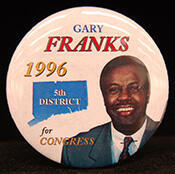
Here you will find contact information for Representative Gary A. Franks, including email address, phone number, and mailing address.
| Name | Gary A. Franks |
| Position | Representative |
| State | Connecticut |
| District | 5 |
| Party | Republican |
| Status | Former Representative |
| Term Start | January 3, 1991 |
| Term End | January 3, 1997 |
| Terms Served | 3 |
| Born | February 9, 1953 |
| Gender | Male |
| Bioguide ID | F000348 |
About Representative Gary A. Franks
Gary Alvin Franks (born February 9, 1953) is an American politician, consultant, academic, and commentator who served as a Republican member of the U.S. House of Representatives from Connecticut from January 3, 1991, to January 3, 1997. A member of the Republican Party, he was the first African-American elected to the U.S. Congress from Connecticut, the first modern black conservative elected to the House of Representatives, and the first Black Republican elected to the House since Oscar De Priest’s re-election in 1932. Over three terms in office he contributed to the legislative process during a significant period in American political history, participating in the democratic process and representing the interests of his constituents in Connecticut’s 5th (then-numbered 6th) District.
Franks was born in Waterbury, Connecticut, one of six children of a brass mill worker and a hospital dietary aide. Raised in a working-class family in an industrial city, he attended Sacred Heart High School in Waterbury, where he was elected president of his class, an early indication of his interest in leadership and public life. His upbringing in Waterbury, a community shaped by manufacturing and later by economic transition, would inform his later focus on economic development and defense-related employment in his home state.
Franks received his Bachelor of Arts degree from Yale University in 1975. While at Yale, he distinguished himself both academically and athletically, serving as captain of the Yale basketball team. Following his collegiate career, he briefly pursued professional basketball, signing as a free agent with the New Orleans Jazz of the National Basketball Association. After leaving Yale, Franks entered the private sector and worked in labor relations for approximately a decade. He held positions with several major corporations, including Continental Can Company, Chesebrough-Pond’s Inc., and Cadbury Schweppes PLC, gaining experience in corporate management, labor issues, and industrial operations that would later shape his views on economic and regulatory policy.
Franks began his formal political career in local government in his hometown. He served as a member of the Waterbury Board of Aldermen from 1986 to 1990, participating in municipal governance during a period of economic and social change for the city. In 1986 he was an unsuccessful candidate for Comptroller of Connecticut, a statewide office, marking his first bid for higher public office. These early campaigns and local service helped establish his profile within the Connecticut Republican Party and introduced him to statewide voters.
In 1990, Franks ran for the U.S. House of Representatives in what was then Connecticut’s 6th Congressional District. In the general election he defeated former Democratic congressman Toby Moffett, whom he portrayed as too liberal to represent the district. His campaign received national attention, and both President George H. W. Bush and First Lady Barbara Bush campaigned on his behalf. With his victory, Franks became the first African-American Republican elected to the House since Oscar Stanton De Priest, last elected from Chicago’s South Side in 1932. During the 1990s he served alongside another African-American Republican, J. C. Watts of Oklahoma. Franks won re-election in 1992 in a three-way race against Democratic candidate James Lawlor of Waterbury and A Connecticut Party candidate Lynn Taborsak of Danbury. In 1994 he was challenged by Democratic state senator James H. Maloney of Danbury; Franks prevailed, with Maloney receiving 46 percent of the vote in that midterm election. In 1996, amid strong statewide support in Connecticut for the re-election of President Bill Clinton, Franks lost a rematch to Maloney, ending his three-term tenure in the House.
During his congressional service from 1991 to 1997, Franks served on the House Armed Services Committee, a key assignment for a representative from a state with substantial defense-related industries. Under his tenure, more defense contracts were awarded in Connecticut than ever before, including production of the Seawolf-class submarine, a major naval program that continued for more than a decade, and orders of the M16 rifle for Colt Manufacturing. He served as chairman of the Panel for Defense Conversion, which addressed the transition of defense-dependent communities and facilities in the post–Cold War era. Through this work, $20 million was approved for the demolition and environmental cleanup of an old defense manufacturing site in Waterbury, which was subsequently redeveloped as a commercial center that became, at its opening, New England’s second-largest commercial mall. Franks also wrote the law that established Weir Farm National Historic Site in Ridgefield, Connecticut, as a unit of the National Park Service, preserving an important American artistic landscape. He authored the Small Business Administration’s New Markets Program; although it was not enacted during his tenure, many of its components were later incorporated into the Urban Entrepreneurial Opportunities legislation signed by President Bill Clinton in 2000.
Ideologically, Franks was known as a black conservative and ran as a candidate in favor of welfare reform and in opposition to affirmative action. He supported the nomination of Clarence Thomas to the Supreme Court and opposed increased taxation, advocating instead for a reduced capital gains tax and supporting a proposed constitutional amendment to ban desecration of the American flag. He opposed the Civil Rights Act of 1990, arguing that it would effectively impose hiring quotas and could encourage companies to relocate from Connecticut to states with a higher proportion of white residents. However, he later voted in favor of the Civil Rights Act of 1991, which revised and clarified several provisions of the earlier legislation. During his time in Congress, Franks supported abortion rights, a position he would later publicly renounce. He became the first Republican voting member of the Congressional Black Caucus, but his presence and ideological stance led to friction; he was eventually excluded from the caucus’s internal strategy sessions amid accusations from some members that he was acting as a Republican “mole.”
Following his defeat for re-election in 1996, Franks’s prominence in national politics fueled speculation about a bid for higher office. In 1998 he declared his candidacy for the United States Senate from Connecticut, challenging incumbent Democratic Senator Christopher J. Dodd. Franks ran unopposed for the Republican nomination but was defeated by Dodd in the general election, receiving about 32 percent of the vote in what was widely described as a landslide victory for the incumbent. After leaving elective office, Franks transitioned into business, consulting, and academia. In 1999 he founded and became a partner in the public affairs firm Gary Alvin Associates, LLC, based in Washington, D.C. He served as president and chairman of Pacific Rim Trading & Investment Corp., a Fort Lauderdale–based group engaged in recycling American scrap metal for export to China. He has also held academic appointments, serving as an adjunct professor at Georgetown University and later as a visiting professor at Hampton University and the University of Virginia, where he has taught courses related to politics, public policy, and government.
Franks has remained a public commentator and writer in the years after his congressional service. He has written for the Boston Herald, where he has addressed contemporary political and social issues, including revisiting his own legislative record. In a 2022 Boston Herald column, he stated that he regretted his earlier support for abortion rights while in Congress, particularly in light of what he described as the disproportionate number of abortions among Black women. He wrote, “I supported the so-called pro-choice position while in Congress. These are votes I regret today and pray for God’s forgiveness on so many levels…. I implore the U.S. Supreme Court to do everything in its power to stop the madness. Socioeconomic reasons should not be justification to abort a pregnancy in America. We, as a society, are better than that.” He has also been featured in national media discussions of race and party politics; in 2015, the Wall Street Journal profiled him in an article titled “Making the Republican Case for Black Support,” in which he emphasized the importance of African-American engagement with both major political parties and highlighted Republican positions on school choice and faith-based initiatives.
Franks’s post-congressional life has also included controversy. In 2010, the Waterbury Republican-American published a profile alleging a history of unpaid debts, back taxes, and foreclosed properties, and reported that although Franks was registered to vote in Waterbury, he had not voted there in a decade and had lived with his wife in Maryland and Florida under alternate versions of their legal names. Franks strongly contested the newspaper’s account. In a 2015 interview he responded, “Most of those things are lies. I’ve had the same name all my life. I have lived in my same residence for 12 years. I have visited and have lived in a little place in Florida for a year or so.” He further stated that rental properties he had purchased while in politics had been burned down by the Ku Klux Klan, and he alleged that after he sued a hospital following the death of his sister, the hospital retaliated by working through newspapers to spread what he characterized as fictitious and libelous stories.
In addition to his written commentary, Franks has remained active in public discourse through broadcasting. He hosts a podcast titled “We Speak Frankly” with his son Gary, in which they discuss politics, public policy, and current events from a conservative perspective. Franks is married to Donna Williams, whom he wed in 1990; they have two daughters and a son. He is a Baptist, and his religious faith has increasingly informed his public positions, particularly on social issues, in the decades since his service in the U.S. House of Representatives.