Senator Gaylord Nelson
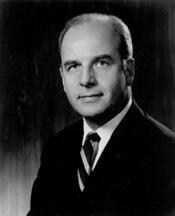
Here you will find contact information for Senator Gaylord Nelson, including email address, phone number, and mailing address.
| Name | Gaylord Nelson |
| Position | Senator |
| State | Wisconsin |
| Party | Democratic |
| Status | Former Representative |
| Term Start | January 9, 1963 |
| Term End | January 3, 1981 |
| Terms Served | 9 |
| Born | June 4, 1916 |
| Gender | Male |
| Bioguide ID | N000033 |
About Senator Gaylord Nelson
Gaylord Anton Nelson (June 4, 1916 – July 3, 2005) was an American politician and environmentalist from Wisconsin who served as a Wisconsin state senator, governor of Wisconsin, and a United States senator. A member of the Democratic Party, he served as a United States senator from Wisconsin from 1963 to 1981, completing three consecutive terms in office. Widely recognized as the founder of Earth Day, he helped launch a new wave of environmental activism and became one of the most prominent conservation voices in American public life during a significant period in the nation’s history.
Nelson was born on June 4, 1916, in Clear Lake, Wisconsin. Raised in a small-town environment that would later inform his advocacy for conservation and rural communities, he developed an early interest in public affairs and social issues. His upbringing in Wisconsin, a state with a strong Progressive tradition, shaped his political outlook and commitment to public service, which would later be reflected in his legislative priorities on the environment, consumer protection, and civil rights.
After completing his early education in Wisconsin, Nelson pursued higher education and legal training, preparing for a career in law and politics. He was admitted to the bar and began practicing law in Wisconsin, using his legal background as a foundation for his entry into elective office. His legal and civic work helped establish his reputation as an engaged and capable advocate for his community, setting the stage for his rapid rise in state politics in the post–World War II era.
In 1948, Nelson was elected to the Wisconsin Senate, marking the beginning of his formal political career. He remained a member of the Wisconsin Senate for a decade, serving until 1958. During this period he aligned himself with the Democratic Party’s reform and progressive wing, building a record that led to his election as governor of Wisconsin in 1958. Nelson served as governor for four years, winning two consecutive two-year terms. As governor, he advanced policies consistent with his growing interest in conservation and public welfare, and his success at the state level positioned him for national office.
In 1962, Nelson was elected to the United States Senate from Wisconsin, and he took office in January 1963. He served three consecutive terms as a senator, remaining in the Senate until 1981. His service in Congress occurred during a significant period in American history, encompassing the civil rights movement, the Vietnam War, and the rise of the modern environmental movement. As a member of the Senate, Nelson participated actively in the legislative process and represented the interests of his Wisconsin constituents while also emerging as a national leader on environmental and consumer issues. Early in his Senate career, in 1963, he persuaded President John F. Kennedy to undertake a national speaking tour to discuss conservation issues, an initiative that helped elevate environmental concerns on the national agenda.
Nelson is best known for founding Earth Day, which began as a nationwide environmental “teach-in” on April 22, 1970. Conceived as a way to channel growing public concern about pollution and ecological degradation into political action, Earth Day drew millions of participants across the United States and is widely credited with launching a new wave of environmental activism. During congressional debate on air pollution and automobile emissions that same year, Nelson sponsored an amendment to the Clean Air Act that would have phased out gasoline-powered automobiles in favor of electric or steam-powered vehicles. Although the proposal was defeated after intense lobbying by automotive manufacturers, it underscored his willingness to advance ambitious environmental reforms. In 1968, during his Senate re-election campaign, he was publicly praised by Vince Lombardi, the general manager and former coach of the Green Bay Packers, who called him the “nation’s #1 conservationist” at a banquet in Oshkosh. Nelson’s campaign used Lombardi’s remarks in radio and television commercials, a move that angered Lombardi, the Wisconsin Republican Party, and Lombardi’s wife, Marie, a staunch Republican.
Although known primarily for his environmental work, Nelson developed a broad legislative portfolio. He was a leading consumer advocate and a strong supporter of civil rights and civil liberties, and he became one of the early outspoken opponents of the Vietnam War in the Senate. In 1969, he was one of four senators to introduce a bill to establish the Wisconsin Islands Wilderness, reflecting his continued focus on land and resource protection. In 1970, he called for congressional hearings on the safety of combined oral contraceptive pills, proceedings that became known as “The Nelson Pill Hearings.” These hearings led to a requirement that patient inserts disclose side effects for the pill, the first such mandated disclosure for any pharmaceutical drug. In 1971, he further sought to overhaul pharmaceutical regulation by proposing legislation that would require drug manufacturers to prove both the safety and efficacy of their products. His office later received a 1975 memorandum indicating that popular over-the-counter sleeping aids such as Sominex and its competitor Compoz had been shown ineffective compared with placebos, despite the $34 million Americans spent on sleeping aids in 1974.
Nelson also emerged as a notable advocate for small business. As chairman of the Senate Small Business Committee, he led successful efforts to authorize the first modern White House Conference on Small Business, to create the system of Small Business Development Centers at U.S. universities, and to improve the way federal agencies regulate small entities through what became the Regulatory Flexibility Act. His independent streak was evident in other areas as well; in 1973, he was one of only three senators—along with Thomas Eagleton and William Hathaway—to oppose the nomination of Gerald R. Ford to be vice president of the United States. Throughout his Senate tenure, he consistently linked environmental protection to broader questions of economic and social policy, famously asserting that “the economy is a wholly owned subsidiary of the environment, not the other way around.”
In his later years, Nelson continued to speak and write about environmental protection, population, and immigration policy, arguing that population growth posed serious challenges to environmental sustainability. Reflecting his view that environmental and demographic issues were intertwined, he stated that “the bigger the population gets, the more serious the problems become” and criticized the notion that one could support environmental protection without addressing population and immigration. Even after leaving the Senate in 1981, he remained a prominent public figure in environmental circles and appeared in 2002 as a contestant on the television program “To Tell the Truth,” where his role in founding Earth Day was highlighted. Gaylord Anton Nelson died on July 3, 2005, leaving a legacy as a central figure in the development of modern American environmental policy and as a long-serving Democratic senator from Wisconsin who contributed significantly to the legislative process over three terms in office.