Senator George Aiken
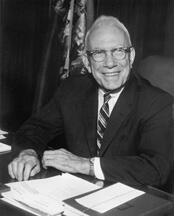
Here you will find contact information for Senator George Aiken, including email address, phone number, and mailing address.
| Name | George Aiken |
| Position | Senator |
| State | Vermont |
| Party | Republican |
| Status | Former Representative |
| Term Start | January 3, 1941 |
| Term End | January 3, 1975 |
| Terms Served | 17 |
| Born | August 20, 1892 |
| Gender | Male |
| Bioguide ID | A000062 |
About Senator George Aiken
George David Aiken (August 20, 1892 – November 19, 1984) was an American politician, horticulturist, and long‑serving United States senator from Vermont. A member of the Republican Party, he served as the 64th governor of Vermont from 1937 to 1941 before representing the state in the United States Senate for 34 years, from January 3, 1941, to January 3, 1975. Over six full terms in office, he became one of the most influential New England Republicans of the mid‑twentieth century. At the time of his retirement, he was the most senior member of the Senate, a distinction later matched by his immediate successor, Patrick Leahy, who would go on to become Dean of the Senate.
Aiken was born in Dummerston, Vermont, and grew up in a rural environment that shaped his lifelong attachment to agriculture and the landscape of his home state. He attended local schools and developed an early interest in horticulture and farming, pursuits that would remain central to his identity throughout his public life. Before entering high office, he became well known in Vermont as a successful horticulturist and nurseryman, gaining practical experience with small‑scale agriculture and rural enterprise that informed his later legislative priorities. His affection for Vermont’s natural beauty was enduring; he later remarked that “some folks just naturally love the mountains, and like to live up among them where freedom of thought and action is logical and inherent.”
Aiken’s political career began in state and local affairs, where he rose steadily through Vermont’s Republican establishment. He served in the Vermont House of Representatives, eventually becoming Speaker, and later in the Vermont Senate. In 1936 he was elected governor, taking office in January 1937 as the state’s 64th chief executive. As governor from 1937 to 1941, Aiken frequently clashed with the New Deal over federal programs for hydroelectric power and flood control in Vermont, reflecting his concern for state autonomy and local control over natural resources. At the same time, he supported public works and rural development initiatives that he believed would benefit small farmers and rural communities, foreshadowing his later advocacy in the Senate.
A vacancy in the United States Senate set the stage for Aiken’s transition to national office. Senator Ernest Willard Gibson died on June 20, 1940, and on June 24, 1940, Governor Aiken appointed Ernest W. Gibson Jr. to fill the seat temporarily, pending a special election for the four years remaining in the elder Gibson’s term. The younger Gibson served as a caretaker senator until January 3, 1941, and did not run in the special election. Political observers widely concluded that Gibson Jr. accepted the interim appointment with the understanding that he would not oppose Aiken, who was known to desire a Senate seat and who might otherwise have faced a primary challenge from another appointee. Gibson Jr., who hoped to serve as governor, was willing to fill the vacancy temporarily and then defer to Aiken. Aiken won the special election on November 5, 1940, and took his seat in January 1941. He was subsequently re‑elected in 1944, 1950, 1956, 1962, and 1968, serving continuously until his retirement in 1975.
During his long Senate career, Aiken held several important leadership positions and played a significant role in shaping mid‑century domestic policy. He served as chairman of the Committee on Expenditures in Executive Departments in the 80th Congress and later chaired the Committee on Agriculture and Forestry in the 83rd Congress. As a Northeastern Republican, he was one of four Republican co‑sponsors of the Full Employment Act of 1946, reflecting his willingness to support an active federal role in stabilizing the economy. In 1945 he sponsored the food allotment bill, a forerunner of the modern food stamp program, and he consistently promoted federal aid to education. In 1947 he sought to establish a federal minimum wage of 65 cents per hour. A strong supporter of the small farmer, he advocated public works and spending programs for rural America, including rural electrification, flood control, and crop insurance, positions that often put him at odds with more conservative “Old Guard” Republicans in the Senate.
Agricultural and labor policy were central concerns for Aiken. As acting chairman of the Senate Agriculture Committee in 1947, he opposed high, rigid price supports for farm commodities, arguing instead for more flexible mechanisms. The resulting compromise, known as the Hope‑Aiken Act of 1948, introduced a sliding scale of price supports that sought to balance farm income stability with market responsiveness. On labor issues, Aiken positioned himself between pro‑union Democrats and pro‑management Republicans. He favored resolving labor disputes through negotiation rather than through sweeping legislative or judicial intervention. He voted against the stringent Case labor bill backed by conservative Republicans, a stance that contributed to their blocking his appointment to the Labor and Public Welfare Committee and to the elevation of Robert A. Taft as its chair. Although he spoke out in favor of unions, Aiken ultimately voted for the Taft‑Hartley Act of 1947 and to override President Harry S. Truman’s veto, arguing that it was a lesser evil compared with the more restrictive Case bill.
Aiken’s views on foreign policy evolved over time. Initially an isolationist in 1941, he shifted his stance as global circumstances changed. He supported the Truman Doctrine in 1947 and the Marshall Plan in 1948, endorsing a robust American role in postwar reconstruction and the containment of Soviet influence. In the realm of civil rights, his record was generally supportive but sometimes qualified. He voted in favor of the Civil Rights Acts of 1957, 1964, and 1968, the 24th Amendment to the U.S. Constitution abolishing the poll tax in federal elections, the Voting Rights Act of 1965, and the confirmation of Thurgood Marshall to the U.S. Supreme Court, though he did not vote on the Civil Rights Act of 1960. While he consistently backed major civil rights legislation, he often did so with amendments or reservations that led some militant civil rights groups and the NAACP to criticize his approach as ambiguous or obstructive.
During the 1960s and 1970s, Aiken became particularly noted for his stance on the Vietnam War. Neither a committed hawk nor a dove, he was sometimes described as an “owl” for his cautious, pragmatic approach. He reluctantly supported the Gulf of Tonkin Resolution in 1964 but later opposed President Lyndon B. Johnson’s escalation of the conflict, while supporting President Richard Nixon’s policy of gradual withdrawal and “Vietnamization,” under which South Vietnamese forces assumed more of the fighting with American financial support. Aiken is widely associated with the suggestion that the United States should “declare victory and bring the troops home.” His actual proposal was that the United States could unilaterally declare that it had “won” in the sense that its forces controlled most of the field and no enemy could establish authority over South Vietnam, and then shift the conflict back to the realm of political struggle. Acknowledging the unconventional nature of this idea, he conceded, “It may be a far‑fetched proposal, but nothing else has worked.”
Aiken also distinguished himself as an early Republican critic of Senator Joseph McCarthy. In 1950 he was one of seven Republican senators who, in a public written statement, denounced McCarthy’s tactics and warned against those who sought “victory through the selfish political exploitation of fear, bigotry, ignorance and intolerance.” His independent streak and strong base of support in Vermont allowed him to maintain this moderate, often dissenting posture. His popularity at home was such that he reportedly spent only $17.09 on his final re‑election campaign. Over the course of his six Senate terms, he represented Vermont during a period of profound national change, participating in the legislative process on issues ranging from economic policy and agriculture to civil rights and foreign affairs, and consistently representing the interests of his constituents.
Aiken left the Senate in January 1975 and was succeeded by Democrat Patrick Leahy, the first member of his party to represent Vermont in the Senate. Leahy would later become Dean of the Senate, the title Aiken held when he retired. Together, Aiken and Leahy held Vermont’s Class 3 Senate seat for more than 80 years, forming the longest back‑to‑back tenure for a single seat in Senate history; by the time of Leahy’s retirement at the end of the 117th Congress in January 2023, they had occupied the seat for a combined 81 years, 11 months, and 24 days. In recognition of Aiken’s long service and his attachment to his home state, a north‑south avenue on the west side of the public lawn at the Vermont State House has been named in his honor. George David Aiken died on November 19, 1984, leaving a legacy as a pragmatic New England Republican, a champion of small farmers and rural communities, and a prominent figure in mid‑twentieth‑century American legislative history.