Senator George Harrison Bender
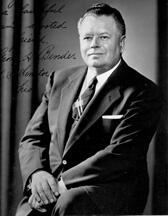
Here you will find contact information for Senator George Harrison Bender, including email address, phone number, and mailing address.
| Name | George Harrison Bender |
| Position | Senator |
| State | Ohio |
| Party | Republican |
| Status | Former Representative |
| Term Start | January 3, 1939 |
| Term End | January 3, 1957 |
| Terms Served | 7 |
| Born | September 29, 1896 |
| Gender | Male |
| Bioguide ID | B000356 |
About Senator George Harrison Bender
George Harrison Bender (September 29, 1896 – June 18, 1961) was an American Republican politician from Ohio who served in the United States House of Representatives from 1939 to 1949 and from 1951 to 1954, and in the United States Senate from 1954 to 1957. Over the course of seven terms in Congress, he contributed to the legislative process during a significant period in American history, participating in the democratic process and representing the interests of his Ohio constituents.
Bender was born in Cleveland, Ohio, to Czech immigrants Joseph Bender, an employee of General Electric, and Anna Šírová (1866–1933). His mother was born in Fryšava pod Žákovou horou, in what is now the Czech Republic, to Jan Šír and Anna Slámová, and was baptized in the Calvinist Helvetian Reform church in Nové Město na Moravě. Of Czech descent and raised in a working-class immigrant family, Bender attended West Commerce High School in Cleveland, graduating in 1914. He showed an early and intense interest in politics: at age fifteen he collected 10,000 signatures on a petition urging former President Theodore Roosevelt to run again in 1912, personally presented the petition to Roosevelt, and received a letter from Roosevelt informing him of his decision to seek the Republican presidential nomination shortly before it was publicly announced. In 1916, Bender served as a delegate to the abortive Progressive Party convention, which voted to dissolve rather than nominate its own presidential candidate, and he campaigned that fall for Republican candidates, reflecting the broader tensions between “progressive” and “Old Guard” Republicans in those years.
In 1920, Bender married Edna Eckhardt; the couple had two daughters. To support his family, he pursued a varied business career while nurturing his political ambitions. He worked as a department store advertising manager, served as manager of Cleveland Stadium, and later operated his own start-up, the Bender Insurance Company. Despite these ventures, he regarded politics as his primary vocation. That same year, running as a Republican, he became the youngest person to that time to win a seat in the Ohio Senate. He served in the state senate from 1921 until 1930, where his influence was initially limited but he advocated for measures such as teacher tenure, which he unsuccessfully promoted. Originally a strong supporter of Prohibition, his views shifted dramatically after police, acting on an anonymous tip, raided his home in search of liquor and found nothing; thereafter he became a vehement opponent of the alcohol ban. In 1934, he founded and edited two party periodicals, the National Republican and the Ohio Republican magazines, which he used to advance Republican ideas and causes.
Bender’s early attempts to enter national office were marked by persistence in the face of defeat. He ran unsuccessfully for the U.S. House of Representatives in 1930, 1932, 1934, and 1936 before finally winning election in 1938. Taking his seat in January 1939, he served in the House through successive re-elections until 1949, losing his seat in the Democratic landslide year of 1948. He regained the seat in the 1950 election and served again from 1951 to 1954. During his House career he emerged as a vigorous critic of President Franklin D. Roosevelt’s foreign and domestic policies. In his 1940 polemical work, The Challenge of 1940, he sharply attacked most elements of the New Deal, making an exception only for certain humanitarian relief programs such as the Works Progress Administration, which he accepted as a temporary necessity. After World War II, as the Cold War began, Bender opposed the Marshall Plan and the Truman Doctrine. While he did not dispute the need to assist war-ravaged European nations, he argued that aid should be channeled through the United Nations or private relief organizations rather than through direct U.S. government programs, and he strongly objected to American aid to Greece and Turkey, contending that such assistance primarily served the interests of a “collapsing British empire” rather than those of the United States.
Bender’s reputation as a loyal party man and energetic organizer brought him a prominent role in national Republican politics. He served as an organizer for Senator Robert A. Taft’s campaigns for the Republican presidential nomination at the 1948 and 1952 Republican National Conventions. In this capacity he arranged musical entertainment, conducted mass singing, led floor demonstrations, and famously rang cowbells to rally delegates, behavior that led detractors to label him the “Clown Prince.” Despite the derisive nickname and the often comic tone of his public performances, he remained a serious and influential figure within the party. In 1952 he appeared in a widely seen newsreel addressing more than 15,000 people at Cleveland Public Auditorium immediately after Richard Nixon’s nationally televised “Checkers” speech; when he asked the crowd to indicate its support for Nixon, he was met with a thunderous ovation.
Following the death of Senator Taft in 1953, Bender sought higher office and narrowly won election in 1954 to fill the vacant Ohio seat in the United States Senate, serving the remainder of the term from 1954 to 1957. As a senator, he aligned himself closely with President Dwight D. Eisenhower and consistently supported both Republican Party and administration initiatives. His earlier isolationist leanings moderated significantly; he now endorsed more direct U.S. involvement abroad, including aid to countries of the former British Empire. In July 1956, he joined two fellow Republicans and three Democrats in voting for a five-minute adjournment motion that had the practical effect of advancing a civil rights bill to the Senate floor, an action that also represented a modest challenge to party leadership prerogatives. In the 1956 election, however, Bender lost his Senate seat to Ohio Governor Frank J. Lausche, a popular Democrat.
After leaving the Senate, Bender remained active in public affairs. From June 1957 to May 1958 he served as special assistant to the Secretary of the Interior, during which time he campaigned for the incorporation of Alaska as the forty-ninth state. In 1958, Teamsters president Jimmy Hoffa hired him to chair a three-man commission charged with investigating racketeering within the International Brotherhood of Teamsters. As chairman, Bender independently sent a form letter to every Teamster local in the country requesting information about any “racketeering or gangster alliances” known within their jurisdictions. In December 1958 he submitted a preliminary report to Hoffa declaring the Teamsters “free of corruption,” a conclusion that his two fellow commissioners quickly disavowed. Bender continued his inquiry with the same approach until early May 1959, billing the union $58,636.07 in salary and expenses. His relationship with the Teamsters and his political activities became clouded by allegations that he had curtailed a 1956 investigation into the union after receiving a $40,000 campaign contribution. The United States Senate Select Committee on Improper Activities in Labor and Management held hearings on these accusations in the autumn of 1958 but ultimately recommended no action. Testifying before Senator Barry Goldwater, Bender defended his conduct with characteristic bluntness, stating, “When you run for office, you have to have the votes of the washed and the unwashed as well. If cats and dogs could vote I’d shake hands with them.” He later failed in a 1960 bid to be a delegate to the Republican National Convention and in a 1961 campaign for the position of Republican precinct committeeman.
In his final years, Bender withdrew into a largely self-imposed retirement. He died on June 18, 1961, in Chagrin Falls, a suburb of Cleveland, Ohio. He was interred at Knollwood Cemetery in Mayfield Heights, Ohio, closing the life of a colorful, controversial, and long-serving figure in mid-twentieth-century Republican politics.