Representative George Washington Blanchard
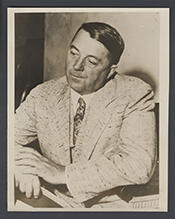
Here you will find contact information for Representative George Washington Blanchard, including email address, phone number, and mailing address.
| Name | George Washington Blanchard |
| Position | Representative |
| State | Wisconsin |
| District | 1 |
| Party | Republican |
| Status | Former Representative |
| Term Start | March 9, 1933 |
| Term End | January 3, 1935 |
| Terms Served | 1 |
| Born | January 26, 1884 |
| Gender | Male |
| Bioguide ID | B000537 |
About Representative George Washington Blanchard
George Washington Blanchard Sr. (January 26, 1884 – October 2, 1964) was an American lawyer and Republican politician from Edgerton, Wisconsin, who served one term as a United States Representative from Wisconsin from 1933 to 1935. A member of the Republican Party, he represented Wisconsin’s 1st congressional district in the 73rd Congress and contributed to the legislative process during a single term in office, participating in the democratic process and representing the interests of his southeastern Wisconsin constituents during a significant period in American history marked by the Great Depression and the advent of the New Deal.
Blanchard was born on January 26, 1884, and grew up in Wisconsin, where he became closely associated with the community of Edgerton. He pursued a legal education and entered the practice of law, establishing himself professionally before embarking on a political career. His early legal and political work brought him into the orbit of state government, where he gained experience in public administration and policy.
Early in his career, Blanchard served as executive clerk to Wisconsin Governor Emanuel L. Philipp, a role that placed him at the center of state executive operations and Republican Party politics in the 1910s. Within the Republican Party of Wisconsin, he was initially aligned with the progressive faction that had been influential in the state since the era of Robert M. La Follette Sr. However, by 1925 he had fallen out with the progressive leadership and shifted his allegiance to the stalwart, or conservative, faction of the party, a realignment that would shape his subsequent legislative and electoral path.
Blanchard entered elective office in the Wisconsin Legislature as a member of the State Assembly, representing Rock County for one term in 1925. He then advanced to the Wisconsin Senate, where he represented Rock County for six years from 1927 to 1933. During his tenure in the state legislature, he emerged as a notable Republican figure, and his move from the progressive to the stalwart wing of the party reflected broader ideological divisions within Wisconsin Republicanism in the interwar period. He continued to serve in the Wisconsin Senate up until his inauguration to the U.S. House of Representatives in March 1933, allowing him to remain a legislative leader in the early months of the 61st Wisconsin Legislature.
Blanchard first sought a seat in the U.S. House of Representatives in a 1931 special election following the death of long-time Representative Henry Allen Cooper, who had represented Wisconsin’s 1st congressional district, comprising roughly the southeast corner of the state. In the Republican primary, Blanchard faced a crowded field that included state representative Edward F. Hilker, attorney Thomas Ryum Amlie, and two other candidates. He ultimately finished second, falling about 1,300 votes short of the progressive candidate, Amlie. By the spring of 1932, conservatives in southeast Wisconsin began endorsing Blanchard again as a candidate for the 1st congressional district, setting up a primary rematch with Amlie. His record of supporting prohibition was seen as a political liability in a district where many voters favored liberalization of alcohol laws. During this same period, the Wisconsin Legislature redistricted the congressional map, removing Waukesha County and adding Green County to the 1st district, altering its political composition. Also in 1932, a stalwart convention of Wisconsin Republicans endorsed Blanchard as a candidate to succeed United States District Judge Claude Luse, who had died in May, but President Herbert Hoover did not make an appointment before leaving office. Blanchard instead intensified his congressional campaign, winning the endorsement of the district Republican convention in July. In the 1932 primary, he and Amlie were the only candidates, and Blanchard prevailed narrowly with 51.75 percent of the vote.
The 1932 general election took place amid a national Democratic wave driven by the economic crisis of the Great Depression and bolstered in Wisconsin by progressive Republicans who supported Franklin D. Roosevelt and his coalition. Despite this unfavorable political climate for Republicans, Blanchard won a narrow victory in the general election, receiving 48.5 percent of the vote and securing a seat in the 73rd Congress. Serving from March 4, 1933, to January 3, 1935, he joined large bipartisan majorities in supporting several key measures proposed by the new Roosevelt administration to address the ongoing economic emergency. Within his first month in Congress, Blanchard voted for the Emergency Banking Act of 1933, which sought to stabilize the financial system, and the Agricultural Adjustment Act, designed to support American farmers suffering from low prices and overproduction. While he backed these early New Deal relief and recovery measures, he ultimately broke with the administration on more controversial legislation, such as the Securities Exchange Act of 1934, reflecting his Republican and stalwart conservative orientation even as he cooperated on certain emergency programs.
In the spring of 1934, the progressive faction in Wisconsin formally split from the Republican Party and organized the Wisconsin Progressive Party, dramatically reshaping the state’s political landscape. Blanchard initially continued with his plans to seek reelection as a Republican and was renominated without opposition in the September 1934 primary. However, just days after securing the nomination, he withdrew from the race to accept a position as special counsel for the United States Brewers’ Association. His decision ended his brief congressional career after a single term and removed a stalwart Republican incumbent from a district already in flux due to the rise of the Progressive Party and the continuing strength of the New Deal coalition.
After leaving Congress, Blanchard continued his work as a lawyer, including his role as special counsel to the brewing industry, and remained a figure of note within Wisconsin’s Republican and legal circles. His family also maintained a strong presence in state politics. His son, David Blanchard, served in the Wisconsin State Assembly and rose to become speaker of the Assembly during the 1961 term. David’s wife, Carolyn Blanchard Allen, was likewise elected to the Wisconsin State Assembly, extending the family’s legislative legacy. George Washington Blanchard Sr. died on October 2, 1964, closing a career that had spanned state and national office during one of the most turbulent political and economic eras in modern American history.