Representative George William Booker
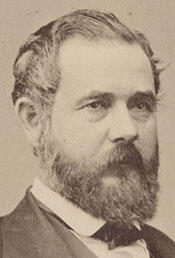
Here you will find contact information for Representative George William Booker, including email address, phone number, and mailing address.
| Name | George William Booker |
| Position | Representative |
| State | Virginia |
| District | 4 |
| Party | Conservative |
| Status | Former Representative |
| Term Start | March 4, 1869 |
| Term End | March 3, 1871 |
| Terms Served | 1 |
| Born | December 5, 1821 |
| Gender | Male |
| Bioguide ID | B000627 |
About Representative George William Booker
George William Booker (December 5, 1821 – June 4, 1883) was a nineteenth-century American politician, farmer, and lawyer from Henry County, Virginia, who served as a Representative from Virginia in the United States Congress from 1869 to 1871. A Unionist during the American Civil War, he later held various local offices during and after the conflict and won election to the Virginia House of Delegates both before and after his single term in the U.S. House of Representatives, while at different times associating with the Democratic, Republican, and Conservative parties. His congressional service occurred during a significant period in American history, when Reconstruction and questions of reunion and amnesty dominated national politics.
Booker was born near Stuart in Patrick County, Virginia, to Edward Booker and the former Elizabeth Anglin. He came from a family whose ancestors had served in the colonial House of Burgesses and fought in the American Revolutionary War, and who had lived in various Southside Virginia counties. Despite this lineage, his father was not wealthy, and Booker himself never became affluent. He received a private education locally and in his youth farmed and taught school. He later studied law, preparing himself for a professional career while maintaining close ties to the agricultural life of the region.
Admitted to the bar in Henry County in 1847, Booker began a legal practice that extended into several nearby counties. Nonetheless, in the 1860 federal census he listed his occupation as “farmer,” reflecting the dual character of his livelihood. At that time he reported real estate valued at $1,000 and other property valued at $2,100, which included a twelve-year-old female slave and the employment or leasing of a twenty-year-old male slave. In 1856 he was appointed a justice of the peace for Henry County, at a time when justices of the peace collectively administered county affairs. Two years later, in 1858, his fellow magistrates elected him presiding judge of the county court, a position he held until 1868.
During the secession crisis and the Civil War, Booker later described himself as a strong Unionist. He stated that he voted for the Ordinance of Secession in 1861 only because he feared reprisals from his neighbors in a region where secessionist sentiment was strong. He also avoided conscription into the Confederate States Army in 1864 by virtue of his office as justice of the peace and his duties as a magistrate, which exempted him from military service. Throughout the conflict he continued his local judicial responsibilities, maintaining a civil presence in a time of upheaval.
Following the Civil War, Booker entered state-level politics. On October 12, 1865, he was elected Henry County’s representative to the Virginia House of Delegates and served from 1866 to 1867. In his first session he sat on the Committee on Military Affairs and the Committee to Examine the Clerk’s Office; in his second session he served on the influential Committees on Propositions and Grievances and on the Militia and Police. During this period he allied himself with other former Unionists such as John Minor Botts and shifted his political allegiance from the Democratic Party to the newly organized Republican Party. Under Congressional Reconstruction he secured several temporary appointments as Commonwealth’s attorney for Patrick County and for the nearby counties of Franklin and Prince Edward. On May 7, 1868, a Republican convention nominated him for Attorney General of Virginia, but no election was held, and he did not attend the following year’s convention, which was dominated by the party’s Radical wing and did not renominate him.
In June 1869, Booker announced his candidacy for the United States House of Representatives from Virginia’s 4th congressional district, which then comprised Brunswick, Charlotte, Franklin, Halifax, Henry, Lunenburg, Mecklenburg, Patrick, and Pittsylvania counties. Moderating his earlier criticisms of secessionists, he endorsed reconciliation and supported the statewide Conservative Party ticket headed by Gilbert C. Walker, who was elected governor. Running as a Conservative, Booker defeated two Radical Republican opponents, one of whom challenged his eligibility on the ground of his magisterial service during the Civil War. The resulting contest delayed his assumption of his seat until February 1, 1870, partway through the second session of the Forty-first Congress. Serving from 1869 to 1871, he was a member of the House Committee on Freedmen’s Affairs. Although he submitted no major legislation and rarely spoke on the floor, in December 1870 he submitted remarks to the Congressional Globe in support of a bill to provide general amnesty to former Confederates and Southern sympathizers, reflecting his commitment to reunion. During his single term he participated in the legislative process and represented the interests of his constituents during a critical phase of Reconstruction.
Booker chose not to seek re-election to Congress in 1870. Instead, he again ran successfully for the Virginia House of Delegates as a representative of Henry County, this time as a leader within the Conservative Party. In the legislature he became one of the party’s floor leaders and chaired important committees, including the Committee on Banks, Currency and Commerce and a special committee charged with investigating allegations that northern bondholders had bribed members of a previous General Assembly to secure passage of the Funding Act of 1871, which dealt with Virginia’s prewar public debt. He at least once served as Speaker pro tempore of the House of Delegates. Booker strongly supported the establishment and maintenance of free public schools in Virginia, and he agreed to present a petition from Anna Whitehead Bodeker of Richmond requesting that women be permitted to vote, an early gesture toward the cause of woman suffrage. In June 1872 he attended the Conservative Party convention and was chosen as a delegate to the Democratic National Convention that nominated Horace Greeley, a former abolitionist and Liberal Republican, for President, illustrating his continued movement within the evolving party system of the Reconstruction era.
After retiring from active politics, Booker resumed the practice of law in Martinsville, Virginia, continuing his legal career in the region where he had long lived and worked. In his personal life he married Maria Philpott in the early 1850s. The couple had several children, including twin elder sons and two or three daughters; in 1868 they had a son whom they named for Booker’s political ally John Minor Botts. Booker died of a stroke near his home in Martinsville on June 4, 1883, and was interred in the family cemetery there.