Representative George Merrick Brooks
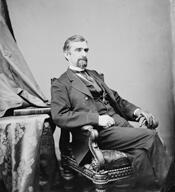
Here you will find contact information for Representative George Merrick Brooks, including email address, phone number, and mailing address.
| Name | George Merrick Brooks |
| Position | Representative |
| State | Massachusetts |
| District | 7 |
| Party | Republican |
| Status | Former Representative |
| Term Start | March 4, 1869 |
| Term End | March 3, 1873 |
| Terms Served | 2 |
| Born | July 26, 1824 |
| Gender | Male |
| Bioguide ID | B000879 |
About Representative George Merrick Brooks
George Merrick Brooks (July 26, 1824 – September 22, 1893) was an American lawyer, state legislator, probate judge, and Republican member of the United States House of Representatives from Massachusetts. He served as a U.S. Representative from 1869 to 1873, completing two terms in Congress, and was active in public life during a significant period in American history following the Civil War and during Reconstruction.
Brooks was born on July 26, 1824, and came of age in a New England society shaped by rapid industrial growth, expanding commerce, and evolving political institutions. His early life unfolded in an environment that placed a high value on education, civic responsibility, and participation in public affairs, influences that would later be reflected in his choice of profession and his long engagement in law and politics.
Educated in the rigorous academic tradition of his region, Brooks pursued legal studies and was admitted to the bar, establishing himself as a practicing attorney. His legal training provided the foundation for his subsequent public service, equipping him with a detailed understanding of statutory interpretation, property rights, and the administration of estates. This background would later prove essential in his work as a legislator and as a probate judge, where questions of inheritance, guardianship, and the orderly transfer of property were central concerns.
Before entering national office, Brooks served as a state legislator in Massachusetts, participating directly in the formulation of state laws and policies. In that capacity he contributed to the governance of a state that was at the forefront of economic development, public education, and legal reform in the nineteenth century. His legislative experience at the state level helped establish his reputation as a capable public servant and prepared him for the broader responsibilities of federal office.
Brooks was elected as a Republican to the United States House of Representatives and served as a Representative from Massachusetts from 1869 to 1873. His tenure in Congress, often dated in contemporary records as 1869 to 1872, encompassed two terms in office. Serving during the Reconstruction era, he participated in the legislative process at a time when Congress was addressing the reintegration of the former Confederate states, the rights of newly freed African Americans, and the reshaping of federal–state relations. As a member of the House of Representatives, he represented the interests of his Massachusetts constituents, took part in debates, and contributed to the development and passage of federal legislation in a period marked by constitutional amendments and significant national policy shifts.
After his service in Congress, Brooks continued his public career in the judiciary as a probate judge. In that role he oversaw matters involving wills, estates, and family-related legal questions, applying his legal expertise to ensure the fair and orderly administration of justice in an area of law that directly affected the lives and property of citizens. His combined experience as a lawyer, legislator, and judge reflected a professional life devoted to the rule of law and the functioning of democratic institutions.
George Merrick Brooks died on September 22, 1893. By the time of his death, he had established a record of service that spanned the courtroom, the statehouse, and the halls of Congress, embodying the nineteenth-century tradition of the lawyer-statesman who moved between law and politics in service to both his state and the nation.