Representative George Quayle Cannon
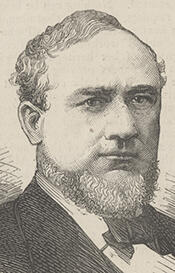
Here you will find contact information for Representative George Quayle Cannon, including email address, phone number, and mailing address.
| Name | George Quayle Cannon |
| Position | Representative |
| State | Utah |
| District | -1 |
| Party | Republican |
| Status | Former Representative |
| Term Start | December 1, 1873 |
| Term End | March 3, 1883 |
| Terms Served | 5 |
| Born | January 11, 1827 |
| Gender | Male |
| Bioguide ID | C000119 |
About Representative George Quayle Cannon
George Quayle Cannon (January 11, 1827 – April 12, 1901) was a Latter-day Saint ecclesiastical leader, publisher, and politician who served as a Representative from Utah in the United States Congress from 1873 to 1883. A member of the Republican Party, he was a five-time Utah territorial delegate to the U.S. Congress and contributed to the legislative process during five terms in office. An early member of the Quorum of the Twelve Apostles of the Church of Jesus Christ of Latter-day Saints (LDS Church), he served in the First Presidency under four successive church presidents—Brigham Young, John Taylor, Wilford Woodruff, and Lorenzo Snow—and was widely regarded as the church’s chief political strategist, earning from the press the sobriquets “the Mormon premier” and “the Mormon Richelieu.”
Cannon was born in Liverpool, England, the eldest of six children of George Cannon and Ann Quayle, both originally from Peel on the Isle of Man. His father’s sister, Leonora Cannon, married future Latter-day Saint apostle John Taylor and was baptized into the Church of Jesus Christ of Latter Day Saints in 1836. When Taylor came to Liverpool four years later, the entire Cannon family accepted the faith, and George Q. Cannon was baptized at age thirteen. His siblings were Mary Alice Cannon (Lambert), Ann Cannon (Woodbury), Angus M. Cannon, David H. Cannon, and Leonora Cannon (Gardner). In 1842 the family emigrated to the United States to join the church in Nauvoo, Illinois. During the Atlantic crossing his mother died, but the family reached Nauvoo in the spring of 1843. George Cannon Sr. married Mary Edwards in 1844, and they had another daughter, Elizabeth Cannon (Piggott), before his death in 1845.
In Nauvoo, Cannon was sent by his father to live with his uncle and aunt, John and Leonora Taylor. Under Taylor’s direction he worked in the printing offices of the Times and Seasons and the Nauvoo Neighbor, gaining experience that would shape his later career as a publisher and editor. In June 1844, when Joseph Smith and Hyrum Smith were killed at Carthage Jail and John Taylor was severely wounded, Cannon helped tend to the printing operations during Taylor’s recovery. After the Latter-day Saints’ expulsion from Illinois, Cannon accompanied the Taylor family to Winter Quarters, Nebraska, and then traveled with them to the Salt Lake Valley, arriving in October 1847. Immersed from youth in both the religious and practical affairs of the church, he quickly emerged as a trusted young leader.
In 1849, church president Brigham Young called Cannon to serve a mission in California, where he worked in the gold fields while attempting to preach to miners. Soon afterward he was reassigned to the Kingdom of Hawaii, where he labored for four years. In Hawaii he was the first Latter-day Saint missionary to focus systematically on teaching Native Hawaiians on the island of Maui, organizing multiple branches and seeking official recognition for the church from government ministers. Among his most notable converts was Jonatana Napela, who assisted Cannon in translating the Book of Mormon into Hawaiian. By October 1852, largely through these efforts, there were slightly more than 900 Latter-day Saints in Hawaii, most on Maui. After returning to Utah Territory, Cannon married Elizabeth Hoagland, daughter of Abraham Hoagland, and was almost immediately sent again to the Pacific coast to assist apostle Parley P. Pratt in publishing a church newspaper in California. When Pratt departed, Cannon remained as president of the church’s Oregon and California Mission from 1856 to 1858, during which time he published the Hawaiian translation of the Book of Mormon and, beginning in February 1856, issued the Western Standard, a weekly paper from San Francisco. Returning to Utah in 1857 to assist during the Utah War, he was commissioned a lieutenant general in the Nauvoo Legion and served as printer of the Deseret News while it operated in exile in Fillmore, Utah. After the conflict he was called to preside over the church’s Eastern States Mission.
The murder of Parley P. Pratt in 1857 created a vacancy in the Quorum of the Twelve Apostles that was filled when Brigham Young called Cannon to the apostleship. Cannon was ordained an apostle on August 26, 1860, at age thirty-three, and was assigned to preside over the church’s European Mission. Recalled to Washington, D.C., in 1862 to assist with the church’s efforts to secure statehood for Utah Territory, he worked in the nation’s capital before returning to Europe to resume leadership of the mission. In Europe he served as editor of the Millennial Star and, briefly, of the church’s Welsh-language periodical, Udgorn Seion. Back in Utah, from 1867 to 1874 he was managing editor of the Deseret News and oversaw its transition to daily publication. In 1866 he founded The Juvenile Instructor, a magazine for Latter-day Saint youth and young adults, which he owned and published until his death; in 1901 his family sold it to the LDS Church’s Sunday School organization, where it remained the official organ until 1930. Cannon also became the first general superintendent of the church’s Sunday School in 1867 and held that position for the remainder of his life.
Cannon’s prominence in church leadership was further solidified on April 8, 1873, when Brigham Young called him as an assistant counselor in the First Presidency. He subsequently served as a counselor in the First Presidency to three additional church presidents—John Taylor, Wilford Woodruff, and Lorenzo Snow—making him one of the most continuously influential figures in late nineteenth-century Latter-day Saint governance. Although he was the second-most senior apostle at Woodruff’s death in 1898, Cannon did not become President of the Quorum of the Twelve Apostles because he was then serving in the First Presidency; instead, Brigham Young Jr., the next senior apostle, was appointed quorum president under the practices of that time. Under current LDS Church procedures, Cannon would have been designated president of the quorum and Young as acting president.
In parallel with his ecclesiastical responsibilities, Cannon played a central role in the political representation of Utah Territory. He was elected in 1872 as the non-voting territorial delegate to the United States House of Representatives and took his seat in the 43rd Congress in 1873. He remained a congressional delegate until 1882, serving five terms and participating actively in debates affecting the territory and the status of the Latter-day Saints. His service in Congress occurred during a significant period in American history marked by Reconstruction’s aftermath, westward expansion, and intensifying federal scrutiny of plural marriage. As a member of the House of Representatives, Cannon participated in the democratic process and represented the interests of his constituents in Utah Territory, working to defend the church and to advance measures favorable to territorial development and eventual statehood.
By 1880, Cannon had completed four terms as Utah’s territorial delegate and sought reelection amid rising tension between the church-backed People’s Party and the anti-Mormon Liberal Party. In the territory-wide election that year, the Liberal Party candidate, Allen G. Campbell, received 1,357 votes, while Cannon won decisively with 18,567 votes. Nevertheless, the newly appointed anti-Mormon territorial governor, Eli Houston Murray, who openly supported the Liberal Party, refused to certify Cannon’s victory. A protest filed on Campbell’s behalf alleged that Cannon, as an English-born Latter-day Saint, was not a naturalized citizen and that his practice of polygamy violated federal law and the oath of office. Murray accepted these arguments and issued the certificate of election to Campbell despite his minority of the vote. Cannon, already in Washington, D.C., contended that only Congress could judge the qualifications of its members and presented a certificate from territorial officials affirming that he had received the most votes. The House clerk entered Cannon’s name on the roll, and he began drawing the delegate’s salary. Governor Murray and Campbell then traveled to Washington to contest the seat. After more than a year of dispute, on February 25, 1882, the House of Representatives rejected both claimants. Cannon was denied his seat on the ground of his involvement in polygamy, and John T. Caine was ultimately seated as delegate during the 47th Congress, going on to serve for several years. The controversy drew unfavorable national attention to Utah and contributed to the passage of the Edmunds Act on March 23, 1882, which reinforced the 1862 Morrill Anti-Bigamy Act by declaring polygamy a felony, revoking polygamists’ voting rights, barring them from jury service, and prohibiting them from holding political office. Cannon’s seat was declared vacant under this legislation, effectively ending his congressional service.
Cannon was a prominent practitioner and defender of plural marriage and was married to six women, with whom he fathered thirty-three children. In public discourse he frequently justified the practice, and in the wake of the Supreme Court’s 1879 decision in Reynolds v. United States upholding federal anti-polygamy laws, he famously declared that Latter-day Saints were being punished for marrying and rearing children rather than engaging in what he characterized as social evils such as seduction, prostitution, and infanticide. As federal enforcement intensified under the Edmunds Act, Cannon went “underground” along with other senior church leaders to avoid arrest. In September 1888 he surrendered to federal authorities, pleaded guilty to unlawful cohabitation, and served nearly six months in the Utah territorial penitentiary. During the sequence of events leading up to Wilford Woodruff’s 1890 Manifesto announcing that the church would no longer sanction new plural marriages, Cannon’s son Frank J. Cannon acted as an intermediary, carrying communications on polygamy between his father and members of the U.S. Congress. In 1894 President Grover Cleveland granted George Q. Cannon a formal pardon.
Beyond his ecclesiastical and political roles, Cannon was a prolific writer and publisher whose works helped shape Latter-day Saint historical and devotional literature. Among his best-known publications are Life of Joseph Smith: The Prophet (1886), The Life of Nephi: The Son of Lehi (1883), My First Mission (1882), and several accounts of the life of Joseph Smith written for younger readers, including The Latter-Day Prophet: History of Joseph Smith Written for Young People (1900). His discourses and writings were later collected in Gospel Truth, edited by Jerreld L. Newquist, and his extensive journals have been published in multiple volumes by church historians. His influence extended into civic life as well; the communities of Georgetown, Idaho, and Cannonville, Utah, bear his name, and at Brigham Young University football games a cannon named “George Q” is fired by the BYU ROTC in his honor.
Cannon’s family produced several prominent religious and political figures. Among his children were Abraham H. Cannon, John Q. Cannon, and Sylvester Q. Cannon, all of whom became general authorities of the LDS Church; Frank J. Cannon, who served as Utah’s first United States Senator; and Lewis T. Cannon and Georgius Y. Cannon, who became well-known architects in Utah. His descendants include Howard Cannon, United States Senator from Nevada from 1959 to 1983; Chris Cannon, a member of the U.S. House of Representatives from 1997 to 2009; and George I. Cannon, a general authority of the LDS Church. George Q. Cannon died on April 12, 1901, in Monterey, California, at the age of seventy-four. He was buried in the Salt Lake City Cemetery. Had he lived a few months longer, he would have become president of the LDS Church following the death of Lorenzo Snow on October 10, 1901, a final indication of his long-standing position at the pinnacle of church leadership.