Representative George Anthony Dondero
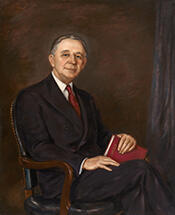
Here you will find contact information for Representative George Anthony Dondero, including email address, phone number, and mailing address.
| Name | George Anthony Dondero |
| Position | Representative |
| State | Michigan |
| District | 18 |
| Party | Republican |
| Status | Former Representative |
| Term Start | March 9, 1933 |
| Term End | January 3, 1957 |
| Terms Served | 12 |
| Born | December 16, 1883 |
| Gender | Male |
| Bioguide ID | D000411 |
About Representative George Anthony Dondero
George Anthony Dondero (December 16, 1883 – January 29, 1968) was a Republican member of the U.S. House of Representatives from Michigan who served twelve consecutive terms in Congress from 1933 to 1957. He represented Michigan during a significant period in American history, spanning the Great Depression, World War II, and the early Cold War, and was noted both for his long service on key House committees and for his outspoken anti-communist positions, including a highly publicized attack on modern art.
Dondero was born on a farm in Greenfield Township, Michigan, on December 16, 1883, in an area that has since been incorporated into the city of Detroit. His father was an immigrant from Italy and his mother an immigrant from Germany, and he grew up in a household shaped by the experiences of European newcomers to the United States. Raised in southeastern Michigan, he was educated in local schools and became familiar early in life with the agricultural and small-town communities that would later form the core of his political base.
After completing his early schooling, Dondero pursued legal studies in Detroit. He enrolled at the Detroit College of Law, from which he graduated in 1910. That same year he was admitted to the bar and immediately began the practice of law in Royal Oak, Michigan. His legal training and early professional work in Royal Oak provided the foundation for his subsequent career in public service, as he combined his law practice with an expanding portfolio of local governmental responsibilities.
Dondero’s public career began at the municipal level in Royal Oak. He served as village clerk in 1905 and 1906, town treasurer in 1907 and 1908, and village assessor in 1909. Following his admission to the bar, he became village attorney from 1911 to 1921, while also serving as assistant prosecuting attorney for Oakland County in 1918 and 1919. He was elected mayor of Royal Oak in 1921 and 1922, and he served on the Royal Oak board of education from 1910 to 1928. Through these roles he gained extensive experience in local governance, finance, education, and law enforcement, establishing himself as a prominent Republican figure in Oakland County and the surrounding region.
In 1932, Dondero was elected as a Republican to the 73rd United States Congress and to the eleven succeeding Congresses, serving from March 4, 1933, to January 3, 1957. He initially represented Michigan’s newly created 17th congressional district, formed after the 1930 census, and, following redistricting after the 1950 census, he was elected two additional times from the 18th district. Both districts have since become obsolete. During his twelve terms in the House of Representatives, Dondero participated actively in the legislative process and represented the interests of his Michigan constituents throughout the New Deal era, World War II, and the onset of the Cold War.
Within Congress, Dondero held significant committee assignments and leadership positions. From 1937 to 1947, he served as the ranking member of the House Committee on Education, where he was involved in federal policy affecting schools and educational institutions. He later became chairman of the powerful House Committee on Public Works in the 80th and 81st Congresses. In that capacity he played a central role in shaping federal infrastructure policy. In 1954, he sponsored the bill creating the Saint Lawrence Seaway, a major binational project that opened the Great Lakes to large ocean-going vessels and had lasting economic implications for the Midwest and the nation’s inland waterways.
Dondero was also a prominent and often controversial figure in the anti-communist politics of the mid-twentieth century. Sympathetic to McCarthyism, he asserted that American liberals had been responsible for a “whitewash” in the Amerasia affair, a case involving the alleged mishandling of classified documents. In 1947, he attempted to block the trial of IG Farben executives for war crimes at Nuremberg by seeking to withhold funding for the prosecution team before indictments could be issued. On July 9, 1947, he publicly questioned the “fitness” of Secretary of War Robert P. Patterson, criticizing Patterson’s alleged failure to detect and remove communist infiltrators in the War Department. As part of this attack, Dondero cited ten individuals he claimed had communist backgrounds or leanings—Colonel Bernard Bernstein, Russel A. Nixon, Abraham L. Pomerantz, Josiah E. DuBois Jr., Richard Sasuly, George Shaw Wheeler, Heinz Norden, Max Lowenthal, and Allan Rosenberg (a member of Lowenthal’s staff)—and concluded that Patterson fell short of the standards required to combat what he described as the “international Communist conspiracy.”
Dondero became especially notable for his vehement opposition to modern art, which he claimed was inspired by and served the purposes of communism. He argued that “Cubism aims to destroy by designed disorder… Dadaism aims to destroy by ridicule… Abstractionism aims to destroy by the creation of brainstorms,” and in 1952 he told Congress that modern art constituted a conspiracy orchestrated from Moscow to spread communism in the United States. Paradoxically, this campaign earned him the International Fine Arts Council’s Gold Medal of Honor for “dedicated service to American Art.” In a mid-1950s interview with art critic Emily Genauer, who later won the Pulitzer Prize for Criticism, Dondero stated that modern art was “Communistic because it is distorted and ugly, because it does not glorify our beautiful country, our cheerful and smiling people, our material progress.” He contended that art which did not glorify the United States in “plain simple terms that everyone can understand” bred dissatisfaction and was therefore opposed to the government, and that those who promoted such art were “our enemies.” When Genauer pointed out the similarity between his views and those of the Stalinist cultural authorities he opposed, Dondero reacted angrily and used his influence to have her dismissed from her position at the New York Herald Tribune.
Beyond his legislative and ideological activities, Dondero cultivated a personal interest in Abraham Lincoln and Lincoln memorabilia. In a 1932 feature in The Detroit News, he wrote of knowing Lincoln’s son, Robert Todd Lincoln, and daughter-in-law, Mary Harlan Lincoln. He recounted that Mary Harlan Lincoln had given him the original letter written to President-elect Abraham Lincoln by eleven-year-old Grace Bedell, urging Lincoln to grow a beard. Although he stated that he was not a collector of “Lincoln relics,” Dondero noted that he made it a point to become acquainted with Lincoln’s relatives, those who had known Lincoln personally, and writers who had gathered biographical material about the sixteenth president. His public profile during his congressional years also included appearances in contemporary media; among them is a filmed interview, “Longines Chronoscope with George A. Dondero,” which is preserved and available for viewing at the Internet Archive.
After leaving Congress in January 1957, Dondero retired from elective office and returned to private life in Michigan. He remained associated with Royal Oak, the community where he had built his legal practice and launched his political career. George Anthony Dondero died in Royal Oak, Michigan, on January 29, 1968, at the age of 84. He is interred at Oakview Cemetery in Royal Oak, closing a life that spanned from rural nineteenth-century Greenfield Township to the height of mid-twentieth-century national politics.