Senator George Evans
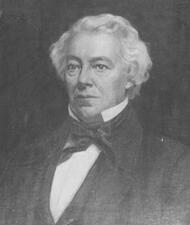
Here you will find contact information for Senator George Evans, including email address, phone number, and mailing address.
| Name | George Evans |
| Position | Senator |
| State | Maine |
| Party | Whig |
| Status | Former Representative |
| Term Start | December 7, 1829 |
| Term End | March 3, 1847 |
| Terms Served | 7 |
| Born | January 12, 1797 |
| Gender | Male |
| Bioguide ID | E000241 |
About Senator George Evans
George Evans was born on January 12, 1797, in Hallowell, Massachusetts (now in Kennebec County, Maine), then a part of the Commonwealth of Massachusetts. He grew up in the District of Maine during the final years before it achieved statehood in 1820, in a region shaped by maritime commerce, small-scale agriculture, and the political currents of the early American republic. His early life in Hallowell, a town situated on the Kennebec River, exposed him to the concerns of a developing frontier community and to the emerging debates over federal power, economic development, and regional interests that would later define his public career.
Evans received his early education in the common schools of Hallowell and demonstrated an aptitude for study that led him to pursue higher education. He attended Bowdoin College in Brunswick, Maine, one of the leading institutions of learning in New England, and graduated in 1815. Following his graduation, he studied law, was admitted to the bar in 1818, and commenced legal practice in Hallowell. His legal training and early professional experience provided him with a grounding in constitutional questions, property law, and commercial regulation, all of which would inform his later work as a legislator.
Evans’s public career began at the state level. He served as a member of the Maine House of Representatives from 1826 to 1829, during the formative years of Maine’s statehood. In the state legislature he gained a reputation as a capable debater and an attentive representative of his constituents’ interests, particularly on matters of finance and internal improvements. His work in Augusta brought him to the attention of national party leaders at a time when the Second Party System was taking shape, and he aligned himself with the emerging National Republican and later Whig coalition that favored a strong role for Congress in promoting economic development.
In 1829, Evans was elected to the United States House of Representatives as a National Republican from Maine and subsequently became affiliated with the Whig Party as it coalesced in the 1830s. He served in the House from March 4, 1829, to March 3, 1841, representing first Maine’s at-large district and later a specific congressional district as the state’s population grew and its representation was reapportioned. During these years he became known for his expertise in financial and fiscal matters, serving as chairman of the Committee on Expenditures in the Department of the Treasury and later of the Committee on Ways and Means. As a member of the Whig Party, he supported policies associated with Henry Clay’s American System, including protective tariffs and federal support for internal improvements, and he played a visible role in the legislative debates of the Jacksonian and Van Buren administrations.
After more than a decade in the House, Evans advanced to the upper chamber of Congress. He served as a Senator from Maine in the United States Congress from March 4, 1841, to March 3, 1847. A member of the Whig Party, George Evans contributed to the legislative process during 7 terms in office when his combined House and Senate service is considered, and his Senate tenure coincided with a significant period in American history marked by disputes over banking policy, tariff legislation, and territorial expansion. As a member of the Senate, George Evans participated in the democratic process and represented the interests of constituents from Maine, engaging in debates over the fiscal policies of the federal government, the reestablishment of a national banking framework, and the economic implications of westward expansion. He was recognized as one of the Whig Party’s leading authorities on revenue and appropriations and was frequently consulted on questions of public finance.
Evans’s congressional service took place against the backdrop of the presidencies of William Henry Harrison, John Tyler, and James K. Polk, and he was involved in deliberations over such issues as the tariff of 1842, the annexation of Texas, and the conduct and financing of the Mexican–American War. While firmly committed to Whig principles, he also remained attentive to the specific needs of Maine, including its commercial interests, fisheries, and transportation links to broader national markets. His work in both chambers of Congress reflected a consistent emphasis on prudent fiscal management, support for economic development, and a belief in the capacity of the federal government, acting through Congress, to shape the nation’s economic future.
After leaving the Senate in 1847, Evans returned to Maine and resumed the practice of law in Portland, which had become a leading commercial and political center of the state. He continued to be regarded as an influential Whig elder statesman in Maine politics, advising party leaders and maintaining an interest in national affairs, even as the political landscape shifted in the 1850s with the decline of the Whig Party and the rise of new political alignments. Although he no longer held national office, his earlier legislative record, particularly in the field of finance, continued to shape how contemporaries and later observers assessed his public career.
George Evans died on April 6, 1867, in Portland, Maine. He was interred in Hallowell Cemetery in his native Hallowell, bringing his life full circle to the community where he had been born and first entered public life. Remembered as an able lawyer, a diligent legislator, and a prominent Whig spokesman on economic policy, Evans’s career in the United States Congress—from his initial election to the House in 1829 through his service in the Senate until 1847—spanned a transformative era in American political and economic development, during which he consistently sought to represent the interests of his Maine constituents within the broader framework of national policy.