Representative George Winthrop Fairchild
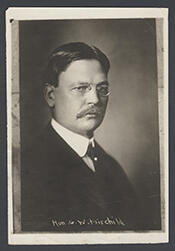
Here you will find contact information for Representative George Winthrop Fairchild, including email address, phone number, and mailing address.
| Name | George Winthrop Fairchild |
| Position | Representative |
| State | New York |
| District | 34 |
| Party | Republican |
| Status | Former Representative |
| Term Start | December 2, 1907 |
| Term End | March 3, 1919 |
| Terms Served | 6 |
| Born | May 6, 1854 |
| Gender | Male |
| Bioguide ID | F000005 |
About Representative George Winthrop Fairchild
George Winthrop Fairchild (May 6, 1854 – December 31, 1924) was a six-term Republican U.S. Representative from New York and a prominent businessman and investor, best known as chairman of the Computing-Tabulating-Recording Company from 1915 to 1924, the firm that later became International Business Machines (IBM). His life spanned a period of rapid industrial and political change in the United States, and he rose from modest beginnings to national prominence in both commerce and public service.
Fairchild was born on May 6, 1854, in Oneonta, Otsego County, New York, to Jesse and Belle Fairchild. His father was a poor farmer, and George and his siblings were required from an early age to assist with work on the family farm, leaving them little opportunity for formal study. He attended the local school in Oneonta until about the age of fourteen, when economic necessity led him to leave the classroom and apprentice as a printer. Primarily self-educated thereafter, he developed his skills in the printing trade and in business through practical experience, gradually building the foundation for his later achievements in journalism, manufacturing, and politics.
Fairchild’s early career was rooted in printing and journalism. After working as a printer and learning the newspaper business, he advanced to ownership in the press. In 1890 he became the sole proprietor of the Oneonta Herald, a weekly newspaper, which gave him a significant role in shaping public opinion in his community and broadened his influence in local affairs. His success as a newspaper proprietor reflected both his entrepreneurial ability and his growing stature in Oneonta and the surrounding region. On March 18, 1891, he married Josephine Mills Sherman, daughter of William Sherman of Davenport, Delaware County, New York. The couple had one son, Sherman Mills Fairchild, born on April 7, 1896, who would later become a noted inventor and industrialist in his own right.
Building on his experience in publishing, Fairchild became a pioneer in the time recording industry during the late nineteenth century. In 1896, in association with his friend Harlow N. Bundy, he joined the Bundy Manufacturing Company, a leading manufacturer of time clocks, as both an investor and director. Recognizing the growing demand for accurate timekeeping and labor-recording devices in an industrializing economy, he helped to consolidate and expand this emerging field. In 1900 he formed the International Time Recording Company as the selling agency for the Bundy Manufacturing Company, the Willard and Frick Manufacturing Company, and the Standard Time Stamp Company, all of which produced various forms of time-recording and card-recorder equipment. This consolidation of sales and distribution laid important groundwork for the larger corporate combinations that followed.
Fairchild’s business activities reached a new level in 1911, when the Computing-Tabulating-Recording Company (CTR) was formed through the efforts of financier Charles R. Flint, combining several firms engaged in tabulating, recording, and related technologies. Fairchild became president of the new company, bringing to it his experience in time recording and his skill in corporate organization. In 1915 he advanced to the position of chairman of the Computing-Tabulating-Recording Company, a role he held through a period of significant growth and technological development. In February 1924, CTR was renamed International Business Machines (IBM), reflecting its expanding scope and international ambitions. Fairchild continued as chairman of IBM until his death on December 31, 1924, and is remembered as one of the key early leaders in the company that would become a global technology enterprise. His residence in Oneonta, known as the Fairchild Mansion, later gained recognition for its historical significance and was listed on the National Register of Historic Places in 1974.
Parallel to his business career, Fairchild developed a substantial record in public life and politics. A member of the Republican Party, he was elected as a Republican to the Sixtieth and to the five succeeding Congresses, serving six consecutive terms in the U.S. House of Representatives from March 4, 1907, to March 3, 1919, as a Representative from New York. During these twelve years in Congress, a period that encompassed the Progressive Era and the First World War, he participated in the legislative process and represented the interests of his constituents in New York. His service in Congress occurred during a significant period in American history, and he took part in debates and decisions affecting industrial regulation, economic development, and the nation’s role in world affairs. In addition to his congressional duties, he was chosen as a delegate from New York to the Republican National Conventions in 1912 and 1916, reflecting his influence within the party at both the state and national levels.
Fairchild’s public service extended beyond domestic politics into international and peace-related activities. He was appointed by President William Howard Taft on August 10, 1910, as special commissioner to represent the United States at the First Centenary of Mexico in Mexico City, with the rank of Minister, underscoring the confidence placed in him to handle sensitive diplomatic and ceremonial responsibilities. He was also elected vice president of the International Peace Conference, indicating his engagement with early twentieth-century efforts to promote international understanding and the peaceful resolution of disputes. These roles complemented his legislative work and highlighted his broader interest in international affairs during a time of growing global tensions.
George Winthrop Fairchild remained active in business and public life until his death on December 31, 1924, while serving as chairman of IBM. From his beginnings on a small farm in Oneonta to his leadership in Congress and in one of the era’s most innovative industrial enterprises, he exemplified the self-made businessman-politician of his generation. His legacy includes his contributions to the development of modern time-recording and computing industries, his six terms of service in the U.S. House of Representatives, and his role in shaping both the economic and political landscape of his time.