Representative George Whitman Hendee
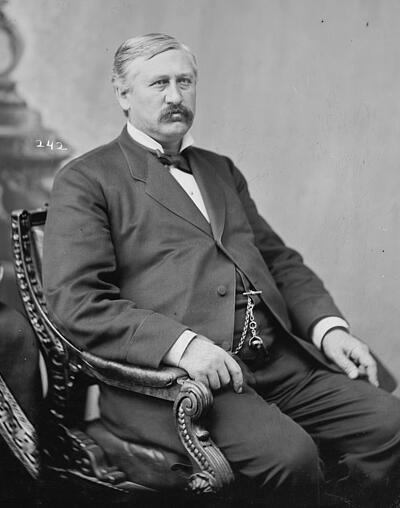
Here you will find contact information for Representative George Whitman Hendee, including email address, phone number, and mailing address.
| Name | George Whitman Hendee |
| Position | Representative |
| State | Vermont |
| District | 3 |
| Party | Republican |
| Status | Former Representative |
| Term Start | December 1, 1873 |
| Term End | March 3, 1879 |
| Terms Served | 3 |
| Born | November 30, 1832 |
| Gender | Male |
| Bioguide ID | H000474 |
About Representative George Whitman Hendee
George Whitman Hendee (November 30, 1832 – December 6, 1906) was a Vermont lawyer, banker, and Republican politician who served as President of the Vermont State Senate, the 27th lieutenant governor, 32nd governor of Vermont, and a U.S. Representative. He represented Vermont in the United States House of Representatives from March 4, 1873, to March 3, 1879, serving three consecutive terms during a significant period in American history and contributing to the legislative process as a member of the Republican Party.
Hendee was born in Stowe, Vermont, and grew up in Lamoille County. He attended the common schools of Morrisville, Vermont, and continued his education at People’s Academy in that community. After completing his schooling, he studied law in the office of his uncle, Whitman G. Ferrin, in Johnson, Vermont. He was admitted to the bar in 1855 and commenced the practice of law in Morrisville, where he would remain closely identified with the legal, political, and business life of the region for the rest of his career.
On November 17, 1855, Hendee married Millissa Redding. The couple had one daughter, who died at the age of six; Millissa Redding Hendee died in 1861. On December 23, 1863, he married his second wife, Viola S. Bundy, who remained his spouse until her death in May 1901. On January 10, 1906, he married his third wife, Mary Louise Watts Woodbury. Throughout these years, Hendee was also active in local civic affairs, serving for many years as superintendent of schools in Morrisville, a role that reflected his interest in public education and community development.
Hendee’s public career began at the county and state level. He served as State’s Attorney for Lamoille County in 1858 and 1859, gaining recognition as a capable prosecutor and legal practitioner. He was elected to the Vermont House of Representatives, serving from 1861 to 1863. During the Civil War, he was appointed a deputy provost marshal, an office created by the federal government to supervise conscription and recruiting activities in each state and congressional district. In this capacity he was involved in enforcing federal draft laws and managing enlistment efforts in Vermont.
Advancing in state politics, Hendee was elected to the Vermont State Senate and served from 1866 to 1869. During his tenure he was chosen President of the Vermont Senate, presiding over the upper chamber and helping to guide legislative business in the post–Civil War period. In 1869 he was elected lieutenant governor of Vermont. On February 7, 1870, Governor Peter T. Washburn died in office, and under the state constitution Hendee succeeded to the governorship. His oath of office as the 32nd governor of Vermont was administered by Justice Benjamin H. Steele of the Vermont Supreme Court. Hendee completed the remainder of Washburn’s term, which ended on October 3, 1870, but did not run for a full term in the 1870 election.
Hendee’s brief governorship occurred at a time when Vermont Republicans were refining the “Mountain Rule,” an informal party arrangement that rotated major offices between residents on the east and west sides of the Green Mountains and limited governors to short, fixed tenures. With the state transitioning from one-year to two-year gubernatorial terms, party leaders debated whether Hendee, who had already served part of a term, should be nominated for a full two-year term, which would have allowed him to exceed the customary limit of two years in office. They ultimately decided that the nomination should go to a candidate from the west side of the mountains, in keeping with the regular rotation policy, but to someone other than Hendee, in order to maintain the two-year limit. As a result, the Republican nomination went to John W. Stewart, who easily won the general election and served as the first governor elected to a two-year term.
After a short interval out of elective office, Hendee returned to public service at the national level. In 1872 he was elected as a Republican to represent Vermont’s 3rd congressional district in the Forty-third Congress, succeeding Worthington C. Smith. He was re-elected to the Forty-fourth and Forty-fifth Congresses, serving from March 4, 1873, to March 3, 1879. The 3rd District, which included the six northern counties of Vermont and bridged the Green Mountains, had been represented by someone from the west side of the mountains for six consecutive terms by the end of Hendee’s service. In the elections of 1874 and 1876, he defeated Democratic nominee John L. Edwards, who had also been the Democratic candidate for governor in 1867 and 1868. In the House of Representatives, Hendee served on the Committee on Private Land Claims and on the Committee on the District of Columbia. In the latter role he participated in drafting and securing passage of legislation that changed the form of government of the District of Columbia, reflecting his involvement in issues of municipal governance and federal oversight of the capital. His three terms in Congress took place during the later Reconstruction era, when questions of federal authority, economic policy, and civil rights were central to national debate, and he represented the interests of his Vermont constituents within that broader context.
In accordance with the Mountain Rule and the Republican Party’s desire to alternate representation between the east and west sides of the Green Mountains, Hendee did not run for re-election in 1878, deferring to William W. Grout as the preferred candidate from the eastern side. Although Grout ultimately lost the general election to Bradley Barlow, a Republican running as a “National Republican” with Greenback Party support, Hendee’s withdrawal reflected his adherence to the party’s long-standing rotational practices. After leaving Congress, he resumed the practice of law in Morrisville and became increasingly active in business and financial affairs. He served as a director of the Portland and Ogdensburg Railway and as president of the Montreal, Portland and Boston Railway, positions that placed him at the center of regional railroad development. He was vice president of the Union Savings Bank and Trust Company of Morrisville and acted as receiver of the National Bank of Poultney and of the Vermont National Bank of St. Albans, underscoring his prominence in Vermont banking circles. From 1879 to 1885 he served as Vermont’s national bank examiner, supervising the condition and conduct of federally chartered banks in the state. In his later years he also took a special interest in the breeding of Morgan horses, contributing to the preservation and promotion of this distinctively Vermont breed.
George Whitman Hendee died in Morrisville, Vermont, on December 6, 1906. He was interred at Pleasant View Cemetery in Morrisville. His long career as lawyer, banker, educator, state legislator, lieutenant governor, governor, and three-term U.S. Representative left a substantial imprint on Vermont’s political and economic life in the second half of the nineteenth century.