Senator George Frisbie Hoar
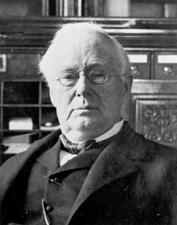
Here you will find contact information for Senator George Frisbie Hoar, including email address, phone number, and mailing address.
| Name | George Frisbie Hoar |
| Position | Senator |
| State | Massachusetts |
| Party | Republican |
| Status | Former Representative |
| Term Start | March 4, 1869 |
| Term End | March 3, 1905 |
| Terms Served | 9 |
| Born | August 29, 1826 |
| Gender | Male |
| Bioguide ID | H000654 |
About Senator George Frisbie Hoar
George Frisbie Hoar (August 29, 1826 – September 30, 1904) was an American attorney and politician who represented Massachusetts in the United States Senate from 1877 until his death in 1904. A member of the Republican Party and an abolitionist aligned with the Radical Republicans, he became one of the most prominent New England statesmen of the late nineteenth century. He belonged to an extended family that was politically influential in 18th- and 19th-century New England, and among friends he was commonly addressed by his middle name, “Frisbie.”
Hoar was born in Concord, Massachusetts, into a family deeply engaged in law and public affairs. His father, Samuel Hoar, was a prominent lawyer who served in the Massachusetts State Senate and in the United States House of Representatives. His brother, Ebenezer Rockwood Hoar, became an associate justice of the Massachusetts Supreme Judicial Court, served as attorney general of the United States under President Ulysses S. Grant, and was nominated to the U.S. Supreme Court. Through his extended family, Hoar was related to several other leading statesmen: his first cousin Roger Sherman Baldwin served as governor of Connecticut and as a U.S. senator, and another first cousin, William Maxwell Evarts, served as U.S. secretary of state, U.S. attorney general, and U.S. senator from New York. He was the uncle of U.S. Representative Sherman Hoar and the great-uncle of Massachusetts state senator and assistant attorney general Roger Sherman Hoar. His second wife’s sister, Alice Miller (1840–1900), married U.S. Representative William W. Rice, who succeeded George F. Hoar as a U.S. representative from Massachusetts. Raised in a household that actively opposed racial bigotry and was willing to defy laws it deemed unjust, Hoar came early to the conviction that slavery was immoral, a belief that shaped his entire public career.
Educated in this atmosphere of reform and public service, Hoar pursued the study of law and entered the Massachusetts bar, establishing himself as an attorney before entering politics. His legal training and family connections helped propel him into public life in the years following the Civil War. An ardent Republican, he identified with the party’s antislavery and Reconstruction wings and quickly gained a reputation as a principled and articulate advocate on questions of civil rights and constitutional governance. His early political career included service in state and federal office, culminating in his election to Congress. According to existing records, he served in the United States Congress from 1869 to 1905, completing nine terms in office, a span that encompassed both his service in the House of Representatives and his long tenure in the Senate.
Hoar’s congressional career began in the House of Representatives, where he emerged as a committed opponent of slavery’s legacy and a defender of African American civil rights during Reconstruction. He was a member of the Congressional Electoral Commission that resolved the highly disputed 1876 presidential election between Rutherford B. Hayes and Samuel J. Tilden, a role that placed him at the center of one of the most contentious constitutional crises of the era. In 1877 he entered the United States Senate as a Republican from Massachusetts, a position he would hold without interruption until his death in 1904. As a senator, he participated actively in the legislative process during a transformative period in American history, representing the interests of his Massachusetts constituents while engaging in national debates over civil rights, political reform, and the expansion of American power.
Throughout his Senate career, Hoar was long noted as a fighter against political corruption and a champion of civil rights. He campaigned vigorously for the rights of African Americans and Native Americans. In the post–Civil War struggle over civil rights legislation, he was closely associated with efforts to secure federal protections; he admonished colleagues, “You must take care of the civil rights bill – my bill, the civil rights bill – don’t let it fail!” and successfully fought to ensure its passage, though it ultimately became law in a weakened form. He strongly opposed and assailed the Democratic Party, which he denounced as the “party of the saloon keeper, ballot-box stuffer, and Klansman.” He also argued in favor of women’s suffrage in the Senate as early as 1886 and was one of only seven senators, and one of only two Republicans—along with Henry W. Blair of New Hampshire—to vote against the Edmunds–Tucker Act of 1887, which abolished women’s suffrage in Utah and curtailed the institutional power of the Church of Jesus Christ of Latter-day Saints while targeting Mormon polygamy.
Hoar played a significant role in shaping federal law and policy. He authored the Presidential Succession Act of 1886, which restructured the line of succession beyond the vice president and reflected his concern for constitutional continuity. He was a strong advocate of the Dawes Act and related allotment schemes that broke up communal tribal lands and allocated them to individual Native Americans, a policy he supported in the belief that federal Indian relations should resemble that of “a father to his son, or by a guardian to an insane ward,” language that reflected both the paternalism and the reformist assumptions of his era. At the same time, he opposed racially discriminatory immigration policies, voting against the Chinese Exclusion Act of 1882 and describing it as “nothing less than the legalization of racial discrimination.” During the 1884 presidential election, he remained loyal to the Republican nominee James G. Blaine and expressed sharp anger at the Mugwumps—Republicans who supported Democrat Grover Cleveland—telling a friend who backed Cleveland, “There was a time when I hoped to meet you in heaven, it is gone.”
In foreign policy and questions of American expansion, Hoar became one of the Senate’s most consistent and outspoken opponents of imperialism. He did not share the enthusiasm of many of his colleagues for American intervention in Cuba in the late 1890s. In December 1897 he met with Native Hawaiian leaders opposed to the annexation of their nation, presented the Kūʻē Petitions to Congress, and helped to defeat President William McKinley’s attempt to annex the Republic of Hawaii by treaty, although the islands were later annexed by joint resolution through the Newlands Resolution. After the Spanish–American War, he emerged as a leading critic of the imperial policies of the McKinley and Theodore Roosevelt administrations. He denounced the Philippine–American War and called for Philippine independence in a lengthy Senate speech, condemning the devastation of provinces, the loss of American and Filipino lives, the use of reconcentration camps, and abuses such as the “water torture.” He argued that American policy had transformed a people who had once welcomed the United States as liberators into “sullen and irreconcilable enemies,” and he contrasted these policies unfavorably with the ideals of George Washington and Abraham Lincoln. In these debates he often found himself opposed by his fellow Massachusetts senator Henry Cabot Lodge, a leading advocate of the Treaty of Paris and American expansion. Hoar pressed for and served on the Lodge Committee, which investigated allegations—later confirmed—of U.S. war crimes in the Philippine–American War, and he also denounced U.S. intervention in Panama.
Hoar’s long public life made him a central figure in the Republican Party’s evolution from the Civil War through the dawn of the Progressive Era. An abolitionist and Radical Republican by conviction, he regarded slavery as immoral and consistently opposed racial bigotry, while also reflecting some of the paternalistic attitudes of his time in his approach to Native American policy. He was referred to by his middle name “Frisbie” among friends and colleagues, a sign of the personal regard in which he was held despite his often sharp partisanship and moral fervor. He died in office on September 30, 1904, in Worcester, Massachusetts, bringing to a close a congressional career that, by contemporary accounts, extended from 1869 to 1905 and encompassed nine terms in the national legislature, including twenty-seven years in the United States Senate.