Representative George Huddleston
Here you will find contact information for Representative George Huddleston, including email address, phone number, and mailing address.
| Name | George Huddleston |
| Position | Representative |
| State | Alabama |
| District | 9 |
| Party | Democratic |
| Status | Former Representative |
| Term Start | December 6, 1915 |
| Term End | January 3, 1937 |
| Terms Served | 11 |
| Born | November 11, 1869 |
| Gender | Male |
| Bioguide ID | H000903 |
About Representative George Huddleston
George Huddleston (November 11, 1869 – February 29, 1960) was a U.S. Representative from Alabama and a long-serving Democratic member of the House of Representatives, noted for his progressive legislative positions and his advocacy on behalf of impoverished constituents. He was the father of George Huddleston, Jr., and of several other children who would themselves become notable in literary and public life.
Huddleston was born on a farm near Lebanon, Wilson County, Tennessee, the son of Nancy Emeline (Sherrill) and Joseph Franklin Huddleston. He attended the common schools in his rural community, receiving a basic formal education before pursuing professional training. Drawn to the law, he enrolled at the Cumberland School of Law at Cumberland University in Lebanon, Tennessee, which at the time was one of the South’s leading institutions for legal education.
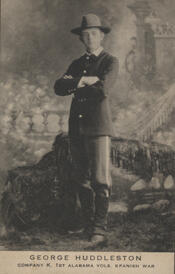
After completing his legal studies, Huddleston was admitted to the bar in 1891. He moved to Birmingham, Alabama, where he established a law practice and quickly became identified with the city’s emerging professional and civic life. He practiced law in Birmingham from 1891 until 1911, when he retired from active legal practice. During the Spanish–American War, he served as a private in the First Regiment, Alabama Volunteer Infantry, reflecting his willingness to participate in national service during a period of conflict.
Huddleston entered national politics as a member of the Democratic Party and was elected to the United States House of Representatives from Alabama’s 9th congressional district. He was first elected to the Sixty-Fourth Congress and then to ten succeeding Congresses, serving from March 4, 1915, to January 3, 1937. Over these 11 consecutive terms, he represented his Birmingham-area constituents during a transformative era in American history that encompassed World War I, the 1920s, and the early years of the Great Depression. As a member of the House of Representatives, George Huddleston participated actively in the legislative process and consistently championed progressive laws and measures, often aligning himself with efforts to regulate corporate power and to improve conditions for working people and the rural poor.
Huddleston’s congressional service was marked by outspoken advocacy on issues of poverty and social justice. In March 1932, during the depths of the Great Depression, he addressed a committee of the United States Senate on the condition of sharecroppers, forcefully rejecting claims that hunger was not widespread. He declared, “Any thought that there has been no starvation, that no man has starved and no man will starve, is the rankest nonsense. Men are actually starving in their thousands today…” His willingness to speak bluntly on behalf of the destitute reflected his broader progressive orientation. During World War I, he also defended civil liberties and the right to dissent, remarking, “In a time like this…it takes a lion-hearted courage for a man to stand up on his feet and dare to speak for peace,” at a moment when individuals faced prosecution and imprisonment for advocating non-intervention.
Although Huddleston opposed the Ku Klux Klan and race-based violence, his record on civil rights legislation was shaped by the political constraints of his majority-white Alabama constituency. He did not support the Dyer Anti-Lynching Bill, fearing the reaction of his voters if he backed federal anti-lynching legislation. Over time, his independent and often insurgent positions on regulatory and public utility issues eroded his political base. He lost support among his constituents for opposing certain bills regarding public services and energy legislation, and in 1936 he was an unsuccessful candidate for renomination, bringing his long congressional career to a close in January 1937.
In his later years, Huddleston’s political allegiances shifted in the national arena, even as he remained rooted in Birmingham. Beginning as early as the 1940 presidential election, he supported Republican nominee Wendell Willkie, reflecting his growing estrangement from elements of the national Democratic Party. Nonetheless, he continued to navigate the complex politics of the South; in 1948 he supported Strom Thurmond when Thurmond ran under the “Democratic” label in Alabama as part of the Dixiecrat movement. Away from public office, Huddleston remained a figure of local and regional significance, associated with the political tradition of Birmingham and remembered for his long tenure in Congress.
Huddleston’s family included several children who would go on to prominence in their own right. He was the father of Nancy Packer (author), Jane Aaron, Mary Chiles, George Huddleston, and John Huddleston. Through his daughter Nancy, he was the grandfather of the writers George Packer and Ann Packer, both of whom became well-known American authors. George Huddleston died in Birmingham, Alabama, on February 29, 1960. He was interred in Elmwood Cemetery, leaving behind a legacy as a progressive Southern congressman who served Alabama in the United States Congress from 1915 to 1937 and helped shape the legislative response to some of the most challenging decades of the early twentieth century.