Representative George Washington Kittredge
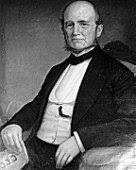
Here you will find contact information for Representative George Washington Kittredge, including email address, phone number, and mailing address.
| Name | George Washington Kittredge |
| Position | Representative |
| State | New Hampshire |
| District | 1 |
| Party | Democratic |
| Status | Former Representative |
| Term Start | December 5, 1853 |
| Term End | March 3, 1855 |
| Terms Served | 1 |
| Born | January 31, 1805 |
| Gender | Male |
| Bioguide ID | K000256 |
About Representative George Washington Kittredge
George Washington Kittredge (January 31, 1805 – March 6, 1881) was a physician, banker, railroad director, and U.S. Representative from New Hampshire. He was born in Epping, Rockingham County, New Hampshire, on January 31, 1805. Raised in rural New Hampshire, he received what was described as a liberal schooling, indicating a broader and more advanced education than was common in many small New England towns of the early nineteenth century. This early education prepared him for professional training at a time when formal schooling beyond the basics was still relatively rare.
Kittredge pursued medical studies and attended the medical department of Harvard University, then one of the leading centers of medical education in the United States. After completing his medical training, he settled in Newmarket, New Hampshire, where he engaged in the practice of medicine beginning in 1835. As a physician in a growing mill town on the Lamprey River, he would have served a mixed population of industrial workers, merchants, and farmers, establishing himself as a prominent professional figure in the community.
Alongside his medical practice, Kittredge entered public life at the state level. He served as a member of the New Hampshire House of Representatives in 1835, 1847, 1848, and 1852, reflecting repeated confidence in his leadership by local voters. In 1852 he was chosen Speaker of the New Hampshire House of Representatives, a position that placed him at the center of legislative deliberations during a period of increasing sectional tension in national politics. His legislative service coincided with New Hampshire’s transition from a predominantly agrarian society to one shaped by manufacturing and rail transportation.
Kittredge was also active in the emerging railroad and financial sectors that were transforming New England’s economy. He served as a director of the Boston and Maine Railroad from 1836 to 1856, a twenty-year tenure that spanned the line’s early expansion and consolidation as a major regional carrier linking New Hampshire and northern New England to Boston. In addition, he served as president of the Newmarket Savings Bank for forty years, overseeing local savings and investment at a time when community banks played a central role in financing small businesses, industry, and personal savings in mill towns such as Newmarket.
On the national stage, Kittredge was elected as an Anti-Nebraska Democrat to the Thirty-third Congress, serving from March 4, 1853, to March 3, 1855. His identification as an Anti-Nebraska Democrat placed him among those Democrats who opposed the Kansas-Nebraska Act and the extension of slavery into the western territories, aligning him with a significant faction that would help give rise to the Republican Party. During his term in the U.S. House of Representatives, he served as chairman of the Committee on Expenditures in the Department of War, where he was responsible for overseeing and reviewing federal spending related to military affairs. He was an unsuccessful candidate for reelection in 1854 to the Thirty-fourth Congress and again an unsuccessful candidate in 1856 for election to the Thirty-fifth Congress, as party alignments shifted rapidly in the years leading up to the Civil War.
After leaving Congress, Kittredge returned to New Hampshire and resumed the practice of medicine in Newmarket, continuing his long-standing role as a local physician while maintaining his interests in banking and community affairs. His later years were marked by declining health. In late January 1878, The Boston Post reported that he had suffered an attack of apoplexy and noted that “his recovery is doubtful,” indicating a serious stroke or related cerebrovascular event. George Washington Kittredge died in Newmarket, New Hampshire, on March 6, 1881. He was interred in Forest Hills Cemetery in Boston, Massachusetts, a prominent rural cemetery that was the final resting place for many notable New England figures of the nineteenth century.