Representative George Marcellus Landers
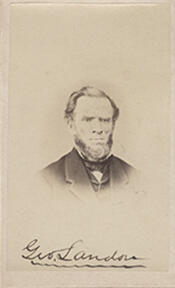
Here you will find contact information for Representative George Marcellus Landers, including email address, phone number, and mailing address.
| Name | George Marcellus Landers |
| Position | Representative |
| State | Connecticut |
| District | 1 |
| Party | Democratic |
| Status | Former Representative |
| Term Start | December 6, 1875 |
| Term End | March 3, 1879 |
| Terms Served | 2 |
| Born | February 22, 1813 |
| Gender | Male |
| Bioguide ID | L000047 |
About Representative George Marcellus Landers
George Marcellus Landers (February 22, 1813 – March 27, 1895) was a Democratic U.S. Representative from Connecticut who served two terms in the United States Congress from 1875 to 1879. Over a long career in public life, he held multiple offices in Connecticut state government and played a role in the political and economic development of his adopted community of New Britain.
Landers was born in Lenox, Berkshire County, Massachusetts, on February 22, 1813. He attended the local public schools, receiving a basic education typical of early nineteenth-century New England. As a young man he sought broader opportunities outside his native state, eventually relocating to Connecticut, where he would spend the remainder of his life and career.
In 1830 Landers moved to New Britain, Connecticut, which at the time was emerging as a center of small-scale manufacturing. There he engaged in the manufacture of hardware, entering an industry that would become central to the town’s economic identity. His work in hardware manufacturing placed him among the growing class of industrial entrepreneurs and business leaders in Connecticut, and his experience in this sector informed his later public service, particularly on matters affecting commerce, banking, and industry.
Landers began his political career in the Connecticut General Assembly. He served as a member of the Connecticut House of Representatives in 1851, 1867, and 1874, participating in state-level legislative deliberations over a span of more than two decades. He also served in the Connecticut Senate in 1853, 1869, and 1873. During his tenure in the upper chamber, he rose to the position of president pro tempore of the Connecticut Senate, reflecting the confidence of his colleagues in his leadership and parliamentary abilities. In addition to his legislative service, Landers was appointed state bank commissioner in 1874, a role that placed him at the center of oversight and regulation of Connecticut’s banking institutions during a period of expanding financial activity.
Building on his state legislative experience, Landers was elected as a Democrat to the United States House of Representatives. He won election to the Forty-fourth and Forty-fifth Congresses and served from March 4, 1875, to March 3, 1879. His service in Congress occurred during a significant period in American history, in the decade following the Civil War and during the later years of Reconstruction and the early Gilded Age. As a member of the House of Representatives, George Marcellus Landers participated in the national legislative process, contributed to debates on issues of the era, and represented the interests of his Connecticut constituents. A member of the Democratic Party, he served two consecutive terms, completing his congressional service at the close of the Forty-fifth Congress.
After leaving Congress in 1879, Landers returned to New Britain and to his business and community interests. Although no longer serving in national office, his long record in both state and federal government, combined with his background in manufacturing and banking oversight, left him a respected figure in Connecticut public life. He continued to reside in New Britain during his later years.
George Marcellus Landers died in New Britain, Connecticut, on March 27, 1895. He was interred in Fairview Cemetery in New Britain. His career, spanning local industry, multiple terms in both houses of the Connecticut legislature, service as president pro tempore of the state senate, a term as state bank commissioner, and two terms in the U.S. House of Representatives, reflected the trajectory of a nineteenth-century New England industrialist who translated business experience into sustained public service.