Representative George Henry Lindsay
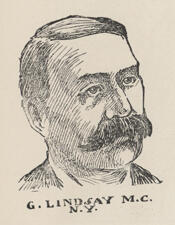
Here you will find contact information for Representative George Henry Lindsay, including email address, phone number, and mailing address.
| Name | George Henry Lindsay |
| Position | Representative |
| State | New York |
| District | 2 |
| Party | Democratic |
| Status | Former Representative |
| Term Start | December 2, 1901 |
| Term End | March 3, 1913 |
| Terms Served | 6 |
| Born | January 7, 1837 |
| Gender | Male |
| Bioguide ID | L000324 |
About Representative George Henry Lindsay
George Henry Lindsay (January 7, 1837 – May 25, 1916) was an American businessman and Democratic politician who served six terms as a United States Representative from New York from 1901 to 1913. He was born in Manhattan, New York City, on January 7, 1837. In 1843 he moved with his parents to Brooklyn, New York, which would remain the center of his personal, business, and political life. He attended the public schools in Brooklyn, receiving a basic formal education typical of the mid-19th century urban school system.
After completing his schooling, Lindsay engaged in the real estate and investment business. His work in real estate coincided with a period of rapid growth and urbanization in Brooklyn, giving him familiarity with property, taxation, and local economic development issues. This business background helped establish his standing in the community and provided a foundation for his later public service, as he developed connections and experience that would prove useful in elective and appointive office.
Lindsay entered public life as a member of the New York State Assembly, representing the 7th District of Kings County. He served in the Assembly in 1882, 1883, 1884, 1885, and 1886. During these consecutive terms he participated in state-level legislative deliberations at a time when New York was grappling with questions of urban governance, infrastructure, and the regulation of business. His service in the Assembly marked his emergence as a significant Democratic figure in Brooklyn politics and prepared him for higher office.
In 1886 Lindsay was elected Coroner of Kings County, New York, a position he held until 1892. As coroner, he was responsible for overseeing inquests into sudden or unexplained deaths in a large and growing urban county, a role that combined administrative, legal, and medical-legal responsibilities. After his tenure as coroner, he continued his involvement in public affairs. In 1898 he was appointed assistant tax commissioner, a post that drew on his experience in real estate and his understanding of property valuation and municipal finance. Over the years he also served as a delegate to various national and state Democratic conventions, reflecting his standing within the party and his participation in broader party deliberations beyond his home district.
Lindsay’s congressional career began with his election as a Democrat to the Fifty-seventh Congress. He was subsequently reelected to the five succeeding Congresses, serving continuously from March 4, 1901, to March 3, 1913. Representing a New York district during a significant period in American history that encompassed the Progressive Era and the presidencies of William McKinley, Theodore Roosevelt, and William Howard Taft, he contributed to the legislative process over six terms in office. As a member of the House of Representatives, George Henry Lindsay participated in the democratic process and represented the interests of his constituents, taking part in debates and votes on the major political, economic, and social issues confronting the nation in the early twentieth century. His service in Congress occurred during a time of expanding federal authority, industrial regulation, and increasing attention to urban and labor concerns, issues of particular relevance to his Brooklyn constituency.
In 1912 Lindsay declined to be a candidate for renomination, thereby concluding his congressional career at the end of the Sixty-second Congress on March 3, 1913. After leaving the House of Representatives, he retired from public life and lived in retirement in Brooklyn. He did not return to elective office, but his long record of service at the local, state, and national levels left him as a respected elder figure in Brooklyn’s Democratic circles.
George Henry Lindsay died in Brooklyn on May 25, 1916. He was interred in the Cemetery of the Evergreens in Brooklyn, New York. His public legacy extended through his family as well as his own career: his son, George Washington Lindsay, later served as a U.S. Representative from New York, continuing the Lindsay family’s involvement in national legislative service.