Representative George Edward MacKinnon
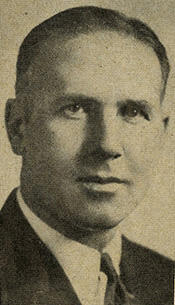
Here you will find contact information for Representative George Edward MacKinnon, including email address, phone number, and mailing address.
| Name | George Edward MacKinnon |
| Position | Representative |
| State | Minnesota |
| District | 3 |
| Party | Republican |
| Status | Former Representative |
| Term Start | January 3, 1947 |
| Term End | January 3, 1949 |
| Terms Served | 1 |
| Born | April 22, 1906 |
| Gender | Male |
| Bioguide ID | M000027 |
About Representative George Edward MacKinnon
George Edward MacKinnon (April 22, 1906 – May 1, 1995) was an American politician, attorney, and judge who served as a United States Representative from Minnesota, United States Attorney for Minnesota, and United States Circuit Judge of the United States Court of Appeals for the District of Columbia Circuit. A member of the Republican Party, he served one term in the United States House of Representatives from 1947 to 1949 and later became known as a prominent conservative jurist. He was the father of feminist legal scholar Catharine MacKinnon.
MacKinnon was born on April 22, 1906, in Saint Paul, Minnesota. He grew up in Minnesota and maintained close ties to the state throughout his professional and political life. Details of his early family life are less extensively documented than his later public career, but his formative years in Minnesota helped shape his political identity and long-standing association with the state’s Republican Party.
MacKinnon pursued higher education at the University of Minnesota, where he received his Bachelor of Arts degree in 1927. He continued at the University of Minnesota Law School, earning his Bachelor of Laws (LL.B.) degree in 1929. Shortly thereafter, he was admitted to the bar and entered private practice in Minnesota. During the 1930s and early 1940s he built a reputation as a capable lawyer, which laid the foundation for his later roles in public service. His legal career was interrupted by World War II, during which he served in the United States Navy, further broadening his experience in public duty before returning to civilian legal practice.
MacKinnon’s political career advanced rapidly in the mid-1940s. A Republican, he was elected to the United States House of Representatives from Minnesota and served in the Eightieth Congress from January 3, 1947, to January 3, 1949. His single term in Congress occurred during a significant period in American history, in the immediate post–World War II era and the early stages of the Cold War. As a member of the House of Representatives, George Edward MacKinnon participated in the democratic process, contributed to the legislative work of the Eightieth Congress, and represented the interests of his Minnesota constituents. After losing his bid for reelection, he returned to legal practice and party activities in Minnesota, remaining an influential figure in state Republican circles.
Following his congressional service, MacKinnon continued in public legal roles of increasing responsibility. He was appointed United States Attorney for the District of Minnesota, where he gained national attention for his work as a federal prosecutor. His tenure as United States Attorney for Minnesota further solidified his reputation as a tough, principled lawyer, and he handled a range of federal criminal and civil matters on behalf of the United States. He also served in the Minnesota legislature earlier in his career, and his combined legislative and prosecutorial experience made him a strong candidate for the federal bench.
MacKinnon was appointed as a United States Circuit Judge of the United States Court of Appeals for the District of Columbia Circuit, one of the nation’s most influential appellate courts. On that court he became known as a staunch conservative, once described as “so far right he makes Goldwater look like George McGovern,” a characterization that observers have noted may have been hyperbolic but that reflected his reputation for firm, often strongly worded positions. Judge Harry T. Edwards later recalled that MacKinnon was “a real character: he was someone who was not easily dissuaded from his positions, who always aimed to get his way, and, yet, who always enjoyed his colleagues and fostered collegiality on the court.” Chief Justice Warren E. Burger, a fellow Minnesotan who appointed MacKinnon to the United States Sentencing Commission and to the special court division that selected independent counsel, said of him, “He’s a man who can’t be frightened or pushed by anybody.”
In addition to his judicial work on the D.C. Circuit, MacKinnon played an important role in the development of federal sentencing and ethics oversight. As a member of the United States Sentencing Commission and of the special court division responsible for appointing independent counsel, he helped shape the institutional framework for federal criminal justice and executive-branch accountability in the late twentieth century. His former law clerk Thomas J. Campbell later wrote that Judge MacKinnon inspired not only by his opinions and public deeds but also by his personal habits: he introduced himself simply as “George,” answered his own telephone quickly, and insisted on calling his wife on a private line so that the government would not bear even the marginal cost of a personal call. Campbell also recounted that MacKinnon presided in chambers at the marriage of a man he had once prosecuted, convicted, and sent to prison as United States Attorney, and that he was “loved by Democrats and Republicans, liberals and conservatives, and sought the approval of neither to find his own sense of worth.”
George Edward MacKinnon remained active in the law and public affairs well into his later years. His long career spanned private practice, legislative service, federal prosecution, and high judicial office, and he was widely regarded as a principled, independent-minded conservative who nonetheless maintained warm personal relations across ideological lines. He died on May 1, 1995, leaving a legacy that extended both through his judicial opinions and public service and through the work of his daughter, Catharine MacKinnon, a leading feminist legal scholar.