Representative George Alexander Marshall
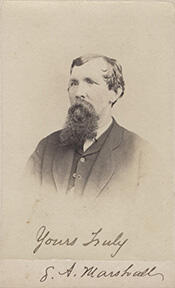
Here you will find contact information for Representative George Alexander Marshall, including email address, phone number, and mailing address.
| Name | George Alexander Marshall |
| Position | Representative |
| State | Ohio |
| District | 4 |
| Party | Democratic |
| Status | Former Representative |
| Term Start | March 15, 1897 |
| Term End | March 3, 1899 |
| Terms Served | 1 |
| Born | September 14, 1851 |
| Gender | Male |
| Bioguide ID | M000153 |
About Representative George Alexander Marshall
George Alexander Marshall (September 14, 1851 – April 21, 1899) was an American lawyer and Democratic politician who served as a one-term U.S. Representative from Ohio from 1897 to 1899. He represented his Ohio constituency in the Fifty-fifth Congress during a significant period in American history, participating in the legislative process and the broader democratic governance of the nation.
Marshall was born near Sidney, Ohio, on September 14, 1851. He was raised in Shelby County, where he attended the local public schools, receiving the foundational education that prepared him for professional and public life. Seeking further education, he enrolled at Ohio Wesleyan University in Delaware, Ohio, an institution that was then emerging as a prominent center of higher learning in the state.
After his university studies, Marshall turned to the law. He read law in the customary manner of the period and was admitted to the bar in 1876. Upon admission, he commenced the practice of law in Sidney, Ohio, where he built a legal career that would form the basis for his later public service. His professional work in Sidney placed him in close contact with the civic and legal affairs of Shelby County and helped establish his reputation as an attorney.
Marshall’s personal life was marked by both happiness and tragedy. In 1872 he married Mary Caroline Cowan, the daughter of Wilson V. Cowan, a local physician. Their marriage was cut short when Mary Caroline died in 1874 while giving birth to their first child. Several years later, on December 8, 1880, Marshall married Mary Caroline’s youngest sister, Lucinda Frazer Cowan, further strengthening his ties to the Cowan family and the local community.
Marshall entered public office as a county prosecutor. He was elected prosecuting attorney of Shelby County, Ohio, in 1878 and was subsequently reelected in 1880 and 1883, serving a total of eight years in that position. In this role he was responsible for representing the state in criminal matters within the county, gaining extensive courtroom experience and deepening his involvement in public affairs. His repeated elections reflected the confidence of local voters in his judgment and integrity.
Building on his legal and prosecutorial career, Marshall was elected as a Democrat to the United States House of Representatives, winning a seat in the Fifty-fifth Congress. He served from March 4, 1897, to March 3, 1899, as a Representative from Ohio. During his single term in Congress, he contributed to the legislative process and represented the interests of his constituents at the national level at a time when the country was grappling with issues of economic change, industrial growth, and emerging international concerns. A member of the Democratic Party, he participated in debates and votes that shaped federal policy in the late nineteenth century. He chose not to be a candidate for reelection in 1898, thus concluding his congressional service after one term.
After leaving Congress in March 1899, Marshall’s public career was cut short soon thereafter. He died in Sidney, Ohio, on April 21, 1899. He was interred in Presbyterian Cemetery in Hardin, Ohio. His life and career, spanning law, county prosecution, and national legislative service, reflected the trajectory of a nineteenth-century Midwestern lawyer who rose from local practice to the halls of Congress while maintaining close ties to his home community in Shelby County.