Representative George Washington McCrary
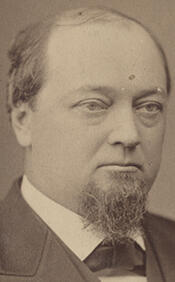
Here you will find contact information for Representative George Washington McCrary, including email address, phone number, and mailing address.
| Name | George Washington McCrary |
| Position | Representative |
| State | Iowa |
| District | 1 |
| Party | Republican |
| Status | Former Representative |
| Term Start | March 4, 1869 |
| Term End | March 3, 1877 |
| Terms Served | 4 |
| Born | August 29, 1835 |
| Gender | Male |
| Bioguide ID | M000379 |
About Representative George Washington McCrary
George Washington McCrary (August 29, 1835 – June 23, 1890) was a United States Representative from Iowa, the 33rd United States Secretary of War, and a United States circuit judge of the United States Circuit Courts for the Eighth Circuit. A member of the Republican Party, he served four terms in the United States House of Representatives from 1869 to 1877, during a significant period in American history marked by Reconstruction and the nation’s post–Civil War political realignment.
McCrary was born on August 29, 1835, near Evansville, Vanderburgh County, Indiana. In 1836 he moved with his parents to the Wisconsin Territory, which became the Iowa Territory in 1838 and the State of Iowa in 1846, where the family settled in Van Buren County. He attended public schools and, at the age of 18, taught in country schools. Drawn to the law, he read law in the office of Samuel Freeman Miller, who would later become an Associate Justice of the Supreme Court of the United States. McCrary was admitted to the bar in 1856 and that same year entered private practice in Keokuk, Iowa.
McCrary’s early public career developed in tandem with his legal practice. He practiced law in Keokuk from 1856 to 1857, then won election to the Iowa House of Representatives in 1857. After a term in the state house, he resumed private practice in Keokuk from 1858 to 1861. During the Civil War era he continued to combine law and politics, serving in the Iowa Senate from 1861 to 1865 while again maintaining a private practice in Keokuk from 1862 to 1869. Through these roles he became a prominent Republican figure in Iowa and gained experience in legislative affairs that would shape his later national service.
In 1868 McCrary successfully sought election to the United States House of Representatives from Iowa’s 1st congressional district, succeeding Radical Republican James F. Wilson. He was elected as a Republican to the 41st Congress and to the three succeeding Congresses, serving from March 4, 1869, to March 3, 1877. As a member of the House of Representatives, he participated actively in the legislative process and represented the interests of his Iowa constituents during a transformative period in American politics. He served as Chairman of the Committee on Elections in the 42nd Congress and as Chairman of the Committee on Railways and Canals in the 43rd Congress. In the 44th Congress he served on the House Committee on the Judiciary. He was not a candidate for renomination in 1876, choosing instead to leave the House at the end of his fourth term.
McCrary quickly gained national attention in Congress. In his first month in office, he refused to support an appropriation for a federal courthouse in Keokuk, explaining that the nation was in debt and that he could not justify such a project in every district, a stance that underscored his fiscal caution and independence. He developed a recognized expertise in contested elections and election law, culminating in the publication of A Treatise on the American Law of Elections in 1875, a work that later went through four editions and became an important reference in the field. During his House years he allied with the “Half-Breeds,” the more moderate wing of the Republican Party that favored civil service reform and emphasized industrial interests and protective tariffs, in contrast to the patronage-oriented Stalwarts. He played a notable role in the creation of the Electoral Commission that resolved the disputed 1876 presidential election and served on the committee that investigated the Crédit Mobilier scandal. In the 44th Congress he authored a farsighted, though ultimately unsuccessful, bill to reorganize the federal courts to provide more efficient and prompt judicial review.
On March 12, 1877, President Rutherford B. Hayes appointed McCrary as the 33rd United States Secretary of War, a position he held until his resignation on December 11, 1879. His tenure coincided with the final phase of Reconstruction and significant labor and frontier conflicts. As Secretary of War, McCrary oversaw the withdrawal of federal troops from the remaining Reconstruction governments in South Carolina and Louisiana, a key step in the end of federal military involvement in Southern state politics. He also directed the use of federal troops during the Great Railroad Strike of 1877 and in response to disturbances along the Mexican border. The most serious military engagements during his administration occurred in the American West, where United States forces were involved in conflicts with Native American tribes in Colorado, New Mexico, and other territories. During this period he was elected as a 3rd Class (honorary) member of the Military Order of the Loyal Legion of the United States, likely reflecting President Hayes’s influence and McCrary’s service in the War Department.
Following his cabinet service, McCrary entered the federal judiciary. On December 1, 1879, President Hayes nominated him to the United States Circuit Courts for the Eighth Circuit, to fill the vacancy created by the resignation of Judge John Forrest Dillon. The United States Senate confirmed his nomination on December 9, 1879, and he received his commission the same day. As a circuit judge, McCrary presided over a vast region of the growing American West and Midwest, applying his long-standing interest in judicial administration and federal jurisdiction. His judicial service ended on March 18, 1884, when he resigned, citing his family’s financial needs after many years in public office.
After leaving the bench, McCrary returned to private legal practice, this time in Kansas City, Missouri, where he practiced from 1884 until his death in 1890. He served concurrently as general counsel for the Atchison, Topeka and Santa Fe Railroad Company, one of the major railroads of the era, from 1884 to 1890, reflecting both his legal acumen and his familiarity with transportation and infrastructure issues developed during his congressional service. McCrary died on June 23, 1890, in St. Joseph, Missouri, after suffering from a stomach tumor. He was interred in Oakland Cemetery in Keokuk, Iowa, the city where he had begun his legal career and from which he rose to national prominence.