Senator George Lloyd Murphy
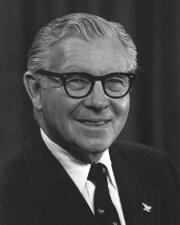
Here you will find contact information for Senator George Lloyd Murphy, including email address, phone number, and mailing address.
| Name | George Lloyd Murphy |
| Position | Senator |
| State | California |
| Party | Republican |
| Status | Former Representative |
| Term Start | January 4, 1965 |
| Term End | January 3, 1971 |
| Terms Served | 1 |
| Born | July 4, 1902 |
| Gender | Male |
| Bioguide ID | M001092 |
About Senator George Lloyd Murphy
George Lloyd Murphy (July 4, 1902 – May 3, 1992) was an American actor, union leader, and Republican politician who served as a United States Senator from California from 1965 to 1971. A prominent song-and-dance leading man in Hollywood musicals between 1930 and 1952, he later became the first notable American film actor elected to statewide office in California, predating the gubernatorial careers of Ronald Reagan and Arnold Schwarzenegger. He is the only United States Senator represented by a star on the Hollywood Walk of Fame and was awarded an honorary Academy Award in 1951 for his contributions to the film industry.
Murphy was born in New Haven, Connecticut, of Irish Catholic extraction, the son of Michael Charles “Mike” Murphy, a well-known athletic trainer and coach, and Nora Long Murphy. He was raised in New Haven and attended a series of preparatory schools, including Trinity-Pawling School and the Peddie School, before studying at Yale University in his native city. His early exposure to athletics through his father and his education at prominent East Coast schools preceded his eventual move into the performing arts and, later, public life.
Murphy began his professional career in entertainment on the stage and then in motion pictures, making his film debut shortly after the advent of talking pictures in 1930. Over the next two decades he became known as a polished song-and-dance man, appearing in numerous big-budget Hollywood musicals. Among his notable films were “Broadway Melody of 1938” (1937), “Broadway Melody of 1940” (1940), and “For Me and My Gal” (1942). His screen persona was that of an affable, athletic leading man, and he remained a familiar presence in musicals until he retired from acting in 1952 at the age of 50. During World War II he organized entertainment for American troops, contributing to wartime morale through USO-style efforts and industry-backed performances.
In addition to his acting career, Murphy played a significant role in Hollywood labor and industry organizations. He served as president of the Screen Actors Guild from 1944 to 1946, a period marked by postwar adjustments in the film industry and evolving labor relations. In 1951 he received an honorary Academy Award, recognizing his services to the industry; he was never nominated for a competitive Oscar. That same year, on March 14, 1951, he hosted the first-ever Eddie Awards ceremony for American Cinema Editors. Beyond guild leadership, he held executive positions in the entertainment business, serving as a vice president of Desilu Productions and of the Technicolor Corporation. He also acted as director of entertainment for presidential inaugurations in 1953, 1957, and 1961, helping to organize and stage the artistic programs that accompanied these national ceremonies.
Murphy’s formal entry into partisan politics came in 1952, when he joined the leadership of the California Republican Party, coinciding with his role directing entertainment for the Eisenhower–Nixon inauguration that year. Over the next decade he became increasingly active in Republican politics, gaining a reputation as an effective speaker and fundraiser. Fellow Republicans praised his ability to address fundraising dinners and public events, support that later underpinned his rise to national office. His move from the screen to California politics helped establish a model for later actor-politicians; Ronald Reagan, who followed him into elected office, later referred to Murphy as his “John the Baptist” for having paved the way for entertainers seeking political careers.
In 1964 Murphy was elected as a Republican to the United States Senate from California, defeating Democrat Pierre Salinger, the former White House press secretary to President John F. Kennedy, who had been appointed earlier that year to complete the unexpired term of the late Senator Clair Engle. Murphy’s official Senate service is recorded from January 1, 1965, to January 1, 1971, encompassing one full term. In a procedural move to gain seniority, Salinger resigned two days before his term ended, and Democratic Governor Pat Brown appointed Murphy to serve the remaining two days, allowing him to take his seat early; in turn, Murphy resigned two days before his own term expired in 1971 to extend the same courtesy to his successor. During his Senate tenure, he represented California during a period of major national upheaval, including the civil rights movement and the Vietnam War, and participated in the legislative process on behalf of his constituents. He voted in favor of the Voting Rights Act of 1965 and the Civil Rights Act of 1968, aligning himself with key federal civil rights measures of the era.
Murphy quickly became a visible figure within the Senate Republican leadership. From 1967 to 1968 he served as chairman of the National Republican Senatorial Committee (often referred to as the Senate Republican Campaign Committee), a role in which he was in demand to assist other Republican candidates across the country. In 1966 he hosted a fundraising dinner in Atlanta for Representative Howard “Bo” Callaway, the first Republican candidate for governor of Georgia since Reconstruction; although Callaway outpolled Democrat Lester Maddox, he failed to secure a majority, and the state legislature ultimately elected Maddox. Within the Senate chamber, Murphy left a lighter legacy by creating the “candy desk,” placing a supply of confectionery on his desk on the Senate floor for colleagues to share. After he left office in 1971, the tradition was continued by a succession of senators; as of 2025, the keeper of the candy desk is Oklahoma Republican Markwayne Mullin.
Murphy’s Senate career was complicated by serious health and political challenges. During his term he developed throat cancer, and part of his larynx was surgically removed, leaving him unable to speak above a whisper for the remainder of his life. In 1970 he sought re-election and was opposed by Democrat John V. Tunney, a young congressman from California. Murphy’s vocal impairment, his staunch support for the continuing Vietnam War, and publicized reports that he had continued to receive a salary from Technicolor after taking office all worked against him in a difficult political climate. Despite Republican Governor Ronald Reagan’s concurrent re-election victory by a seven-percent margin, Murphy lost his Senate seat to Tunney by 618,941 votes. Tunney’s successful 1970 campaign was later widely cited as an inspiration for the 1972 Robert Redford film “The Candidate.” Murphy’s prominence also drew criticism from cultural commentators; he was the subject of a satirical song by Tom Lehrer, “George Murphy,” on Lehrer’s album “That Was the Year That Was,” which took aim at Murphy’s comments about Mexicans working in the United States.
In his personal life, Murphy married his ballroom dancing partner, Juliette “Julie” Henkel-Johnson, on December 18, 1926. The couple remained married until her death in 1973 and had two children, Dennis Michael Murphy and Melissa Elaine Murphy. After several years as a widower, he married Bette Blandi in 1982; they remained married until his death, and she survived him until 1999. Following his departure from elective office, Murphy largely withdrew from public life and subsequently moved to Palm Beach, Florida. He died there on May 3, 1992, at the age of 89, from leukemia. His dual legacy as a Hollywood musical star, Screen Actors Guild president, and United States Senator—along with his unique distinction of having both a Senate career and a star on the Hollywood Walk of Fame—marked him as a pioneering figure at the intersection of American entertainment and politics.