Representative George R. Nethercutt Jr.
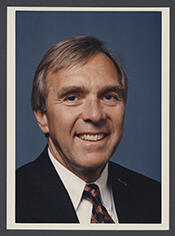
Here you will find contact information for Representative George R. Nethercutt Jr., including email address, phone number, and mailing address.
| Name | George R. Nethercutt Jr. |
| Position | Representative |
| State | Washington |
| District | 5 |
| Party | Republican |
| Status | Former Representative |
| Term Start | January 4, 1995 |
| Term End | January 3, 2005 |
| Terms Served | 5 |
| Born | October 7, 1944 |
| Gender | Male |
| Bioguide ID | N000051 |
About Representative George R. Nethercutt Jr.
George Rector Nethercutt Jr. (October 7, 1944 – June 14, 2024) was an American lawyer, author, and politician who represented Washington’s 5th Congressional District in the United States House of Representatives from January 3, 1995, to January 3, 2005. A member of the Republican Party, he rose to national prominence in 1994 when, in his first run for public office, he defeated Speaker of the House Tom Foley in a closely watched race that formed part of the Republican landslide of that year. Over five terms in Congress, he contributed to the legislative process during a significant period in American political history, participating in the democratic process and representing the interests of his eastern Washington constituents.
Nethercutt was born in Spokane, Washington, on October 7, 1944, the son of Nancy (Sampson) Nethercutt and George Nethercutt, who served as a local school board president. He grew up in Spokane and attended North Central High School, from which he graduated before enrolling at Washington State University. At Washington State, he studied English and received a Bachelor of Arts degree in 1967. He then returned to Spokane for legal studies, earning a Juris Doctor degree from Gonzaga University School of Law in 1971, laying the foundation for a career that would combine law, public service, and politics.
After law school, Nethercutt began his legal career as a law clerk to U.S. District Judge Raymond Plummer in Alaska, gaining early exposure to federal judicial proceedings. In 1972 he moved to Capitol Hill, joining the staff of U.S. Senator Ted Stevens of Alaska. From 1972 to 1977 he served first as staff counsel and later as chief of staff to Senator Stevens, a role that provided him with substantial experience in legislative affairs, federal policy, and the workings of the U.S. Senate. Following his Washington, D.C., service, he returned to Washington State and entered private legal practice. He served as town attorney for the eastern Washington communities of Reardan, Creston, and Almira, and became active in local Republican politics, eventually chairing the Spokane County Republican Party. In Spokane he also co-founded the Vanessa Behan Crisis Nursery, a nonprofit organization dedicated to providing emergency care and support for children and families in crisis.
Nethercutt’s entry into electoral politics came in 1994, when he challenged Tom Foley, the Democratic Speaker of the House and a 30-year incumbent, in Washington’s 5th Congressional District. The district, centered on Spokane and encompassing much of eastern Washington, had been trending more conservative since the early 1980s, though Foley had maintained his seat by running strongly in Democratic-leaning Spokane. Nethercutt’s campaign capitalized on growing support for term limits and dissatisfaction with entrenched incumbency. He repeatedly highlighted Foley’s opposition to term limits and drew attention to Foley’s successful lawsuit challenging Washington State’s voter-approved term-limits measure, often citing the case caption, “Foley against the People of the State of Washington.” Nethercutt himself pledged to serve no more than three terms in the House. In the November 1994 election, he ran up large margins in the rural parts of the district and held Foley to relatively narrow margins in Spokane and Spokane County—about 9,000 votes in the city and 3,000 in the county—ultimately winning by roughly 4,000 votes. His victory marked the first time since 1862 that a sitting Speaker of the House was unseated in a general election and was emblematic of the broader Republican “wave” that gave the GOP control of the House for the first time in 40 years.
During his five terms in Congress, from 1995 to 2005, Nethercutt developed a reputation as a reliably conservative Republican, in line with many of those elected in the 1994 “Contract with America” class. He served on the House Appropriations Committee, where he participated in decisions on federal spending priorities, and on the House Science Committee, engaging with issues related to research, technology, and innovation. He was re-elected in 1996 by a comfortable 12-point margin despite a strong Democratic effort to reclaim the seat and even as President Bill Clinton narrowly carried the district at the top of the ticket. Nethercutt was handily re-elected again in 1998. In 2000, when his self-imposed three-term limit would have taken effect, he announced that he would seek a fourth term, a decision that angered term-limits advocates but did not prevent his re-election in 2000 and again in 2002. His decade in the House coincided with major national developments, including the end of the Cold War era, the impeachment of President Clinton, and the early years of the war on terror, and he participated in the legislative debates that accompanied these events. His congressional papers were later deposited at Gonzaga University.
Rather than running for a sixth House term in 2004, Nethercutt sought higher office, entering the race for the U.S. Senate against incumbent Democrat Patty Murray. Encouraged to run by President George W. Bush, he campaigned in a statewide contest that highlighted both regional and ideological divides within Washington. Term limits again emerged as a central theme, as Democrats emphasized his earlier pledge to limit his House service to three terms and his subsequent decision to run for additional terms. The campaign also focused on national security and the Iraq War: Nethercutt supported the 2003 U.S.-led invasion of Iraq, while Murray opposed it. Despite his strong base in eastern Washington, Nethercutt faced limited name recognition in the more populous western part of the state, and Washington had not elected a senator from east of the Cascade Range since Clarence Dill in 1928. In the November 2004 election he lost to Murray, receiving about 43 percent of the vote to her 55 percent, a margin of 345,124 votes. He dominated in eastern Washington, including his former congressional district, and carried only two counties west of the Cascades—Clark and Lewis. He left the House of Representatives at the conclusion of his term in January 2005.
After departing Congress, Nethercutt remained active in law, public affairs, and civic education. In 2005 he joined with former Interior Department deputy secretary J. Steven Griles and former White House national energy policy director Andrew Lundquist to form the lobbying and consulting firm Lundquist, Nethercutt & Griles, LLC. Griles resigned from the firm in 2007 after pleading guilty to obstruction of justice in connection with the Jack Abramoff lobbying scandal. Nethercutt later served as chairman of Nethercutt Consulting LLC and was of counsel to the law and government-relations firms Bluewater Strategies and Lee & Hayes. He sat on several corporate boards and continued to comment on public affairs. He wrote a monthly column for The Pacific Northwest Inlander newspaper and recorded radio commentaries for stations in the region. An advocate for civic engagement, he founded The George Nethercutt Foundation in Spokane, a nonpartisan nonprofit organization dedicated to fostering civic involvement among young people. The foundation’s Nethercutt Fellowship program offers college students opportunities to travel to Washington, D.C., and observe the workings of the federal government firsthand. He also served on the Dutch board of JDRF (Juvenile Diabetes Research Foundation), reflecting an interest in health and medical research advocacy.
In addition to his legal and political work, Nethercutt was an author. He co-wrote “In Tune with America: Our History in Song” (Marquette Books LLC, 2010; ISBN 978-0-982-65970-0), which explored American history through its musical traditions, and later authored “Saving Patriotism: American Patriotism in a Global Era” (Marquette Books LLC, 2022; ISBN 978-1-732-71972-9), a reflection on national identity and civic values in a changing world. His interest in history, culture, and public life informed both his writing and his foundation’s educational mission.
Nethercutt married Mary Beth Socha in 1977, and the couple had two children. In his later years he divided his time between professional consulting, writing, and philanthropic and civic activities. He died in Colorado on June 14, 2024, at the age of 79, from progressive supranuclear palsy.