Representative George Donoghue O’Brien
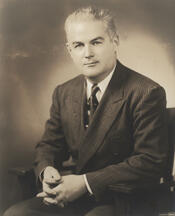
Here you will find contact information for Representative George Donoghue O’Brien, including email address, phone number, and mailing address.
| Name | George Donoghue O’Brien |
| Position | Representative |
| State | Michigan |
| District | 13 |
| Party | Democratic |
| Status | Former Representative |
| Term Start | January 5, 1937 |
| Term End | January 3, 1955 |
| Terms Served | 7 |
| Born | January 1, 1900 |
| Gender | Male |
| Bioguide ID | O000009 |
About Representative George Donoghue O’Brien
George Donoghue O’Brien (January 1, 1900 – October 25, 1957) was a Democratic politician from the U.S. state of Michigan who served as a member of the U.S. House of Representatives on three separate occasions. Over the course of his career in national politics, he represented his Michigan constituents in the United States Congress from 1937 to 1955, contributing to the legislative process during seven terms in office and participating actively in the democratic governance of the country during a period marked by the Great Depression, World War II, and the early Cold War.
O’Brien’s early life and formative years preceded his entry into public service, and he came of age at the turn of the twentieth century, a time of rapid industrialization and social change in the United States. Born on January 1, 1900, he grew up in an era when Michigan, and particularly the Detroit area, was emerging as a center of the American automobile industry and organized labor. These developments would later shape the political and economic issues that came before him in Congress, especially those related to labor rights, industrial policy, and economic recovery.
As he advanced into adulthood, O’Brien pursued the education and professional grounding that would support his later political career. Coming from a state with a strong tradition of civic engagement and public debate, he was exposed to the legal, economic, and social questions that dominated early twentieth-century American public life. His educational and early professional experiences helped prepare him for the responsibilities of legislative service, including the careful consideration of complex policy matters and the representation of a diverse constituency in Michigan.
O’Brien’s political career was defined by his affiliation with the Democratic Party and his repeated elections to the U.S. House of Representatives. A member of the Democratic Party throughout his time in public office, he was first elected to Congress during the New Deal era, when Democrats held substantial majorities and were engaged in reshaping the federal government’s role in economic and social policy. His service in Congress occurred during a significant period in American history, and he took part in debates and votes on legislation related to economic recovery, wartime mobilization, veterans’ affairs, and postwar domestic policy. Serving on three separate occasions between 1937 and 1955, he accumulated seven terms in office, reflecting sustained support from his constituents and a durable presence in Michigan’s political landscape.
During his years in the House of Representatives, George Donoghue O’Brien participated fully in the work of the legislative branch, helping to shape federal policy through committee work, floor debate, and constituent advocacy. As a representative from Michigan, he was attentive to the needs of an industrial state whose economy was closely tied to manufacturing, transportation, and organized labor. His tenure spanned the implementation of New Deal programs, the national mobilization for World War II, and the transition to a peacetime economy, as well as the early years of the Cold War, when questions of national security, international alliances, and domestic anti-communism were prominent in congressional deliberations.
O’Brien’s congressional service from 1937 to 1955 placed him among the lawmakers who guided the United States through profound economic, social, and geopolitical transformations. Over these years, he represented the interests of his constituents in Michigan while also engaging with national issues that affected Americans across the country. His repeated returns to office underscored both his political resilience and his ability to navigate shifting electoral and policy landscapes within the Democratic Party and the broader electorate.
After leaving Congress in 1955, O’Brien’s long period of public service came to a close as he entered the final years of his life. He remained identified with the generation of mid-twentieth-century legislators who had overseen the expansion of federal responsibilities at home and the assumption of new international commitments abroad. George Donoghue O’Brien died on October 25, 1957, leaving a record of nearly two decades of service in the U.S. House of Representatives and a legacy as a Michigan Democrat who helped steer the nation through some of the most consequential decades of the twentieth century.