Representative George Washington Patterson
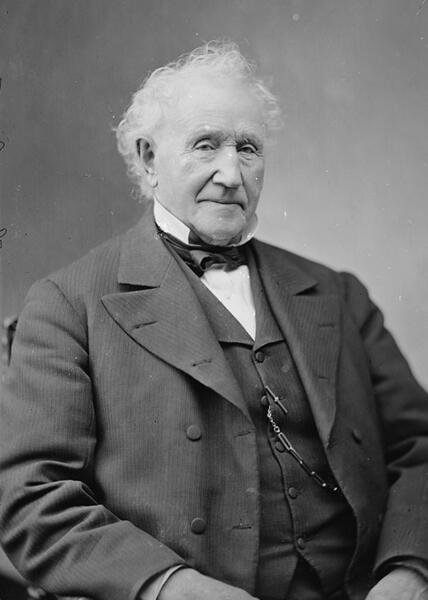
Here you will find contact information for Representative George Washington Patterson, including email address, phone number, and mailing address.
| Name | George Washington Patterson |
| Position | Representative |
| State | New York |
| District | 33 |
| Party | Republican |
| Status | Former Representative |
| Term Start | October 15, 1877 |
| Term End | March 3, 1879 |
| Terms Served | 1 |
| Born | November 11, 1799 |
| Gender | Male |
| Bioguide ID | P000116 |
About Representative George Washington Patterson
George Washington Patterson (November 11, 1799 – October 15, 1879) was an American politician from the State of New York who served as a member of the United States House of Representatives and as lieutenant governor of New York. A member of the Republican Party in his later career, he represented New York in the Forty-fifth Congress from 1877 to 1879 and contributed to the legislative process during one term in office.
Patterson was born in Londonderry, Rockingham County, New Hampshire, on November 11, 1799, the youngest of twelve children of Thomas Patterson and Elizabeth (Wallace) Patterson. He received a common school education and went on to graduate from Pinkerton Academy in New Hampshire. At the age of eighteen he taught school in New Hampshire for three months before leaving his native state. He then moved to Livingston, New York, with his older brother, where they established a successful business devoted to the manufacture and sale of fanning mills, an enterprise that introduced him to agricultural and mechanical pursuits that would shape his early career.
Continuing in this line of work, Patterson engaged in the manufacture of fanning mills in Genesee County, New York, until 1825. That year he settled in Leicester, Livingston County, New York, where he expanded his interests to include general agricultural pursuits and the manufacture of farming implements. His growing prominence in the community led to local public service; he served as commissioner of highways of Leicester and as a justice of the peace. On the personal front, in February 1825 he married Hannah Dickey. The couple had two children, a son, George W. Patterson, and a daughter, Hannah Whiting Patterson. Public service became something of a family tradition: his brother William Patterson and his nephew Augustus Frank also later served as United States Representatives from New York.
Patterson entered state-level politics as a member of the New York State Assembly from Livingston County, serving in 1832, 1833, and from 1835 to 1840. During this period he rose to a position of leadership, serving as Speaker of the Assembly in 1839 and 1840. Concurrently, he was basin commissioner at Albany in 1839 and 1840, overseeing matters related to canal and harbor facilities at a time when New York’s internal improvements were central to the state’s economic development. In 1841 he moved to Westfield, in Chautauqua County, New York, to take charge of the Chautauqua land office, reflecting his growing involvement in land management and regional development.
Patterson continued to play an important role in New York’s public affairs through the mid-nineteenth century. He was a delegate to the New York State Constitutional Convention of 1846, participating in the revision of the state’s fundamental law. He served as lieutenant governor of New York from 1849 to 1850, a period during which the state was grappling with issues of infrastructure, commerce, and the early sectional tensions preceding the Civil War. Later, he was chairman of the harbor commission at New York from 1855 to 1857, overseeing aspects of one of the nation’s most important ports. In 1859 he was appointed quarantine commissioner of the Port of New York, a position that involved public health oversight at a major point of entry for immigrants and trade. He also served for many years as a local supervisor and as president of the board of education, underscoring his long-standing engagement with municipal governance and public schooling. As national politics realigned in the 1850s, Patterson became active in the emerging Republican Party and was a delegate to the Republican National Conventions of 1856 and 1860.
Elected as a Republican to the Forty-fifth United States Congress, Patterson represented New York’s thirty-third congressional district in the U.S. House of Representatives from March 4, 1877, to March 3, 1879. His service in Congress occurred during a significant period in American history, immediately following the contested presidential election of 1876 and at the close of Reconstruction. As a member of the House of Representatives, he participated in the democratic process and represented the interests of his New York constituents, contributing to the legislative work of the national government during his single term in office.
After leaving Congress in 1879, Patterson returned to Westfield, New York, where he had long made his home and remained a respected elder statesman. He died in Westfield on October 15, 1879, at the age of 79 years and 338 days. George Washington Patterson was interred at Westfield Cemetery in Westfield, New York, closing a public career that had spanned local, state, and national office over more than four decades.