Senator George Hunt Pendleton
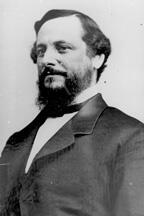
Here you will find contact information for Senator George Hunt Pendleton, including email address, phone number, and mailing address.
| Name | George Hunt Pendleton |
| Position | Senator |
| State | Ohio |
| Party | Democratic |
| Status | Former Representative |
| Term Start | December 7, 1857 |
| Term End | March 3, 1885 |
| Terms Served | 5 |
| Born | July 19, 1825 |
| Gender | Male |
| Bioguide ID | P000203 |
About Senator George Hunt Pendleton
George Hunt Pendleton (July 19, 1825 – November 24, 1889) was an American politician, lawyer, and diplomat who represented Ohio in both houses of the United States Congress and served as the Democratic nominee for Vice President of the United States in 1864. A member of the Democratic Party, he contributed to the legislative process over multiple terms in office, including service in the U.S. House of Representatives from 1857 to 1865 and a single term in the U.S. Senate beginning in 1879. His congressional career spanned a significant period in American history, encompassing the sectional crisis, the Civil War, and the early years of Reconstruction.
Pendleton was born in Cincinnati, Ohio, the son of Nathanael G. Pendleton, a lawyer and former member of the Ohio Senate and the U.S. House of Representatives. Through his father he was descended from Captain Nathaniel Pendleton of the Continental Army, a lineage that later qualified him for membership in the New York Society of the Cincinnati. He received his early education in Ohio and then studied at the University of Cincinnati before continuing his education at Heidelberg University in Europe. After completing his studies, he returned to Cincinnati, where he read law and was admitted to the bar, establishing a legal practice in his hometown.
In 1846 Pendleton married Mary Alicia Key, daughter of Francis Scott Key, the lawyer and amateur poet best known for writing the poem that became the lyrics of the United States national anthem, “The Star-Spangled Banner.” This marriage linked Pendleton to one of the most recognizable cultural figures of the early republic. George and Mary Alicia Pendleton had several children: Sarah Pendleton (born in Ireland, about 1846); Francis Key Pendleton (1850–1930), who was born in Cincinnati and later became prominent in New York society during the Gilded Age; Mary Lloyd Pendleton (1852–1929), also born in Cincinnati; Jane Francis Pendleton (1860–1950), born in the District of Columbia on April 22, 1860; and George Hunt Pendleton (1863–1868). In 1886 Pendleton became a member of the New York Society of the Cincinnati by right of his descent from Captain Nathaniel Pendleton.
Pendleton’s public career began in state politics. He was elected as a member of the Ohio Senate, serving from 1854 to 1856, following in the footsteps of his father, who had served in that body from 1825 to 1827. In 1854 he ran unsuccessfully for election to the Thirty-fourth Congress, but two years later he was elected as a Democrat to the Thirty-fifth Congress. He was reelected to the three succeeding Congresses and served in the U.S. House of Representatives from March 4, 1857, to March 3, 1865. During the 1850s he actively opposed measures to prohibit slavery in the western territories and became a leading defender of slavery within the Democratic Party. In 1862 he was appointed one of the managers to conduct the impeachment proceedings against West H. Humphreys, a U.S. judge for several districts of Tennessee.
During the Civil War, Pendleton emerged as a leader of the “peace” faction of the Democratic Party, closely associated with the Copperheads, who favored a negotiated settlement with the Confederacy. He opposed many of the Lincoln administration’s war measures and, after the war, resisted key elements of the emerging Reconstruction program. He voted against the Thirteenth Amendment to the Constitution, which abolished slavery and involuntary servitude, and opposed the Civil Rights Act of 1866. His prominence within the party led to his selection as the vice-presidential nominee at the 1864 Democratic National Convention, which paired him with General George B. McClellan. The ticket was internally divided—McClellan favored continuing the war, while Pendleton was identified with the peace wing—and it was defeated by the National Union ticket of Abraham Lincoln and Andrew Johnson in the general election. Pendleton’s term in the House expired shortly thereafter in March 1865.
Despite the defeat in 1864, Pendleton remained an important figure in Democratic politics. He was a strong contender for the presidential nomination at the 1868 Democratic National Convention, where his name was seriously considered before the delegates turned to New York Governor Horatio Seymour as a compromise choice. In 1869 Pendleton ran for governor of Ohio as the Democratic nominee but was defeated, and after this loss he temporarily withdrew from elective politics. During this interval he entered the business world, serving as president of the Kentucky Central Railroad, a position that helped maintain his public profile and connections even as he stepped back from officeholding.
Pendleton returned to national office when he was elected by the Ohio legislature to the United States Senate, taking his seat in 1879. Although one source inaccurately places his Senate service from 1857 to 1885, his actual tenure in the Senate comprised a single term beginning in 1879. During this period he rose to a leadership role within his party, becoming Chairman of the Senate Democratic Conference. His Senate service coincided with the growing national movement for civil service reform. After the assassination of President James A. Garfield in 1881, public concern over the spoils system intensified, and Pendleton authored and helped secure passage of the Pendleton Civil Service Reform Act of 1883. This landmark legislation required that many federal civil service positions be filled on the basis of competitive examinations and merit rather than political patronage, laying the foundation for the modern professional civil service. While the act enhanced his national reputation as a reformer, it alienated some party leaders and patronage interests in Ohio, contributing to the loss of support that led to his failure to secure renomination for a second Senate term.
Following his Senate career, Pendleton continued in public service on the international stage. President Grover Cleveland appointed him Envoy Extraordinary and Minister Plenipotentiary (commonly styled ambassador) to the German Empire in 1885, the year he left the Senate. He served in Berlin until April 1889, representing American interests in one of Europe’s major powers during a period of growing U.S. engagement in international affairs. At the end of his life Pendleton suffered a stroke. While returning to the United States after concluding his diplomatic service, he died in Brussels, Belgium, on November 24, 1889. He was interred in Spring Grove Cemetery in Cincinnati, Ohio, closing a career that had encompassed state and national legislative service, a vice-presidential nomination, party leadership, major civil service reform, and diplomatic representation abroad.