Representative George E. Sangmeister
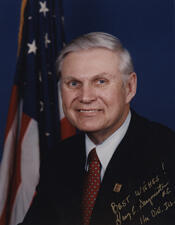
Here you will find contact information for Representative George E. Sangmeister, including email address, phone number, and mailing address.
| Name | George E. Sangmeister |
| Position | Representative |
| State | Illinois |
| District | 11 |
| Party | Democratic |
| Status | Former Representative |
| Term Start | January 3, 1989 |
| Term End | January 3, 1995 |
| Terms Served | 3 |
| Born | February 16, 1931 |
| Gender | Male |
| Bioguide ID | S000056 |
About Representative George E. Sangmeister
George Edward Sangmeister (February 16, 1931 – October 7, 2007) was an American politician, attorney, and Democratic member of the United States House of Representatives from Illinois. He served in Congress from January 3, 1989, to January 3, 1995, originally representing Illinois’s 4th congressional district before it was renumbered as the 11th district. Over the course of three terms in office, he participated actively in the legislative process and represented the interests of a largely suburban and exurban constituency during a period of significant political and economic change in the late 1980s and early 1990s.
Sangmeister was born on February 16, 1931, in Frankfort, Illinois. He grew up in the south suburban region of the Chicago metropolitan area, an area that would remain central to his personal and political life. He married Doris Hinspeter, and the couple made their home in Will County. After attending Joliet Junior College, he entered the United States Army and served as a sergeant during the Korean War. His military service provided him with early leadership experience and a grounding in public service that would later inform his legal and political career.
Following his return to civilian life, Sangmeister continued his education in Illinois. He attended Elmhurst College and subsequently enrolled at John Marshall Law School in Chicago, where he earned his law degree. Upon admission to the bar, he entered private law practice, building a reputation as a capable attorney in Will County. His legal work and growing involvement in local affairs led to his appointment as a magistrate for Will County in 1961, marking his first formal role in the administration of justice. In 1964, he was elected Will County State’s Attorney, becoming the county’s chief prosecutor and legal representative, and gaining prominence as a public official.
Sangmeister’s success at the county level propelled him into state politics. In 1972, he was elected as a Democrat to the Illinois House of Representatives, where he began to develop a record on issues affecting his district, including criminal justice, local government, and infrastructure. In the 1976 general election, he defeated Republican incumbent James F. Bell to win a four-year term as state senator from the 42nd district in the Illinois Senate. During his tenure in the Senate, he became a powerful Democratic leader, playing an influential role in legislative negotiations and party strategy in Springfield. His stature within the party was reflected in his selection as a running mate in a major statewide campaign.
In the 1986 Illinois gubernatorial election, Sangmeister sought the Democratic nomination for lieutenant governor. He was endorsed by Adlai Stevenson III, the presumptive Democratic nominee for governor, as Stevenson’s preferred running mate. In an upset that drew national attention, Sangmeister lost the Democratic primary to Mark Fairchild, a candidate associated with the LaRouche movement. When Stevenson subsequently left the Democratic ticket to head the newly formed Solidarity Party, Sangmeister declined to join him. Stevenson instead chose Michael J. Howlett Jr., a former Cook County judge and son of former Illinois Secretary of State Michael Howlett, as his new running mate. In the general election, the incumbent Republican ticket of Governor James R. Thompson and Lieutenant Governor George Ryan defeated Stevenson and Howlett.
In 1988, Sangmeister was elected to the U.S. House of Representatives from a marginally Republican district in Illinois, reflecting his appeal across party lines and his strong local base. A member of the Democratic Party, he served three consecutive terms in Congress from 1989 to 1995. During this period, he represented his constituents through the end of the Cold War, the Persian Gulf War, and the early years of the post–Cold War era, participating in debates over federal spending, infrastructure, veterans’ issues, and economic policy. His district, initially designated as the 4th and later renumbered as the 11th, encompassed growing suburban communities where concerns about transportation, development, and jobs were central. After three terms in the House of Representatives, Sangmeister declined to seek re-election in 1994, publicly citing his frustration with national politics and the increasingly polarized climate in Washington. In the 1994 general election, Republican state legislator Jerry Weller defeated Democratic state legislator Frank Giglio to succeed him.
After leaving Congress in January 1995, Sangmeister returned to private law practice in Illinois, resuming the legal career that had first brought him to public attention. He remained a respected figure in Will County and the surrounding region, known for his long record of service at the county, state, and federal levels. In his later years, he continued to be involved in civic and community affairs, drawing on decades of experience in law and legislation.
George Edward Sangmeister died of leukemia on October 7, 2007, at the age of 76. He was interred on October 11, 2007, at Abraham Lincoln National Cemetery in Elwood, Illinois, a national cemetery not far from the communities he had represented for much of his life. His career spanned military service, local and county office, the Illinois General Assembly, and the United States Congress, marking him as a significant Democratic leader in Illinois politics over several decades.