Senator George Eliphaz Spencer
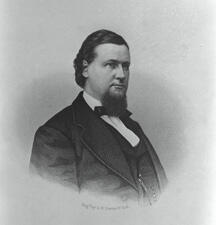
Here you will find contact information for Senator George Eliphaz Spencer, including email address, phone number, and mailing address.
| Name | George Eliphaz Spencer |
| Position | Senator |
| State | Alabama |
| Party | Republican |
| Status | Former Representative |
| Term Start | January 1, 1868 |
| Term End | March 3, 1879 |
| Terms Served | 2 |
| Born | November 1, 1836 |
| Gender | Male |
| Bioguide ID | S000723 |
About Senator George Eliphaz Spencer
George Eliphaz Spencer (November 1, 1836 – February 19, 1893) was an American politician, lawyer, and Union Army officer who represented Alabama as a Republican in the United States Senate from 1868 to 1879. His congressional service spanned the critical Reconstruction era, during which he participated in the legislative process and represented the interests of his constituents in a state newly readmitted to the Union.
Spencer was born on November 1, 1836, in Champion, Jefferson County, New York, the son of Gordon Percival Spencer and Deborah Mallory Spencer. He received part of his education at Montreal College in Canada, reflecting an early exposure to both American and Canadian academic environments. After completing his studies, he moved west to Iowa, where he engaged in the study of law, laying the groundwork for a legal and political career that would later unfold in the context of the Civil War and Reconstruction.
Drawn by the opportunities of the Pike’s Peak Gold Rush, Spencer relocated to the Colorado region in 1859. In November of that year he was among the founders of the town of Breckenridge, Colorado, and he also resided in Golden from 1859 to 1860. These ventures placed him at the forefront of frontier development in the Rocky Mountain West. In 1862 he married English author Bella Zilfa, a union that coincided with the nation’s deepening involvement in civil conflict.
During the American Civil War, Spencer enlisted in the Union Army as a captain on October 16, 1862. He initially served on the staff of Brigadier General Grenville M. Dodge, a prominent Union commander in the Western Theater. Seeking a more direct command role, he requested transfer to the 1st Alabama Cavalry Regiment, a volunteer unit composed largely of Southern Unionists from Alabama and neighboring states. Promoted to colonel, Spencer assumed command of the regiment on September 11, 1863, and led it through the latter stages of the war until his resignation on July 5, 1865. His leadership of a Union regiment raised from a Confederate state underscored his alignment with the Union cause and foreshadowed his later political role in Reconstruction Alabama.
After the war, Spencer settled in Alabama, where he resumed the practice of law and became involved in the state’s postwar legal and political reorganization. His wife, Bella Zilfa Spencer, died of typhoid fever in 1867, a personal loss that occurred just as Alabama was moving toward readmission to the Union. During this period he also served as register in bankruptcy for the fourth district of Alabama, a position created under federal bankruptcy laws to manage the complex financial and legal aftermath of the war in the South.
Upon the readmission of Alabama to the Union, Spencer was elected as a Republican to the United States Senate. He took his seat on July 13, 1868, and served two full terms, remaining in office until March 3, 1879. As a member of the Senate during Reconstruction, Spencer contributed to the legislative process at a time when Congress was grappling with the reintegration of the former Confederate states, the protection of the civil and political rights of formerly enslaved people, and the redefinition of federal–state relations. His tenure was marked by intense partisan and sectional conflict. The Ku Klux Klan and their supporters in Alabama accused him of corruption and of rewarding allies in the state legislature with patronage positions, allegations he publicly denied. Nonetheless, he maintained his Senate seat for more than a decade, reflecting both his influence within the state’s Republican organization and his alignment with national Reconstruction policies.
After leaving the Senate in 1879, Spencer remained active in business and public affairs. With the assistance of his former commanding officer, now Major General Grenville M. Dodge, he was appointed a commissioner of the Union Pacific Railroad, a position that connected him to the era’s major infrastructure and economic development initiatives. In 1877 he married May Nunez, a prominent actress whose given names at birth were “William Wing” in honor of her uncle, one-armed Confederate General William Wing Loring. The marriage symbolically bridged former Union and Confederate circles. Spencer and his wife spent approximately two years on a ranch in Nevada, where they tended to mining interests, before relocating around 1880 to Washington, D.C., which became their long-term residence.
George Eliphaz Spencer died in Washington, D.C., on February 19, 1893, at the age of 56. He was interred at Arlington National Cemetery in Arlington, Virginia, a burial place reserved for many of the nation’s military and political leaders. His life encompassed frontier town-building, Civil War command, and a central role in the Reconstruction politics of Alabama, culminating in more than a decade of service in the United States Senate from 1867–1868 to 1879 as a member of the Republican Party.