Representative George Washington Steele
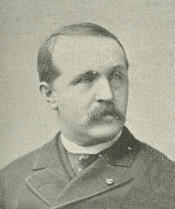
Here you will find contact information for Representative George Washington Steele, including email address, phone number, and mailing address.
| Name | George Washington Steele |
| Position | Representative |
| State | Indiana |
| District | 11 |
| Party | Republican |
| Status | Former Representative |
| Term Start | December 5, 1881 |
| Term End | March 3, 1903 |
| Terms Served | 8 |
| Born | December 13, 1839 |
| Gender | Male |
| Bioguide ID | S000830 |
About Representative George Washington Steele
George Washington Steele (December 13, 1839 – July 12, 1922) was an American lawyer, soldier, banker, and Republican politician who twice served as a Representative from Indiana in the United States Congress, from 1881 to 1889 and again from 1895 to 1903. He was also the first governor of Oklahoma Territory and was instrumental in developing that territory’s public education system and its two largest universities. Over the course of eight terms in the House of Representatives, Steele contributed to the legislative process during a significant period in American history, representing the interests of his Indiana constituents while also advancing veterans’ affairs and western territorial development.
Steele was born to Asbury and Marie Louise Steele in Fayette County, Indiana, on December 13, 1839. He was educated in Indiana’s public schools and later pursued higher education at Ohio Wesleyan University, where he studied law. After completing his legal studies, he passed the bar examination and established a law practice in Hartford City, Indiana. His early professional life as a lawyer in a growing Midwestern state provided him with experience in local affairs and the concerns of rural and small-town communities that would later inform his political career.
Steele continued his law practice until the outbreak of the American Civil War in 1861. With Indiana remaining loyal to the Union, he volunteered for service and joined the 12th Indiana Regiment of the Union Army on May 2, 1861. He later transferred to the 101st Indiana Regiment, in which he served until the conclusion of the war. During his military service he served under Major General William Tecumseh Sherman and took part in Sherman’s famous March to the Sea and the subsequent Carolinas campaign. In recognition of his service, he was promoted to the rank of lieutenant colonel in July 1865. After the war ended and the Union was restored, Steele transferred from the volunteer forces to the Regular Army, receiving a commission as a major in the 14th U.S. Infantry. He served in the Regular Army for a decade, from February 23, 1866, until his resignation in February 1876, gaining administrative and leadership experience that would later recommend him for territorial executive office.
Upon retiring from the army, Steele returned to Indiana and settled in Marion, Grant County. There he entered business, engaging in agricultural pursuits and pork packing, and became active in civic and political life. His wartime loyalty to the Union naturally aligned him with the Republican Party, and he soon emerged as a local party leader. In early 1890 he also became the first president of the First National Bank in Marion, reflecting his growing prominence in business and finance. His political support in the region enabled him to win election as a Republican to the United States House of Representatives from Indiana’s 11th Congressional District in 1880. Although he was elected in 1880, his first term in Congress began on March 4, 1881, and he was reelected in 1882, 1884, and 1886, serving continuously until March 3, 1889. During these years he participated actively in the legislative process at a time of rapid industrial growth and postwar adjustment.
One of Steele’s most notable achievements during his early congressional service was his role in securing a National Home for Disabled Volunteer Soldiers in Grant County, Indiana. During his last term of this initial period in Congress, he introduced legislation in the Fiftieth Congress to establish a branch home in Marion. The measure was taken up in December and, after several months of consideration, was approved by an Act of Congress and signed by President Grover Cleveland on July 23, 1888, under the title “An Act to authorize the location of a Branch Home for Disabled Volunteer Soldiers in Grant County, Indiana, and For Other Purposes.” The approval of Steele’s bill was received with great enthusiasm in Marion, where the local press predicted expenditures for the branch would total at least $500,000. On July 30, 1888, the city held a large public celebration, with crowds described as the largest assemblage ever reported in Marion, underscoring Steele’s influence in bringing federal investment and veterans’ care to his district.
After leaving Congress on March 3, 1889, Steele returned to Marion and resumed private life and business. His military background and administrative experience soon drew national attention when the western portion of what is now Oklahoma was organized as Oklahoma Territory on May 2, 1890. Reports of disorder in the newly opened territory led President Benjamin Harrison to seek a former military officer to serve as its first governor. At Harrison’s request, Steele accepted the appointment and was inaugurated as governor of Oklahoma Territory on May 22, 1890, in Guthrie. Immediately upon assuming office, he declared a state of emergency throughout the territory, using his military training to impose order and establish functioning civil institutions in a rapidly growing and often turbulent frontier society.
Steele’s tenure as territorial governor was marked by both conflict and institution-building. He faced persistent disputes with the Oklahoma Territorial Legislature, which sought to move the capital from Guthrie, first to Oklahoma City and then to Kingfisher; Steele vetoed each of these efforts, insisting on stability in the seat of government. At the same time, he strongly advocated the creation of a public school system and institutions of higher education for the territory. Under his leadership, the legislature approved and established two key institutions: a university at Norman and an agricultural and mechanical college at Stillwater. The Norman Territorial University later became the University of Oklahoma, and the Stillwater A&M College evolved into Oklahoma State University. Although he served only about seventeen months, resigning effective October 18, 1891, Steele’s work laid the foundation for Oklahoma’s modern public education system. After his resignation, President Harrison appointed Abraham Jefferson Seay as his successor, with Robert Martin, the territorial secretary, serving as acting governor from October 18, 1891, until Seay took the oath of office in February 1892.
Upon returning to Marion after his territorial service, Steele resumed private life until he reentered politics in 1894. That year he was again elected as a Republican to represent Indiana’s 11th Congressional District in the United States House of Representatives. His new term began on March 4, 1895, marking the start of his second period of congressional service, which continued until 1903. During this time he was reelected three times, serving four consecutive terms and bringing his total House service to eight terms overall. In the Fifty-seventh Congress he served as chairman of the House Committee on Manufactures, a position that placed him at the center of legislative deliberations on industrial and commercial policy during a period of expanding American manufacturing and economic change. Throughout his congressional career, Steele remained a member of the Republican Party and participated in the broader democratic process, representing his Indiana constituents while drawing on his military and territorial experience in national debates.
Steele’s commitment to veterans extended beyond his legislative work. He served on the Board of Managers of the National Military Home at Marion from April 21, 1890, to December 10, 1904, overseeing the institution he had helped bring into existence. On December 11, 1904, he became the third director of the Marion Branch of the National Home for Disabled Volunteer Soldiers. He moved into the Director’s House on the grounds and served in that capacity until his retirement on May 31, 1915, supervising the care of disabled veterans for more than a decade. His leadership at the Marion Branch further solidified his reputation as an advocate for those who had served in the Union Army.
After retiring from his post at the Marion Branch, Steele once again returned to life as a private citizen in Marion. He remained a respected figure in the community he had long served in law, business, politics, and veterans’ affairs. At the age of eighty-three, George Washington Steele died in Marion on July 12, 1922. He was buried in Odd Fellows Cemetery in that city. While he left an important legacy in Indiana through his congressional service, his role in establishing the Oklahoma Territory’s first public school system and helping to found what became the University of Oklahoma and Oklahoma State University ensured that his most enduring influence would be felt in the development of Oklahoma. Observers of his territorial administration later noted that “He was a most capable executive and his unafraid service to the territory must not be minimized,” a judgment that reflects the breadth of his contributions to both state and national history.