Representative George Dionysius Tillman
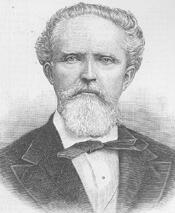
Here you will find contact information for Representative George Dionysius Tillman, including email address, phone number, and mailing address.
| Name | George Dionysius Tillman |
| Position | Representative |
| State | South Carolina |
| District | 2 |
| Party | Democratic |
| Status | Former Representative |
| Term Start | March 18, 1879 |
| Term End | March 3, 1893 |
| Terms Served | 7 |
| Born | August 21, 1826 |
| Gender | Male |
| Bioguide ID | T000275 |
About Representative George Dionysius Tillman
George Dionysius Tillman (August 21, 1826 – February 2, 1902) was a Democratic politician from South Carolina who served as a state representative, state senator, and U.S. Representative. Born near Curryton, South Carolina, he was a member of a prominent political family: he was the brother of Benjamin Ryan Tillman, who later became governor of South Carolina, and the father of James H. Tillman, who served as lieutenant governor of South Carolina from 1901 to 1903 and in the latter year shot newspaper editor Narciso Gener Gonzales and was acquitted. Tillman’s early life unfolded in the antebellum South, where he combined formal education with preparation for a legal and political career.
Tillman attended schools in Penfield, Georgia, and in Greenwood, South Carolina, before pursuing higher education at Harvard University. Although he did not graduate from Harvard, he returned to South Carolina to study law. He was admitted to the bar in 1848 and commenced the practice of law in Edgefield, South Carolina, a community that was then a center of political influence in the state. Alongside his legal work, he developed an interest in agriculture, engaging in farming and related pursuits that would remain an important part of his livelihood and public identity.
Tillman entered public office in the 1850s. He served as a member of the South Carolina House of Representatives from 1854 to 1855, representing his constituency in the state legislature in the years leading up to the Civil War. During the conflict, he enlisted in the Confederate States Army. In 1862 he served in the 3rd South Carolina Infantry Regiment, and after that unit was disbanded he joined the 2nd South Carolina Artillery, in which he served until the close of the war. Returning to politics during the tumultuous Reconstruction era, he again served in the South Carolina House of Representatives in 1864.
In the immediate aftermath of the Civil War, Tillman participated in efforts to reshape state government under federal Reconstruction policy. He was a member of the South Carolina constitutional convention in 1865, which was held pursuant to President Andrew Johnson’s Reconstruction proclamation. That same year he served as a state senator in the South Carolina Senate. He continued to combine his legal practice, agricultural pursuits, and public service, and he also worked as a publicist, contributing to public debate and political discourse in the state.
Tillman sought to extend his political career to the national level during the 1870s. A member of the Democratic Party, he was an unsuccessful candidate for election to the Forty-fifth Congress in 1876. He was subsequently elected as a Democrat to the Forty-sixth Congress from South Carolina’s Fifth Congressional District, serving from 1879 to 1881, and was re-elected to the Forty-seventh Congress (1881–1883). His service in Congress occurred during a significant period in American history, as the nation grappled with the end of Reconstruction and the reordering of political power in the South. However, his tenure in the Forty-seventh Congress was cut short: he served from March 3, 1881, to June 19, 1882, when his election was overturned by the U.S. House of Representatives after his African American Republican opponent, Robert Smalls, successfully contested the result and was seated in his place.
Despite this setback, Tillman soon returned to the House of Representatives. He was elected to the Forty-eighth Congress from South Carolina’s Second Congressional District and was re-elected to the four succeeding Congresses, serving continuously from 1883 to 1893. Over the course of these seven terms, he represented the interests of his South Carolina constituents and participated in the legislative process during a transformative era in national politics. During the Fifty-second Congress he served as chairman of the Committee on Patents, a position that placed him at the center of legislative consideration of intellectual property and technological innovation. He was an unsuccessful candidate for renomination in 1892, which brought his congressional career to a close.
After leaving Congress, Tillman remained active in South Carolina political life. He served as a member of the South Carolina constitutional convention of 1895, which produced a new state constitution that reshaped the political and legal framework of the state. In 1898 he sought higher office as a candidate for governor of South Carolina but was unsuccessful in that bid. In his later years he continued his involvement in agriculture and public affairs, maintaining his role as a notable figure in the state’s Democratic Party and public life.
George Dionysius Tillman died in Clarks Hill, McCormick County, South Carolina, on February 2, 1902. He was interred in the Bethlehem Baptist Church Community Cemetery. His long career in state and national politics, together with his family’s continued prominence in South Carolina public life, made him a significant figure in the political history of the state in the second half of the nineteenth century.