Senator George Michael Troup
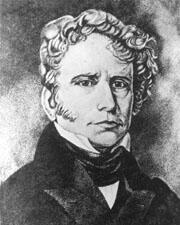
Here you will find contact information for Senator George Michael Troup, including email address, phone number, and mailing address.
| Name | George Michael Troup |
| Position | Senator |
| State | Georgia |
| Party | Jackson |
| Status | Former Representative |
| Term Start | October 26, 1807 |
| Term End | November 8, 1833 |
| Terms Served | 7 |
| Born | September 8, 1780 |
| Gender | Male |
| Bioguide ID | T000382 |
About Senator George Michael Troup
George Michael Troup (September 8, 1780 – April 26, 1856) was an American politician from the state of Georgia who served in the Georgia General Assembly, the U.S. House of Representatives, and the U.S. Senate before becoming the thirty‑second governor of Georgia for two terms and then returning to the U.S. Senate. A member of the Jackson Party and later identified with the Jacksonian Democrats, he was a prominent advocate of expansionist Manifest Destiny policies, a supporter of Native American removal, and a consistent defender of slavery and states’ rights. Over the course of a long public career that spanned the early national and antebellum periods, he was known in his later years as “the Hercules of states’ rights.”
Troup was born during the American Revolution at McIntosh Bluff on the Tombigbee River in what is now Alabama, then a part of the Province of Georgia. He was the son of George Troup and Catherine McIntosh, the Georgia‑born daughter of Captain John McIntosh, a British military officer and chief of the McIntosh clan. Through his mother he was connected to prominent Creek leaders: Catherine McIntosh was of the chiefs of the MacGillivray clan lineage, a first cousin of Creek Chief Alexander McGillivray and an aunt of Creek Chief William McIntosh. Born into a planter family, Troup grew up in a slaveholding environment that shaped his political and economic views and underpinned his later support for the plantation system and the expansion of slavery.
Troup pursued higher education in the North and graduated from the College of New Jersey (later Princeton University) in 1797. After college he read law with an established firm and, following the customary apprenticeship of the period, was admitted to the bar in Savannah, Georgia, in 1799. He established himself as a lawyer and planter and became identified with the interests of the coastal and upcountry planter elite. He primarily resided near Dublin in Laurens County, where he developed his plantation, Valdosta (sometimes spelled Val d’Osta), named for the Valle d’Aosta alpine valley in Italy. His personal life included two marriages and six children. His prominence in Georgia society and politics was later reflected in the naming of the town of Valdosta, Georgia, for his plantation, and of Troupville, Georgia, and Troup County, created from former Lower Creek land in 1826, in his honor.
Troup’s political career began in state politics, where he emerged as a strong opponent of the Yazoo land scandal that had discredited earlier Georgia legislatures. A Democratic‑Republican in his early partisan alignment, he served one term in the Georgia General Assembly from 1803 to 1805. In 1806 he was elected to the U.S. House of Representatives and took his seat in 1807. He was re‑elected three times and served in the House from 1807 to 1815, a period that encompassed the lead‑up to and conduct of the War of 1812. In Congress he aligned with the so‑called War Hawks, a nationalistic group of legislators including Henry Clay of Kentucky and John C. Calhoun of South Carolina, who supported American entry into the war against Great Britain. On the House floor he defended Calhoun when Representative John Randolph of Virginia attacked him, declaring that it was “the great mass of the House … against the solitary gentleman from Virginia,” a remark that underscored his solidarity with the War Hawk faction and his willingness to confront established figures in defense of his allies.
After his House service, Troup advanced to the United States Senate, where he was supported by fellow wealthy plantation owners and continued to represent Georgia’s planter interests. Although the existing record here dates his Senate service from 1807 to 1833, his principal tenure in the Senate followed his early House career and then resumed after his governorship. During his time in the Senate he served as chairman of the Senate Committee on Military Affairs, reflecting his continued interest in national defense and military policy. His service in Congress occurred during a significant period in American history, as the young republic grappled with issues of territorial expansion, relations with European powers, and the balance between federal and state authority. As a member of the Senate, Troup participated in the legislative process, represented the interests of his Georgia constituents, and increasingly articulated a strong doctrine of states’ rights that would define his later reputation.
Troup’s statewide prominence grew through his association with William H. Crawford, a leading Georgia and national political figure, who hand‑picked him as his preferred candidate for governor in 1819. In the fiercely factionalized politics of Georgia, however, Troup twice lost gubernatorial contests to Crawford’s rival, John Clark, who drew his support largely from frontier settlers rather than the planter elite. In 1823, when Clark was no longer eligible to run, Troup again sought the governorship and was elected. As governor, he vigorously advocated the removal of the Creek Indians from western Georgia, seeking to open their lands to white settlement and extend the plantation economy. He supported a plan, first advanced by Thomas Jefferson in 1803, to move the Creek and other Native peoples to the western territory acquired in the Louisiana Purchase. In 1825, in Georgia’s first popular election for governor, Troup was narrowly re‑elected by a razor‑thin margin, confirming both his strength and the deep divisions within the state.
Troup’s second term as governor was dominated by the controversy over the Treaty of Indian Springs, negotiated on February 12, 1825, with his first cousin, the mixed‑blood Creek Chief William McIntosh. Under the treaty, McIntosh and forty‑nine other tribal leaders, predominantly from the Lower Creeks, ceded a large portion of Creek land in Georgia, despite lacking the support of the majority of the Creek Confederacy. The agreement provoked intense opposition among many Creeks and controversy at the federal level. When President John Quincy Adams and federal authorities questioned the treaty’s validity and sought to limit its implementation, Troup responded with defiance, threatening to use state militia to resist any federal interference and to attack federal troops if they attempted to obstruct Georgia’s seizure of Creek lands. In the ensuing confrontation, Adams ultimately conceded, and Troup proceeded to enforce the treaty and secure the remaining Creek land in Georgia. At the same time, Troup supported measures to promote internal improvements and public institutions within the state, backing public education and advocating the construction of new roads and canals to facilitate commerce and settlement.
In foreign affairs, Troup’s views were distinctive for a Southern politician of his era. Despite the recent memory of the War of 1812, he maintained that the United States should cultivate a positive relationship with Great Britain. He habitually referred to the British in familial terms—“our cousins,” “our sister nation,” and advocates of “fraternal relations with England”—and expressed a belief that, because Britain and the United States shared common cultural and political roots, the two nations might “ultimately reunite in some form,” even as he insisted that the United States would and should “remain forever independent from, though no less loving towards, England.” By contrast, he was notably hostile toward France, sharply critical of the French Revolution, particularly the Reign of Terror, and equally dismissive of the subsequent Bourbon Restoration government. These views reflected his broader ideological commitments to order, hierarchy, and Anglo‑American political traditions.
Upon the expiration of his second term as governor, Troup returned to the U.S. Senate in 1829 as a Jacksonian Democrat. In this later phase of his congressional service, which extended into the early 1830s, he continued to champion states’ rights and the interests of the slaveholding South. He served on the Senate Committee on Indian Affairs, where his long‑standing support for Indian removal aligned with the broader policies of the Jackson administration. Over the course of seven terms in Congress—combining his service in the House and Senate—Troup contributed to the legislative process during a transformative era in American politics, from the early republic through the rise of Jacksonian democracy. His uncompromising defense of state sovereignty and the plantation order earned him, in retrospect, the sobriquet “the Hercules of states’ rights.” In 1852, reflecting his continued stature among Southern rights advocates, he was put forward as a nominee for President of the United States by the Southern Rights Party, though his candidacy did not achieve national traction.
In his later years, Troup withdrew from active public life and devoted himself to managing his plantations and family affairs. He continued to reside principally in Laurens County and to oversee his Valdosta plantation, even as places across Georgia bore his name and attested to his enduring influence: Troup County, created in 1826 from former Lower Creek lands, was named in his honor, and during the American Civil War an artillery battery raised in Athens, Georgia, was designated the “Troup Artillery” to commemorate him. He maintained connections with his extended family, which included other prominent planters; among related holdings in the region was the Hofwyl‑Broadfield Plantation, owned by his brother. Troup died on April 26, 1856, while visiting one of his plantations near the Oconee River in Montgomery County, Georgia, in an area that is now part of Treutlen County. He was buried on his Rosemont plantation, leaving a complex legacy as a forceful advocate of Georgia’s interests, an architect of Indian removal in the state, and a symbol of the antebellum South’s commitment to slavery and states’ rights.