Senator George V. Voinovich
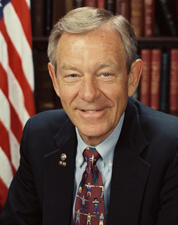
Here you will find contact information for Senator George V. Voinovich, including email address, phone number, and mailing address.
| Name | George V. Voinovich |
| Position | Senator |
| State | Ohio |
| Party | Republican |
| Status | Former Representative |
| Term Start | January 6, 1999 |
| Term End | January 3, 2011 |
| Terms Served | 6 |
| Born | July 15, 1936 |
| Gender | Male |
| Bioguide ID | V000126 |
About Senator George V. Voinovich
George Victor Voinovich (July 15, 1936 – June 12, 2016) was an American politician who served as a United States senator from Ohio from 1999 to 2011. A member of the Republican Party, he previously served as the 65th governor of Ohio from 1991 to 1998 and as the 54th mayor of Cleveland from 1980 to 1989, and he is the last Republican to have held the Cleveland mayoralty. Over a public career spanning more than 46 years, he rose from assistant attorney general of Ohio in 1963 to become the state’s senior U.S. senator, and he became the 15th person to serve both as governor of Ohio and as a U.S. senator. He was also one of only two Cleveland mayors—along with Frank Lausche—to later become both governor and U.S. senator, and he is the only person to have served as both chairman of the National Governors Association and president of the National League of Cities.
Voinovich was born in Cleveland, Ohio, the son of George S. Voinovich and Josephine (Bernot) Voinovich, and was the oldest of six children. His father was of Serbian descent from the Kordun region of Croatia, and his mother was of Slovenian ancestry. He grew up in Cleveland’s Collinwood neighborhood and graduated from Collinwood High School in 1954. Raised in the Roman Catholic faith, he was a lifelong member of his neighborhood parish, Our Lady of the Lake in Euclid (formerly Holy Cross). He attended Ohio University, where he studied government, was a member of the Phi Kappa Tau fraternity, and served as president of the student body and of the men’s dormitory system. He earned a Bachelor of Arts degree in government in 1958. Voinovich then studied law at the Moritz College of Law at The Ohio State University, receiving his Juris Doctor in 1961.
Voinovich began his public career in 1963 as an assistant attorney general of Ohio. He was elected to the Ohio House of Representatives in 1966 and served there from 1967 to 1971. In 1971 he became auditor of Cuyahoga County, a position he held until 1976. That same year he made an unsuccessful bid for the Republican nomination for mayor of Cleveland, losing to Ralph Perk, who went on to win the general election. From 1977 to 1978, Voinovich served as a member of the Cuyahoga County Board of Commissioners. In 1978 he was elected lieutenant governor of Ohio as the running mate of Governor James A. Rhodes, becoming the first Ohio lieutenant governor not elected separately from the governor.
By 1979, Cleveland’s municipal elections had become nonpartisan, and with Mayor Dennis J. Kucinich facing a difficult reelection campaign, Voinovich decided to seek the office again. On July 26, 1979, he entered what he later described as one of the most difficult decisions of his life. In the nonpartisan primary he led the field with 47,000 votes, followed by Kucinich with 36,000, while State Senator Charles Butts and city council majority leader Basil Russo failed to qualify for the general election. Voinovich’s strong showing in predominantly African American wards surprised observers. The campaign was overshadowed by personal tragedy when, on October 8, 1979, his nine-year-old daughter Molly was struck by a van and killed, bringing his campaign to a near halt. He debated Kucinich once, on November 3 at the City Club of Cleveland, and went on to win the general election with 94,541 votes to Kucinich’s 73,755. He was reelected in landslides, defeating former State Representative Patrick Sweeney in 1981 by 107,472 to 32,940 in Cleveland’s first four-year mayoral election, and defeating former councilman Gary Kucinich, Dennis Kucinich’s brother, in 1985 by 82,840 to 32,185.
As mayor, Voinovich was known as a shy and low‑key politician, a characterization he accepted, but he pursued an aggressive agenda to restore Cleveland’s finances and image. When he took office, Cleveland was emerging from national notoriety as the only major American city to go into default in the modern era and as the subject of jokes about the Cuyahoga River and earlier administrations. Voinovich worked with Governor James Rhodes and local banks to negotiate a debt repayment schedule, and in October 1980, with the state as guarantor, eight local banks lent the city $36.2 million, allowing Cleveland to emerge from default. After voters initially rejected a proposed 0.5 percent income tax increase, he resubmitted the measure, which passed in February 1981, helping stabilize city finances. He promoted a civic rebranding effort, supporting campaigns such as “Take Another Look. It’s Cleveland!” and “Cleveland’s a Plum,” and he became a visible symbol of the city’s recovery as national media began to acknowledge Cleveland’s “comeback.” During his tenure, he sponsored a successful referendum to lengthen the terms of the mayor and city council members from two to four years and to reduce the size of the council from 33 to 21 members to improve efficiency and reduce costs.
Under Voinovich’s leadership, Cleveland neighborhoods and the downtown core experienced significant redevelopment. Projects such as the Lexington Village housing development, the use of $149 million in Urban Development Action Grants, and approximately $3 billion in construction either underway or completed contributed to revitalization. Neighborhoods such as Hough and Fairfax began to see new housing and reduced crime. Voinovich worked to reconcile previously warring civic factions, forging closer ties with business leaders, neighborhood organizations, and labor unions under the slogan “Together, we can do it.” As a member of the National League of Cities, he was elected its president in 1985. He oversaw an urban renaissance downtown that included new office towers for Sohio (later BP America), Ohio Bell, and Eaton Corporation, the development of the Galleria at Erieview, and the construction of Society Center (now Key Tower), which became Cleveland’s tallest skyscraper. During his administration, Cleveland received the National Civic League’s All-America City Award three times in five years (1982, 1984, and 1986), adding to an earlier award in 1950.
Voinovich also played a central role in preserving and strengthening Cleveland’s municipal electric utility. One of the major controversies of the Kucinich administration had been the cancellation of the sale of Cleveland Municipal Light (later Cleveland Public Power) to the Cleveland Electric Illuminating Company (CEI). While Voinovich’s early negotiations helped resolve the city’s default, he maintained a firm stance in favor of keeping the public utility independent. He arranged capital improvements to modernize the system, and by 1982 the utility was able to compete effectively with CEI. In 1983, the system was renamed Cleveland Public Power, and in 1984 it received the American Municipal Power Association’s Scattergood Award for outstanding system operation and achievement. Despite pressure from CEI and efforts to secure a buyout, Voinovich resisted, asserting that the private utility was attempting to undermine the municipal system by lobbying against needed legislation.
In 1988, Voinovich sought to move from city hall to the U.S. Senate, running against incumbent Democratic Senator Howard Metzenbaum. The campaign was hard-fought and negative; Voinovich accused Metzenbaum of being soft on child pornography, charges that drew widespread criticism, including a televised rebuttal by Senator John Glenn. Metzenbaum was reelected with 57 percent of the vote to Voinovich’s 43 percent, even as Republican presidential nominee George H. W. Bush carried Ohio by 11 percentage points. Two years later, in 1990, Voinovich secured the Republican nomination for governor to succeed Democrat Richard F. Celeste, who was barred by term limits from seeking a third consecutive term. Voinovich defeated Democratic nominee Anthony J. Celebrezze Jr. and took office as Ohio’s 65th governor.
As governor, Voinovich focused on fiscal discipline, welfare reform, and economic development. During his first four years, he led efforts to eliminate a $1.5 billion state budget deficit and to reduce unfunded mandates. In 1991 he served as chairman of the Midwestern Governors Association. He was reelected in 1994, defeating Democrat Robert L. Burch Jr. with 72 percent of the vote, the largest share for any governor on the ballot that year nationwide and the largest margin of victory for an Ohio governor in the 20th century. During his second term he appointed Nancy Hollister as Ohio’s first female lieutenant governor and named Cincinnati mayor Kenneth Blackwell as state treasurer, making Blackwell the first African American to hold statewide executive office in Ohio. Under Voinovich, Ohio’s unemployment rate fell to a 25‑year low, more than 500,000 new jobs were created, the growth rate of Medicaid spending was cut by more than two‑thirds, and welfare rolls were reduced by half. Site Selection Magazine ranked Ohio No. 1 in the nation for new and expanding business facilities.
Voinovich’s administration also emphasized education and social policy. In 1995, the National Journal named him Public Official of the Year. He championed a school voucher program that used public funds to pay tuition at church‑affiliated schools, a plan that faced extensive litigation but was ultimately upheld by the U.S. Supreme Court in a 5–4 decision as consistent with the Constitution’s prohibition on government establishment of religion. By the end of his second term, Ohio led the nation in the percentage of eligible children enrolled in the Head Start program. When the state legislature moved to close Central State University, Ohio’s only historically Black state-supported university, Voinovich intervened by appointing a new board of trustees and recruiting John Garland as president, helping to preserve the institution. As both mayor and governor, he was instrumental in promoting Cleveland as the birthplace of rock and roll; beginning in 1985, he joined with the city and the state to lobby for the Rock and Roll Hall of Fame and Museum to be located in Cleveland. The museum opened in 1995, and its main atrium was later named the George V. Voinovich Atrium in recognition of his efforts.
On the national political stage, Voinovich was an early supporter of Senator Robert J. Dole’s 1996 campaign for the Republican presidential nomination, becoming the first governor to endorse Dole. He was among nine individuals vetted as potential vice-presidential running mates, but he withdrew his name from consideration, reiterating his intention to seek a U.S. Senate seat in 1998. Barred by term limits from seeking a third consecutive term as governor, he ran that year for the U.S. Senate seat being vacated by retiring Democratic Senator John Glenn. Voinovich won the election over Democratic nominee Mary O. Boyle. He resigned the governorship before the end of his term, and Lieutenant Governor Nancy Hollister briefly succeeded him before Governor-elect Bob Taft took office in January 1999. It was the first time since 1904 that a Republican governor of Ohio was succeeded by another Republican.
Voinovich served as a United States senator from Ohio from January 3, 1999, to January 3, 2011, completing two terms in office. During this period, he participated in the legislative process at a time of significant national and international developments, representing Ohio’s interests in debates over federal spending, foreign policy, and domestic programs. As the senior senator from Ohio for part of his tenure, he drew on his extensive executive experience as mayor and governor, and he continued to be active in intergovernmental affairs, reflecting his earlier service as chairman of the National Governors Association and president of the National League of Cities. Over the course of his Senate career, he was regarded as a pragmatic Republican voice, often emphasizing fiscal responsibility, infrastructure, and the importance of cooperative federalism. He left the Senate at the conclusion of his second term in 2011, closing a long career in elected office that had begun nearly half a century earlier.
George V. Voinovich died on June 12, 2016, in Cleveland, Ohio. His death marked the end of a public life that had encompassed service at virtually every level of government—from state assistant attorney general and state legislator to county official, mayor of a major city, governor, and United States senator. Throughout his career, he remained closely identified with his native Cleveland and with the state of Ohio, whose interests he sought to advance in both state and national forums.