Representative George Chester Robinson Wagoner
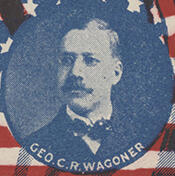
Here you will find contact information for Representative George Chester Robinson Wagoner, including email address, phone number, and mailing address.
| Name | George Chester Robinson Wagoner |
| Position | Representative |
| State | Missouri |
| District | 12 |
| Party | Republican |
| Status | Former Representative |
| Term Start | December 2, 1901 |
| Term End | March 3, 1903 |
| Terms Served | 1 |
| Born | September 3, 1863 |
| Gender | Male |
| Bioguide ID | W000022 |
About Representative George Chester Robinson Wagoner
George Chester Robinson Wagoner (September 3, 1863 – April 27, 1946) was an American businessman and Republican politician who served as a U.S. Representative from Missouri for one week during the Fifty-seventh Congress. His brief tenure in the House of Representatives, from February 26 to March 4, 1903, followed a successfully contested election and occurred during a significant period in American political and economic development at the turn of the twentieth century.
Wagoner was born on September 3, 1863, in Cincinnati, Ohio. He was educated in the public schools, receiving a basic formal education that prepared him for professional and business pursuits. At some point in his youth or early adulthood he moved to Missouri, where he continued his education in St. Louis. He attended Beaumont Hospital Medical College in St. Louis, Missouri, an institution that trained physicians and medical professionals and later became part of the Saint Louis University School of Medicine. Although he pursued medical studies, Wagoner ultimately built his career in business rather than in clinical practice.
Establishing himself in St. Louis, Wagoner became a prominent figure in the city’s commercial and funeral services sectors. He served as president of the Wagoner Undertaking Co., a funeral and undertaking business that reflected the growing professionalization of mortuary services in the late nineteenth and early twentieth centuries. In addition to his role in that enterprise, he was secretary and treasurer of the H.H. Wagoner Realty Co., also based in St. Louis. Through these positions, Wagoner was engaged in both the service industry and real estate, contributing to the economic life of the city during a period of rapid urban growth and industrial expansion.
A member of the Republican Party, Wagoner entered national politics at the beginning of the twentieth century. He became involved in a contested congressional race in Missouri’s representation to the Fifty-seventh Congress. Initially, Democrat James Joseph Butler had been declared the winner of the election. Wagoner, however, challenged the result, asserting that he was the duly elected Representative. After a protracted contest over the validity of the election returns, the House of Representatives ultimately decided in Wagoner’s favor.
As a result of this successful contest, Wagoner was seated as a Representative from Missouri in the United States Congress and served during the final week of the Fifty-seventh Congress, from February 26 to March 4, 1903. Although his time in office was extremely brief, he formally participated in the legislative process and represented the interests of his Missouri constituents during that closing period of the session. His service took place at a time when the nation was addressing issues related to industrial regulation, expansion of federal authority, and the aftermath of the Spanish-American War, situating his short tenure within a broader era of national transition.
Following his short involvement in politics and the conclusion of his one-week term in Congress, Wagoner did not continue in elective office. Instead, he resumed his business activities in St. Louis, returning to his leadership roles in the Wagoner Undertaking Co. and the H.H. Wagoner Realty Co. He remained part of the city’s business community for many years, reflecting the common pattern of early twentieth-century citizen-legislators who alternated between public service and private enterprise rather than pursuing long-term political careers.
George Chester Robinson Wagoner died in St. Louis, Missouri, on April 27, 1946. He was interred in Bellefontaine Cemetery, a historic burial ground that is the resting place of many of the city’s political, business, and civic leaders. His life encompassed both entrepreneurial success in St. Louis and a singular, notably brief episode of service in the United States House of Representatives, marking him as an unusual figure in Missouri’s congressional history.