President Gerald R. Ford
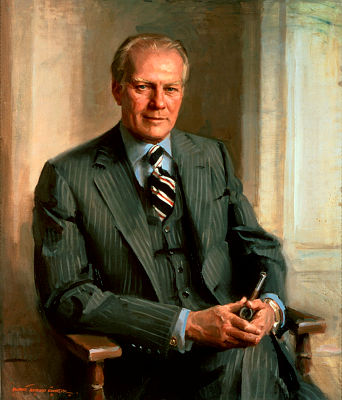
Here you will find contact information for President Gerald R. Ford, including email address, phone number, and mailing address.
| Name | Gerald R. Ford |
| Position | President |
| State | United States |
| Party | |
| Status | Former Representative |
| Term Start | August 9, 1974 |
| Term End | January 20, 1977 |
| Terms Served | 1 |
| Born | July 14, 1913 |
| Gender | Male |
| Website | Official Website |
About President Gerald R. Ford
When Gerald R. Ford took the oath of office on August 9, 1974, he declared, “I assume the Presidency under extraordinary circumstances…. This is an hour of history that troubles our minds and hurts our hearts.” He told Americans, “Our long national nightmare is over.”
Ford was the first vice president chosen under the Twenty-fifth Amendment. In the aftermath of the Watergate scandal, he succeeded the first president to ever resign from the presidency.
Ford was born Leslie King Jr. in Omaha, Nebraska on July 14, 1913, to a businessman and his wife Dorothy. Escaping her husband Leslie King Sr.’s physical abuse and battery, Dorothy divorced King and was subsequently remarried to Gerald Ford of Grand Rapids, Michigan, who later gave his name to his stepson. The young Ford starred on the University of Michigan football team, then went to Yale, where he served as assistant coach while earning his law degree.
During World War II he attained the rank of lieutenant commander in the Navy. After the war he returned to Grand Rapids, where he practiced law, and entered Republican politics. A few weeks before his election to Congress in 1948, he married Betty Bloomer. They had four children: Michael, Jack, Steven, and Susan.
Serving 25 years in the House, Ford had a reputation for integrity, openness, and comity that moved his Republican colleagues to elect him their leader in 1965. His popularity in Congress was the central reason Richard Nixon chose him to succeed the resigned Vice President Spiro Agnew.
After succeeding to the presidency after Nixon’s resignation, Ford focused on the rising inflation, reviving a depressed economy, solving chronic energy shortages, and U.S. relationships with key global partners.
He tried to calm the continuing traumas of Watergate by granting former President Nixon a full pardon. His nominee for vice president, former Governor Nelson Rockefeller of New York, was the second person to ll that office by appointment.
With a Democratic Congress, Ford made vigorous use of the veto. Fearing inflation, he vetoed a number of nonmilitary appropriations bills that would have further increased the budgetary decit. During his first 14 months as president he vetoed 39 measures. His vetoes were usually sustained.
As in his congressional days, Ford viewed himself as “a moderate in domestic affairs, a conservative in fiscal affairs, and a dyed-in-the-wool internationalist in foreign affairs.” Ford was eager to revive U.S. power and prestige after the collapse of Cambodia and South Vietnam. Preventing a new war in the Middle East remained a major objective; by providing aid to both Israel and Egypt, the Ford administration helped persuade the two countries to accept an interim truce. Detente with the Soviet Union continued as President Ford and Soviet leader Leonid Brezhnev set new limitations upon nuclear weapons.
Weakened by a serious primary challenge from former California Governor Ronald Reagan, Ford in 1976 lost narrowly to Jimmy Carter. He and Betty retired to California, where Mrs. Ford obtained treatment for drug and alcohol problems. After her recovery, she opened the Betty Ford Center to provide similar help for others.
Ford died on December 26, 2006, at the age of 93. Americans remembered the words spoken by President Carter when he took power from Ford in 1977, “For myself and for our nation, I want to thank my predecessor for all he has done to heal our land.”