Representative Gerald B. H. Solomon
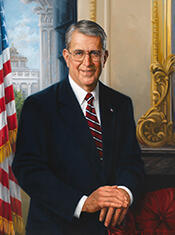
Here you will find contact information for Representative Gerald B. H. Solomon, including email address, phone number, and mailing address.
| Name | Gerald B. H. Solomon |
| Position | Representative |
| State | New York |
| District | 22 |
| Party | Republican |
| Status | Former Representative |
| Term Start | January 15, 1979 |
| Term End | January 3, 1999 |
| Terms Served | 10 |
| Born | August 14, 1930 |
| Gender | Male |
| Bioguide ID | S000675 |
About Representative Gerald B. H. Solomon
Gerald Brooks Hunt Solomon (August 14, 1930 – October 26, 2001) was an American businessman and politician most notable for his long service as a member of the United States House of Representatives from New York. He was born in Okeechobee, Florida, and moved with his family to New York State as a child, eventually settling in the Glens Falls–Queensbury area. Raised during the Great Depression and World War II, he developed an early interest in public service and civic affairs that would later shape his political career.
Solomon attended public schools in New York and left high school to enlist in the United States Marine Corps during the Korean War era. He served on active duty in the Marine Corps and later in the Marine Corps Reserve, experiences that deeply influenced his lifelong advocacy for veterans and a strong national defense. After completing his military service, he entered the private sector, building a successful career as an insurance and investment broker in upstate New York. His business activities, combined with his military background, established him as a prominent local figure and provided a foundation for his entry into elective office.
Solomon’s formal political career began at the local level. Initially a Democrat, he was elected town supervisor of Queensbury, New York, in 1968. During his first term as supervisor he switched his party affiliation to Republican, aligning himself with the region’s increasingly conservative electorate. His performance in local government and his growing reputation as a fiscal conservative and strong supporter of law enforcement and national defense led to his election to the New York State Assembly in 1972 as a Republican. He served three terms in the Assembly, where he represented an upstate district and gained experience in state-level legislative processes, budget matters, and constituent service.
In 1978 Solomon won election to the United States House of Representatives from New York, beginning a congressional career that would span ten consecutive terms from January 3, 1979, to January 3, 1999. A member of the Republican Party, he represented a largely rural and small-city district in upstate New York and became known as a staunch conservative on fiscal, social, and national security issues. During this significant period in American history, encompassing the late Cold War, the Reagan and Bush administrations, and the post–Cold War era, Solomon participated actively in the legislative process and consistently emphasized strong defense, limited government, and support for veterans. He was a reliable advocate for his constituents’ interests in areas such as military installations, infrastructure, and economic development.
Over the course of his House service, Solomon emerged as a high-profile advocate on defense and veterans’ issues. He was best known nationally for authoring the “Solomon Amendment,” federal legislation that prohibited federal funding to colleges and universities that barred military recruiters or ROTC programs from their campuses. The measure reflected his belief that institutions benefiting from federal support should not discriminate against the armed forces, and it became a major point of contention in debates over military policy and academic autonomy. He also supported increased defense spending, a robust intelligence capability, and policies aimed at strengthening the United States’ global posture, while frequently taking a hard line on foreign policy toward adversarial regimes.
Solomon’s influence within the House Republican Conference grew steadily. After Republicans won control of the House of Representatives in the 1994 elections for the first time in four decades, he briefly challenged Newt Gingrich for the position of Speaker of the House. He withdrew from the contest when it became clear that Gingrich had secured the support of a majority of the Republican caucus, but the challenge underscored Solomon’s standing among conservative members. Following the Republican takeover, he was selected to chair the powerful House Rules Committee, a position he held from 1995 until his retirement from Congress in 1999. As chairman, he played a central role in determining the terms of floor debate, shaping the legislative agenda, and advancing key elements of the Republican majority’s program. Upon his retirement, he was succeeded in the House by fellow Republican John E. Sweeney.
After leaving Congress in January 1999, Solomon remained active in public affairs through the operation of a lobbying and strategic consulting firm, advising clients on legislative and regulatory matters in Washington, D.C., and Albany. He continued to be involved in veterans’ causes and regional development initiatives in upstate New York. One of his long-standing priorities had been the creation of a national veterans’ cemetery to serve his region, and he had spearheaded efforts in Congress to establish such a facility near Saratoga.
Gerald Brooks Hunt Solomon died in Queensbury, New York, on October 26, 2001, at the age of 71. He was interred at the national veterans’ cemetery in Schuylerville, New York, a facility whose creation he had championed during his congressional career. In recognition of his service and advocacy on behalf of veterans, the cemetery was named in his honor after his death, commemorating his legacy as a Marine, legislator, and long-serving representative of New York in the United States Congress.