Representative Gibson Atherton
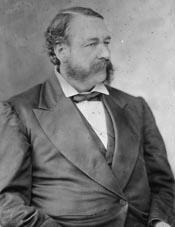
Here you will find contact information for Representative Gibson Atherton, including email address, phone number, and mailing address.
| Name | Gibson Atherton |
| Position | Representative |
| State | Ohio |
| District | 13 |
| Party | Democratic |
| Status | Former Representative |
| Term Start | March 18, 1879 |
| Term End | March 3, 1883 |
| Terms Served | 2 |
| Born | January 19, 1831 |
| Gender | Male |
| Bioguide ID | A000325 |
About Representative Gibson Atherton
Gibson Atherton (January 19, 1831 – November 10, 1887) was an American lawyer, jurist, and Democratic politician who served as a U.S. Representative from Ohio from 1879 to 1883. A member of the Democratic Party, he represented his constituents in the Forty-sixth and Forty-seventh Congresses during a significant period in American history, contributing to the legislative process over two terms in office. His public career also encompassed extensive local service in Newark, Ohio, and a brief appointment to the Supreme Court of Ohio.
Atherton was born on January 19, 1831, into a family of Pennsylvania and Ohio pioneers. He was the son of John Trueman Atherton (1799–1882) and Clarissa Ackley (1796–1883). His grandfather, Thomas Atherton (1765–1848), had moved from Pennsylvania to Ohio, continuing a family migration that began when earlier generations emigrated from Farnworth, Lancashire, England, to Pennsylvania in the 1700s. Atherton descended from a Quaker line; his great-grandfather, Caleb Atherton (1736–1776), was a Quaker who was “outed” on October 4, 1764, at the Uwchlan Monthly Quaker Meeting for not following Quaker principles and for marrying outside the Society. Caleb Atherton later died in the Revolutionary War at the Battle of Wyoming. Through this extended family, Gibson Atherton was related to historian Lewis Eldon Atherton and was a direct descendant of Gawain Atherton; his distant relatives also included Bobby Atherton and Tommy Atherton.
Atherton’s early education included attendance at Denison University in Granville, Ohio, after which he enrolled at Miami University in Oxford, Ohio. He graduated from Miami University in 1853. Immediately following his graduation, he moved to Osceola, Missouri, where he served as principal of the local academy from 1853 to 1854. He subsequently returned to Ohio to study law and was admitted to the bar in 1855. That same year he commenced the practice of law in Newark, Licking County, Ohio, where he quickly became a prominent figure in local civic and educational affairs. He served as president of the board of education of Newark for fifteen years, underscoring his long-standing commitment to public education in the community.
Atherton’s formal political career began at the county level. He was elected prosecuting attorney of Licking County in 1857 and was reelected in 1859 and 1861, reflecting sustained local confidence in his legal abilities and public service. While serving as mayor of Newark from 1860 to 1864, he guided the city through the Civil War years. During this period he also sought higher office; he was an unsuccessful Democratic candidate for the Ohio State Senate in 1863. In 1866 he ran unsuccessfully for judge of the court of common pleas. Beyond these campaigns, Atherton served for two years as a member of the Newark city council and remained active in Democratic Party affairs, including service as a delegate to the Democratic National Convention held in St. Louis in 1876.
In national politics, Atherton was elected as a Democrat to the U.S. House of Representatives, serving in the Forty-sixth and Forty-seventh Congresses from March 4, 1879, to March 3, 1883. As a Representative from Ohio, he participated in the deliberations of the House of Representatives during the post-Reconstruction era, representing the interests of his constituents and engaging in the broader democratic process at a time of industrial expansion and political realignment. After completing his second term, he chose not to seek renomination in 1882 and returned to his legal practice.
Atherton’s judicial career culminated in his appointment to the Supreme Court of Ohio. On August 20, 1885, Governor George Hoadly appointed him to the state’s highest court to fill a vacancy created by the death of Justice John W. Okey. Atherton served on the bench during the ensuing months, but in the autumn election of 1885 he was defeated by his Republican opponent for the remaining two years of Okey’s term. Following his electoral defeat, he resigned from the court on December 16, 1885. After leaving the bench, he resumed the practice of law in Newark, where he continued to work until his death.
In his personal life, Atherton married Margaret A. E. Kumler in Butler County, Ohio, on November 18, 1856. The couple had four children, all born in Ohio: Clara B. Atherton (1858–1939), Charles E. Atherton (born 1860), Della M. Atherton (born 1865), and Anna V. Atherton (born 1867). His eldest daughter, Clara, became an accomplished linguist and later worked for the War Department in Washington, D.C. In 1885 she toured Europe with her parents; during this trip she met her future husband, Emil Reidel, in Italy. They were married in Malta on March 17, 1886, and had two children. Atherton’s family connections and his children’s professional and international experiences reflected both his own educational values and the broader horizons of the post–Civil War generation.
Gibson Atherton died in Newark, Ohio, on November 10, 1887. He was interred in Cedar Hill Cemetery. His career encompassed service as a local educator and school board president, county prosecutor, mayor, city council member, delegate to a national party convention, U.S. Representative, and justice of the Supreme Court of Ohio, marking him as a significant figure in nineteenth-century Ohio public life.