Representative Gilbert Gude
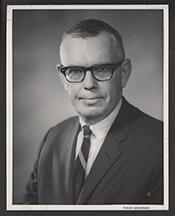
Here you will find contact information for Representative Gilbert Gude, including email address, phone number, and mailing address.
| Name | Gilbert Gude |
| Position | Representative |
| State | Maryland |
| District | 8 |
| Party | Republican |
| Status | Former Representative |
| Term Start | January 10, 1967 |
| Term End | January 3, 1977 |
| Terms Served | 5 |
| Born | March 9, 1923 |
| Gender | Male |
| Bioguide ID | G000513 |
About Representative Gilbert Gude
Gilbert Gude (March 9, 1923 – June 7, 2007) was an American politician who served as the U.S. representative for Maryland’s 8th congressional district from 1967 to 1977. A member of the Republican Party, he served five terms in the United States House of Representatives and contributed to the legislative process during a significant period in American history, representing the interests of his suburban Maryland constituents during the late 1960s and 1970s. He described himself as socially liberal on civil rights and moderate on economic policies, a stance that shaped his work in Congress and in earlier state offices.
Gude was born in Washington, D.C., and was educated in the public schools of Rockville, Maryland, and Washington. He attended the University of Maryland before transferring to Cornell University, where he obtained his Bachelor of Science degree in 1948. He later pursued graduate study in public administration, earning his Master of Arts degree from George Washington University in 1958. During World War II, from 1943 to 1946, Gude served in the Pacific Theater as a member of the United States Army Medical Department, an experience that preceded and informed his later interest in public service and governmental administration.
Following his military service and completion of his undergraduate education, Gude entered Maryland politics. He was appointed to the Maryland House of Delegates in January 1953 and subsequently elected to that body in 1954, serving until 1958. In 1952 he had been a delegate to the Republican State convention, and in 1958 he was elected to the Republican State Central Committee, deepening his involvement in party affairs. Gude advanced to the Maryland State Senate in 1962 and served there until 1967. During his tenure in state office, he sponsored legislation that led to the building of the Washington Metro system and became a leading figure in regional conservation efforts, particularly in the campaign to save the Chesapeake and Ohio Canal and to create the Chesapeake and Ohio Canal National Historical Park. He also emerged as an early and consistent supporter of home rule for the District of Columbia.
In 1966, Gude was elected as a Republican to the 90th Congress from Maryland’s 8th congressional district and was reelected to the four succeeding Congresses, serving from January 3, 1967, until January 3, 1977. His service in Congress occurred during a period marked by the Vietnam War, the civil rights movement, and significant environmental and urban policy debates. He voted in favor of the Civil Rights Act of 1968, reflecting his socially liberal stance on civil rights issues. In the 1970 election, he defeated Democratic challenger Thomas Hale Boggs Jr., who would later become a prominent lawyer and lobbyist in Washington, D.C., and who was the son of Gude’s House colleague, Representative Hale Boggs, and later Representative Lindy Boggs of Louisiana’s 2nd congressional district. Gude was a delegate to the Republican National Convention in 1968, further underscoring his prominence within his party. He chose not to be a candidate for reelection in 1976 to the 95th Congress, concluding a decade of service in the House.
During his time in the House of Representatives, Gude participated actively in committee work and policy development. He served on the Government Operations Committee and its Conservation, Energy, and Natural Resources Subcommittee, where his long-standing interest in environmental issues found legislative expression. He was involved in the House Environmental Study and served on the Franklin Delano Roosevelt Memorial Commission, reflecting his engagement with both environmental and historical preservation. Gude also served on the Select Committee on Aging and its Retirement Income and Employment Subcommittee, and on the House District of Columbia Committee and its Commerce, Housing and Transportation Subcommittee, where he continued to advocate for D.C. home rule and urban policy reforms. In 1972, he was a congressional observer at the United Nations Conference on the Human Environment in Stockholm, Sweden, aligning his domestic environmental concerns with emerging international discussions.
After leaving Congress in 1977, Gude continued his public service in a non-elective capacity. He became director of the Library of Congress’s Congressional Research Service (CRS), serving from 1977 to 1985, where he oversaw nonpartisan research and analysis for members of Congress and their staffs. His work at CRS reinforced his reputation as a thoughtful, policy-oriented legislator and administrator. Internationally, he served as a member and later chairman of the Consultative Committee of Experts of the International Centre for Parliamentary Documentation of the Inter-Parliamentary Union in Geneva, contributing to the development of parliamentary information resources worldwide. In academic life, he taught history and environmental courses at Georgetown University and served on the Board of Trustees of The Catholic University of America, extending his influence into higher education and public policy scholarship. His departure from elective office was noted by contemporaries on Capitol Hill; one observer remarked, “When you start losing the Gil Gudes, then Congress is in trouble,” reflecting the esteem in which he was held.
Gilbert Gude died on June 7, 2007, from congestive heart failure in Washington, D.C. He was survived by his wife, Jane, the daughter of U.S. Navy Vice Admiral William M. Callaghan; five children—Adrienne, Daniel, Sharon, Brett, and Gregory—and three grandchildren, Edward W. Lewis IV, Alexandra Morgan Lewis, and Michael Gude. His career in state and national politics, his leadership on environmental and transportation issues, and his later work in legislative research and education left a lasting imprint on Maryland, the Congress, and the institutions he served.