Representative Gil Gutknecht
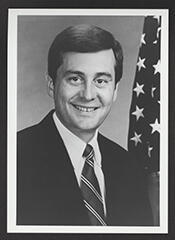
Here you will find contact information for Representative Gil Gutknecht, including email address, phone number, and mailing address.
| Name | Gil Gutknecht |
| Position | Representative |
| State | Minnesota |
| District | 1 |
| Party | Republican |
| Status | Former Representative |
| Term Start | January 4, 1995 |
| Term End | January 3, 2007 |
| Terms Served | 6 |
| Born | March 20, 1951 |
| Gender | Male |
| Bioguide ID | G000536 |
About Representative Gil Gutknecht
Gilbert William Gutknecht Jr. (born March 20, 1951) is an American former politician who represented Minnesota’s 1st congressional district in the United States House of Representatives from January 3, 1995, to January 3, 2007. A member of the Republican Party, he served six consecutive terms in Congress and was an active participant in the legislative process during a significant period in recent American political history.
Gutknecht was born in Cedar Falls, Iowa, and graduated from high school there in 1969. He was the first member of his extended family to attend college, enrolling at the University of Northern Iowa. He earned a degree in business from that institution in 1973. His early life in Iowa and his business education provided the foundation for a career that combined private enterprise, auctioneering, and public service.
After college, Gutknecht worked for a decade as a school supplies salesman. In 1978 he attended auction college, and in 1979 he conducted his first real estate auction, beginning a parallel career as an auctioneer. He later settled in Rochester, Minnesota, where he and his wife, Mary Catherine Keefe, have lived for more than 30 years. The couple has three grown children, and they are members of Pax Christi Catholic Church in Rochester, reflecting a long-standing connection to the local community he would later represent in the state legislature and in Congress.
Gutknecht entered elective office in 1983, when he was elected to the Minnesota House of Representatives. He served in the state legislature until 1994 and rose to a leadership position as Republican floor leader for three years. His tenure in the Minnesota House established his reputation as a conservative legislator and positioned him for a bid for national office when an open congressional seat became available in the mid-1990s.
In 1994, Gutknecht ran for the U.S. House of Representatives in Minnesota’s 1st congressional district, seeking the seat left open by the retirement of six-term Democratic–Farmer–Labor (DFL) Representative Tim Penny. Elected as part of the Republican wave of 1994, he signed the Contract with America during that campaign, which included support for a constitutional amendment to limit congressional terms to 12 years and the pledge, “If we ever break this contract, throw us out.” After his election, he pledged personally to serve no more than 12 years and in March 1995 drafted a bill that would bar House members from accruing additional pension benefits after six terms, stating that the purpose was to provide an incentive not to exceed 12 years in office. He voted in 1995 for a proposed constitutional amendment to impose term limits, which failed to secure the required two-thirds majority in the House following the Supreme Court’s decision in U.S. Term Limits, Inc. v. Thornton that state-imposed congressional term limits were unconstitutional.
During his twelve years in Congress, Gutknecht served in the 104th, 105th, 106th, 107th, 108th, and 109th Congresses. He held several key committee assignments, including chair of the House Agriculture Subcommittee on Operations Oversight, Nutrition and Forestry, vice chair of the House Science Committee, and membership on the House Government Reform Committee. He was considered one of the more conservative members of the Minnesota delegation in the 109th Congress, receiving a 92 percent conservative rating from a conservative organization and a 7 percent progressive rating from a liberal group. At times he took positions that diverged from his party’s leadership, including being the only Minnesota Republican to vote against the Central American Free Trade Agreement, citing the interests of sugar beet growers in his district, and sponsoring legislation to legalize the importation of prescription drugs from other countries despite opposition from the Food and Drug Administration and the White House; the drug import provision passed the House but was removed from the final legislation.
Gutknecht’s congressional career also included notable episodes of intra-party dissent and public controversy. In January 2006, in the wake of the Jack Abramoff lobbying scandal, he called for new elections for all House Republican leadership posts except the speakership, arguing that Republicans needed to regain the trust of the American people. In mid-2006, after returning from a trip to Iraq, he stated that the United States should partially withdraw its troops from that country, again differing from the position of the Republican administration. Earlier, in April 1995, the journal Science quoted his legislative aide Brian Harte as predicting that the federal effort to study AIDS based on the HIV/AIDS link “will be seen as the greatest scandal in American history and will make Watergate look like a no-fault divorce,” a remark that drew attention to his office’s stance on federal AIDS research policy. In August 2002, he publicly supported expansion plans by the Dakota, Minnesota and Eastern Railroad, despite opposition from many constituents in Mankato and Rochester who were concerned about noise and traffic impacts.
Over the course of his six successful House campaigns, Gutknecht consistently won reelection by comfortable margins before his eventual defeat. In the 1996 race for the U.S. House of Representatives in the 1st District, he defeated DFL candidate Mary Rieder, 53 percent to 47 percent. In 1998 he was reelected with 55 percent of the vote against DFL nominee Tracy Beckman, who received 45 percent. In 2000 he again faced Mary Rieder and prevailed 57 percent to 42 percent. In 2002 he won 61 percent of the vote against DFL candidate Steve Andreasen, who received 35 percent, while Green Party candidate Gregg Mikkelson took 4 percent. In 2004 he was reelected with 60 percent of the vote over DFL candidate Leigh Pomeroy, who received 35 percent, and independent candidate Greg Mikkelson, who received 5 percent. Throughout his congressional career he typically filed for office by submitting petitions rather than paying the $300 filing fee, which he described as a more fiscally conservative approach.
Gutknecht’s 2006 reelection campaign was marked by renewed scrutiny of his earlier term-limit pledge and by legal and media controversies. By November 1999 he had stated he was not sure he would personally abide by his recommendation that legislators serve no more than 12 years, saying he still supported term limits in principle but noting that the issue was no longer prominent with the public. According to the Associated Press, he “backtracked” from his 1995 pledge in May 2004, arguing that voters should decide how long a member serves, and in March 2005 he announced he would run for a seventh term. During a March 2006 appearance before College Republicans and other students at Minnesota State University, Mankato, he compared their role in the 2006 elections to that of Minnesota’s 1st Regiment at the Battle of Gettysburg, saying, “We’re asked to stand in that gap and there are big stakes in this election. And remember, had we lost the Battle of Gettysburg, we might have lost the war.” In August 2006, a legal challenge was filed with the Minnesota Supreme Court by Louis Reiter of Elgin, Minnesota, prepared by DFL election attorney Alan Weinblatt, seeking to disqualify Gutknecht from the primary ballot on the grounds that most of his petition signatures were gathered outside an alleged July 4–18, 2006 time window. Gutknecht had filed his petitions on July 5, 2006, the first day allowed, and had not previously faced such a challenge; the state Supreme Court heard the case on August 22, 2006, and denied the attempt to remove his name from the ballot the same day.
The 2006 campaign also drew attention to his office’s interaction with online information sources. On August 17, 2006, WCCO-TV in Minneapolis reported that members of Gutknecht’s campaign staff had edited his Wikipedia article, replacing portions of the entry with his official congressional biography and removing references to his term-limit pledges. The report noted that his office had used the account “Gutknecht01” in an earlier attempt to edit the article on July 24, and that the account had been notified via its talk page of Wikipedia policies discouraging self-editing by subjects or their staff. In the September 12, 2006 Republican primary, Gutknecht defeated challenger Gregory Mikkelson by a margin of 87 percent to 13 percent. In the general election on November 7, 2006, however, he was defeated by DFL candidate Tim Walz, who received 53 percent of the vote to Gutknecht’s 47 percent. His term in Congress concluded in January 2007, ending twelve years of service in the U.S. House of Representatives. Asked after the election about a possible return to politics, he likened the experience to a grueling childbirth, saying, “That’s a little like asking a woman who’s just come out of a 38-hour labor and delivered a 12-pound baby, ‘Well, don’t you want to get pregnant again?’ Not today.”
In the years since leaving office, Gutknecht has remained a public figure associated with his record as a conservative Republican legislator from Minnesota, his leadership roles on agricultural and science-related committees, and his sometimes independent positions on trade, prescription drug policy, party leadership, and U.S. involvement in Iraq. He and his family have continued to reside in Rochester, Minnesota, maintaining the community ties that preceded and underpinned his political career.