Senator Gilman Marston
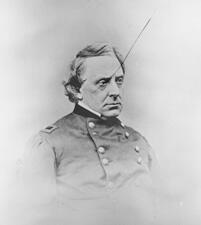
Here you will find contact information for Senator Gilman Marston, including email address, phone number, and mailing address.
| Name | Gilman Marston |
| Position | Senator |
| State | New Hampshire |
| Party | Republican |
| Status | Former Representative |
| Term Start | December 5, 1859 |
| Term End | December 31, 1889 |
| Terms Served | 4 |
| Born | August 20, 1811 |
| Gender | Male |
| Bioguide ID | M000165 |
About Senator Gilman Marston
Gilman Marston (August 20, 1811 – July 3, 1890) was a United States Representative, Senator, and United States Army general from New Hampshire. He was born in Orford, Grafton County, New Hampshire, where he spent his early years before pursuing higher education. He attended local schools and prepared for college in New Hampshire before enrolling at Dartmouth College in Hanover. Marston graduated from Dartmouth in 1837, laying the foundation for a career that would combine law, politics, and military service during one of the most turbulent periods in American history.
Following his graduation from Dartmouth, Marston studied law at the law department of Harvard University, from which he graduated in 1840. He was admitted to the bar in 1841 and commenced the practice of law in Exeter, New Hampshire, which would remain his home for much of his professional life. His legal practice quickly led him into public affairs. Marston served as a member of the New Hampshire House of Representatives from 1845 to 1849, gaining early legislative experience and establishing himself as a prominent figure in state politics. In 1850 he was a delegate to the New Hampshire constitutional convention, participating in efforts to revise and refine the state’s fundamental law.
Marston’s national political career began with his election as a Republican to the Thirty-sixth and Thirty-seventh Congresses, serving as a United States Representative from New Hampshire from March 4, 1859, to March 3, 1863. His service in Congress occurred during a significant period in American history, as the nation moved toward and then into civil war. As a member of the House of Representatives, he participated in the democratic process, represented the interests of his New Hampshire constituents, and emerged as a strong supporter of President Abraham Lincoln and the Union war effort. A member of the Republican Party, he contributed to the legislative process during four terms in office over the course of his congressional career, which would span both the prewar and Reconstruction eras.
With the outbreak of the Civil War, Marston entered military service while still a sitting member of Congress. He was commissioned colonel of the 2nd New Hampshire Volunteer Infantry and first saw combat at the First Battle of Bull Run in July 1861, where his arm was shattered in action. He refused amputation and, after recovering from his wounds, returned to the field. Marston and his regiment participated in the Peninsula Campaign, the Second Battle of Bull Run, and the Battle of Fredericksburg. He was promoted to brigadier general of United States Volunteers, effective November 29, 1862. Prior to the Chancellorsville Campaign, he was relieved from duty with the Army of the Potomac and assigned to the defenses of Washington, D.C., which allowed him to resume his seat in Congress while still holding military command.
After the Battle of Gettysburg in 1863, Marston was directed to establish a prison camp for Confederate prisoners of war in Maryland, a facility that became known as Point Lookout. The area was designated the District of Saint Mary’s and operated under the overall command of Major General Benjamin Butler, with Marston playing a central role in organizing and administering the camp. In 1864 he returned to field operations, commanding a brigade in Major General William F. “Baldy” Smith’s XVIII Corps during the Bermuda Hundred Campaign. He took part in the assault on Cold Harbor, where his brigade suffered heavy casualties. During the initial Union assaults on Petersburg, Marston assumed command of the 1st Division of the XVIII Corps on the last day of battle. Thereafter he commanded Union troops on the north side of the James River, with his headquarters at Fort Pocahontas, and he occasionally returned to command of the 1st Division, including a brief period during the Second Battle of Fair Oaks. Having been re-elected to Congress, he resigned his military commission in 1865, receiving the formal thanks of the state of New Hampshire for his wartime service.
Marston resumed full-time legislative work when he was elected again as a Republican to the Thirty-ninth Congress, serving from March 4, 1865, to March 3, 1867. In this postwar term he participated in the early phases of Reconstruction policy-making while continuing to represent New Hampshire’s interests at the national level. In 1870 he declined an appointment as Governor of Idaho Territory, choosing instead to remain in New England. He continued to play an active role in New Hampshire politics, returning to the New Hampshire House of Representatives in 1872, 1873, and again from 1876 to 1878. During this period he also served as a delegate to the state constitutional convention of 1876, further extending his long record of involvement in state constitutional and legislative affairs. He was an unsuccessful Republican candidate for election to the Forty-fifth Congress in 1876, marking one of the few electoral setbacks in a long public career.
In the closing phase of his public life, Marston briefly served in the United States Senate. On March 4, 1889, he was appointed as a Senator from New Hampshire to fill the vacancy in the term commencing on that date, and he served until June 18, 1889, when a successor was elected and qualified. His service in the Senate, though short, capped a congressional career that had begun three decades earlier and had encompassed both the House of Representatives and the upper chamber during a transformative era in American political history. Gilman Marston died in Exeter, New Hampshire, on July 3, 1890. He was interred in Exeter Cemetery, closing a life marked by sustained service as a lawyer, legislator, and Union general.