Representative Glen Dale Johnson
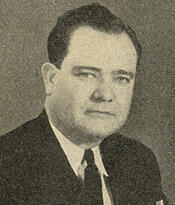
Here you will find contact information for Representative Glen Dale Johnson, including email address, phone number, and mailing address.
| Name | Glen Dale Johnson |
| Position | Representative |
| State | Oklahoma |
| District | 4 |
| Party | Democratic |
| Status | Former Representative |
| Term Start | January 3, 1947 |
| Term End | January 3, 1949 |
| Terms Served | 1 |
| Born | September 11, 1911 |
| Gender | Male |
| Bioguide ID | J000133 |
About Representative Glen Dale Johnson
Glen Dale Johnson (September 11, 1911 – February 10, 1983) was an American World War II veteran, lawyer, and Democratic politician who served as a member of the United States House of Representatives from Oklahoma for one term from 1947 to 1949. His service in Congress occurred during a significant period in American history, in the early post–World War II era, when he contributed to the legislative process and represented the interests of his constituents in Oklahoma’s 4th Congressional District.
Johnson was born in Melbourne, a small town in Izard County, Arkansas, on September 11, 1911, the son of Willie and Jeffie Johnson. In 1920, when he was still a child, his family relocated to Paden, Oklahoma. There he attended the public schools, laying the foundation for his later professional and political career. Growing up in rural Oklahoma during the interwar years, he was shaped by the economic and social conditions of the time, which would later inform his public service.
Pursuing higher education and a legal career, Johnson enrolled at the University of Oklahoma Law School in Norman. He graduated in 1939 and was admitted to the bar that same year. Immediately after his admission, he began the practice of law in Okemah, Oklahoma. His early legal work in Okemah established him as a practicing attorney in the community and provided him with experience that would prove valuable in both state and national public office.
Johnson entered elective politics in 1940, when he was elected to the Oklahoma House of Representatives. He was re-elected in 1942, demonstrating growing support among his constituents. However, following the Japanese attack on Pearl Harbor and the U.S. entry into World War II, he resigned from the Oklahoma House in January 1942 to enlist in the United States Army. While serving in the Army, he returned to Okemah on a three-day pass to marry Imogene Storms on December 5, 1942. He entered the Army as a private and served throughout the war, ultimately being discharged in May 1946 with the rank of captain. After his discharge, he returned to Oklahoma and resumed his law practice in Okemah.
In 1946, Johnson sought national office and ran for Congress as a Democrat from Oklahoma’s 4th Congressional District. In the Democratic primary he defeated the incumbent, Lyle Boren, and went on to win the general election. He served in the U.S. House of Representatives from January 3, 1947, to January 3, 1949. During his single term in Congress, he participated in the democratic process at the federal level and contributed to the legislative work of the House during the early years of the postwar period. Although he considered running for re-election to the House in 1948, he instead chose to seek the Democratic nomination for the United States Senate. After losing that nomination, he retired from Congress at the conclusion of his term in January 1949.
Following his departure from Congress, Johnson continued a career in law and public service. In 1949 and 1950, he served as a neutral arbitrator for the National Mediation Board, working in the resolution of labor disputes. He later joined the U.S. Department of the Interior in Washington, D.C., serving as an attorney in the Office of the Solicitor from 1961 to 1967. From 1967 to 1969, he was chairman of the Oil Import Appeals Board, representing the Department of the Interior in matters related to federal oil import policy. Afterward, from 1969 to 1972, he served as an attorney in the Solicitor’s Office of the Department of the Interior, assigned to the Muskogee, Oklahoma, field office. After completing this period of federal service, he relocated back to Okemah, Oklahoma, where he continued to reside.
Johnson’s family also became prominent in Oklahoma public life. He and his wife Imogene had a son, Glen D. Johnson Jr., who went on to serve as the youngest Speaker of the Oklahoma House of Representatives. Glen D. Johnson Jr. later pursued a distinguished career in higher education, serving for ten years as president of Southeastern Oklahoma State University and then as chancellor of Oklahoma’s state system of higher education. Glen Dale Johnson’s death came just three weeks after his son was sworn in as a member of the Oklahoma House of Representatives, marking a poignant intersection of their public service.
Glen Dale Johnson died of congestive heart failure in Okemah, Okfuskee County, Oklahoma, on February 10, 1983. He was remembered as a World War II veteran, a practicing lawyer, a state legislator, and a one-term member of the United States House of Representatives who participated in the governance of Oklahoma and the nation during a transformative period in the mid-twentieth century.