Representative Glenard Paul Lipscomb
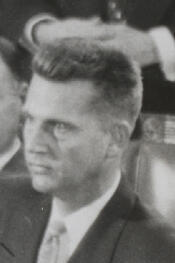
Here you will find contact information for Representative Glenard Paul Lipscomb, including email address, phone number, and mailing address.
| Name | Glenard Paul Lipscomb |
| Position | Representative |
| State | California |
| District | 24 |
| Party | Republican |
| Status | Former Representative |
| Term Start | January 3, 1953 |
| Term End | January 3, 1971 |
| Terms Served | 9 |
| Born | August 19, 1915 |
| Gender | Male |
| Bioguide ID | L000344 |
About Representative Glenard Paul Lipscomb
Glenard Paul (Glen) Lipscomb (August 19, 1915 – February 1, 1970) was a United States Congressman from the state of California, serving as a Republican Representative in the United States House of Representatives from 1953 to 1970. Over the course of nine terms in office, he contributed to the legislative process during a significant period in American history, participating in the democratic process and representing the interests of his California constituents.
Lipscomb was born in Jackson, Michigan, on August 19, 1915. In 1920 he moved with his parents to California, where the family settled in Los Angeles. He was educated in the Los Angeles public schools and attended Belmont High School. During his years at Belmont he met his future wife, Virginia Sognalian, who was a classmate. After high school, Lipscomb pursued further education at the University of Southern California and at Woodbury College (now Woodbury University, located in Burbank, California). He trained in business and accounting, and upon completion of his studies he became an accountant, a profession that would later inform his work in public finance and government service.
During World War II, Lipscomb served in the United States Army, where he was assigned to the Army’s Finance Corps. His wartime service in military financial administration provided him with practical experience in budgeting and fiscal management at a national level. After the war, he returned to California and entered public life. In 1947 he was elected to the California State Assembly from the 56th district. He served in the State Assembly from 1947 until 1953, building a reputation as a fiscally minded legislator and gaining experience in state-level policymaking that would serve as a foundation for his subsequent congressional career.
In 1953, following the election of Representative Norris Poulson as mayor of Los Angeles, a special election was held to fill the vacancy in California’s 24th congressional district. Lipscomb won that special election and entered the U.S. House of Representatives as a Republican, beginning a congressional tenure that would last until his death in 1970. As a member of the House of Representatives during the Cold War, the civil rights era, and a period of rapid economic and social change, he participated actively in the legislative process and represented his district’s interests in national debates. His background in accounting and finance contributed to his work on fiscal and defense-related matters, and he became identified with a generally conservative Republican approach to federal spending and national security.
Lipscomb’s voting record on civil rights legislation reflected both support for certain key measures and opposition to others. He voted in favor of the Civil Rights Acts of 1957 and 1960, early federal efforts to protect voting rights and strengthen civil rights enforcement. He also supported the Twenty-fourth Amendment to the United States Constitution, which prohibited the use of poll taxes in federal elections, and he voted for the Voting Rights Act of 1965, a landmark statute that sought to eliminate racial discrimination in voting. At the same time, he voted against the Civil Rights Act of 1964 and the Civil Rights Act of 1968, major pieces of legislation addressing discrimination in public accommodations, employment, and housing. Throughout his nine terms, he continued to serve in the House, remaining in office for the rest of his life and contributing to congressional deliberations on domestic policy, defense, and the federal budget.
Lipscomb’s congressional service ended with his death in office. He died of cancer at Bethesda Naval Hospital in Bethesda, Maryland, on February 1, 1970, at the age of 54, while still representing California in the U.S. House of Representatives. His death placed him among the members of the United States Congress who died in office between 1950 and 1999. He was interred at Forest Lawn Memorial Park in Hollywood Hills, California. In recognition of his service, the U.S. Navy named the submarine USS Glenard P. Lipscomb in his honor. For a period of time, a Boy Scouts of America camp near Big Bear Lake, California, was also named Camp Lipscomb, further commemorating his public career and regional influence.