Representative Gloria Negrete McLeod
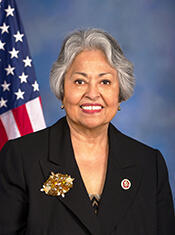
Here you will find contact information for Representative Gloria Negrete McLeod, including email address, phone number, and mailing address.
| Name | Gloria Negrete McLeod |
| Position | Representative |
| State | California |
| District | 35 |
| Party | Democratic |
| Status | Former Representative |
| Term Start | January 3, 2013 |
| Term End | January 3, 2015 |
| Terms Served | 1 |
| Born | September 6, 1941 |
| Gender | Female |
| Bioguide ID | N000187 |
About Representative Gloria Negrete McLeod
Gloria Negrete McLeod (born September 6, 1941) is an American politician who served as the United States representative for California’s 35th congressional district from 2013 to 2015. A member of the Democratic Party, she represented a district that included portions of eastern Los Angeles County and western San Bernardino County during one term in the U.S. House of Representatives. Her congressional service took place during a significant period in American political history, in which she participated in the legislative process and represented the interests of her constituents in the Inland Empire region of Southern California.
Negrete McLeod was born in 1941 in Los Angeles, California. She later attended Chaffey College, a community college in the region, and remained closely connected to the institution throughout her career. She served as a member of the Chaffey Community College Board of Trustees for five years and rose to become president of the board. After her tenure in Congress, she returned to local educational governance and was reelected to the Chaffey Community College board in 2015, underscoring her long-standing commitment to higher education and workforce preparation in her community. A long-time resident of Chino, California, she and her family have been deeply rooted in the communities she later represented in state and federal office.
Negrete McLeod’s formal entry into electoral politics came in the late 1990s. In 1998, she ran for the 61st District in the California State Assembly after incumbent Republican Fred Aguiar was term-limited. In that open primary, she lost the Democratic vote to Nell Soto, 53 percent to 47 percent. Undeterred, she ran again for the same Assembly seat in 2000. In the seven-candidate open primary, she ranked first with 28 percent of the overall vote and 62 percent of the Democratic vote, while Republican Dennis Yates won the Republican vote with 35 percent and 19 percent of the overall vote, qualifying for the general election. In November 2000, she defeated Yates by a margin of 54 percent to 43 percent. She was reelected in 2002, defeating Republican Matt Munson 62 percent to 38 percent, and again in 2004, when she defeated Republican Alan Wapner, an Ontario City Council member, by 64 percent to 36 percent. During her Assembly tenure from 2000 to 2006, she chaired the Committee on Business and Professions and the Committee on Public Employees, and she sponsored legislation to ban age discrimination. In late 2006, she cast a key vote in favor of same-sex marriage, reflecting her support for expanding civil rights protections.
With Assembly term limits approaching, Negrete McLeod sought a seat in the California State Senate. In 2006, she decided to run for the 32nd Senate District after incumbent Democrat Nell Soto was prevented from seeking reelection due to term limits. In the Democratic primary, she defeated Assemblyman Joe Baca Jr. by a margin of 61 percent to 39 percent and then won the November general election unopposed. She was reelected to a second term in 2010 with 68 percent of the vote. The 32nd Senate District stretched over parts of San Bernardino and Los Angeles Counties; in San Bernardino County, she represented the cities of Chino, Colton, Fontana, Montclair, Ontario, Rialto, and San Bernardino, and in Los Angeles County she represented the city of Pomona. In the Senate, she served on several key committees, including Budget and Fiscal Review; Business, Professions and Economic Development; the Legislative Ethics Committee; the Master Plan for Higher Education Committee (as vice chair); the Public Employment and Retirement Committee (as chair); the Sunset Review Committee; and the Veterans Affairs Committee. She was actively involved in efforts to clean up groundwater contamination and focused on ensuring a reliable water supply for her region. In December 2009, the California political periodical Capitol Weekly gave her an ideological score of 49, identifying her as one of the more moderate Democrats in the legislature, even as organizations such as NARAL Pro-Choice America of California and Planned Parenthood of California awarded her perfect 100 ratings in 2012, 2013, 2014, and other years for her positions on reproductive rights.
Negrete McLeod’s transition to national office was shaped by redistricting following the 2010 census. In June 2011, after learning that the California Citizens Redistricting Commission had drawn a new congressional district that was virtually coextensive with her state senate district, she announced her intention to run for the newly created 35th congressional district, declaring, “I’m in, I’m in, I’m in, I’m in. There’s nobody there,” referring to the absence of an incumbent residing in the district. She officially announced her candidacy on September 6, 2011. In the 2012 open primary, she faced Congressman Joe Baca, whose home was in the 31st District but whose former 43rd District overlapped significantly—about 60 percent—with the new 35th. In that primary, Baca placed first with 45 percent of the vote, Negrete McLeod placed second with 36 percent, and Green Party candidate Anthony Vieyra received 19 percent. In the general election, New York City Mayor Michael Bloomberg’s Independence USA PAC spent more than $5 million in support of her candidacy. In November 2012, she defeated Baca Sr. by a margin of 56 percent to 44 percent, securing a seat in the U.S. House of Representatives.
From January 3, 2013, to January 3, 2015, Negrete McLeod served one term in the 113th Congress as the representative for California’s 35th congressional district. During this period, she participated in the national legislative process at a time marked by debates over economic recovery, health care implementation, and federal budget policy. She served on the House Committee on Agriculture, where her assignments included the Subcommittee on Conservation, Energy, and Forestry; the Subcommittee on Department Operations, Oversight, and Nutrition; and the Subcommittee on General Farm Commodities and Risk Management. She also served on the House Committee on Veterans’ Affairs, including the Subcommittee on Disability Assistance and Memorial Affairs and the Subcommittee on Health, reflecting her interest in issues affecting military veterans and their families. As a member of Congress, she continued to represent the interests of constituents in the Inland Empire and eastern Los Angeles County, drawing on her extensive experience in state and local government.
In February 2014, Negrete McLeod announced that she would not seek reelection to Congress in order to run for the San Bernardino County Board of Supervisors. Her decision marked a shift from federal to county-level governance, consistent with her long-standing engagement in local and regional issues. In the November 2014 election, she was defeated by Republican state Assemblyman Curt Hagman. Following this race, she remained active in public and community affairs, including her renewed service on the Chaffey Community College Board of Trustees beginning in 2015, continuing her advocacy for education, public service, and regional development.
Negrete McLeod’s personal life has been closely intertwined with her public service. She is married to Gilbert L. McLeod, a retired police lieutenant. Together they have raised a large family, with 10 children, 27 grandchildren, and 18 great-grandchildren. Her long career in public office—from local education governance to the California State Assembly and Senate, and ultimately the U.S. House of Representatives—has reflected both her deep roots in the communities of San Bernardino and Los Angeles Counties and her sustained engagement with issues ranging from civil rights and public employees to water quality, veterans’ affairs, and higher education.