Representative Goldsmith Whitehouse Hewitt
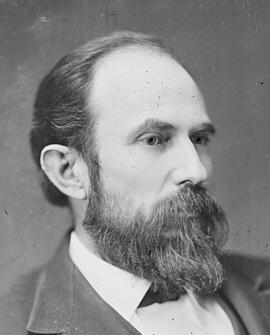
Here you will find contact information for Representative Goldsmith Whitehouse Hewitt, including email address, phone number, and mailing address.
| Name | Goldsmith Whitehouse Hewitt |
| Position | Representative |
| State | Alabama |
| District | 6 |
| Party | Democratic |
| Status | Former Representative |
| Term Start | December 6, 1875 |
| Term End | March 3, 1885 |
| Terms Served | 4 |
| Born | February 14, 1834 |
| Gender | Male |
| Bioguide ID | H000553 |
About Representative Goldsmith Whitehouse Hewitt
Goldsmith Whitehouse Hewitt (February 14, 1834 – May 27, 1895) was a Democratic U.S. Representative from Alabama who served four terms in the United States Congress between 1875 and 1885. His congressional career unfolded during a significant period in American history, as the nation navigated the aftermath of the Civil War and the end of Reconstruction, and he played a role in representing the interests of his Alabama constituents in the federal legislature.
Hewitt was born near Elyton, in Jefferson County, Alabama—an area that later became part of Birmingham—on February 14, 1834. He attended local country schools in rural Jefferson County, receiving a basic education typical of the region and era. His early life in what was then a largely agrarian community helped shape his familiarity with the concerns of Alabama’s citizens, particularly those in and around the developing industrial center that Birmingham would later become.
With the outbreak of the Civil War, Hewitt entered the Confederate States Army in June 1861 as a private in Company B, 10th Regiment Alabama Infantry. He saw active service and, in 1862, was promoted to captain of Company G, 28th Regiment Alabama Infantry. His rise from private to captain reflected both his commitment and his leadership capabilities during the conflict. The experience of military service during the war would later inform his public life in a state and region deeply affected by the conflict and its consequences.
After the war, Hewitt turned to the study of law. He enrolled at the Cumberland School of Law at Cumberland University in Lebanon, Tennessee, from which he graduated in 1866. That same year he was admitted to the bar and commenced the practice of law in Birmingham, Alabama. Establishing himself as an attorney in a city that was beginning to grow as an industrial and commercial center, he entered professional life at a moment when Alabama was undergoing political, economic, and social reconstruction.
Hewitt’s political career began at the state level. He served as a member of the Alabama House of Representatives in 1870 and 1871, participating in state governance during the turbulent Reconstruction era. He then advanced to the Alabama State Senate, serving from 1872 until 1874, when he resigned. These early legislative roles provided him with experience in lawmaking and public policy and positioned him for election to national office as federal authority and local control were being renegotiated throughout the South.
Elected as a Democrat to the Forty-fourth and Forty-fifth Congresses, Hewitt served in the U.S. House of Representatives from March 4, 1875, to March 3, 1879. After a brief interval out of office, he was again elected as a Democrat to the Forty-seventh and Forty-eighth Congresses, serving from March 4, 1881, to March 3, 1885. In total, he served four terms in the House of Representatives, contributing to the legislative process during a decade marked by debates over Reconstruction’s legacy, veterans’ affairs, economic development, and the reintegration of Southern states into national political life. During the Forty-eighth Congress, he served as chairman of the Committee on Pensions, a position that placed him at the center of legislative deliberations concerning benefits for veterans and their families. He was not a candidate for renomination in 1884, bringing his congressional service to a close at the end of his fourth term.
Following his departure from Congress, Hewitt resumed the practice of law in Birmingham. He remained active in public affairs and again served as a member of the Alabama House of Representatives from 1886 to 1888, continuing his involvement in state politics and legislation even after his federal service had ended. His later career reflected an ongoing commitment to representing Alabama’s interests during a period of industrial growth and political realignment in the post-Reconstruction South.
Goldsmith Whitehouse Hewitt died in Birmingham, Alabama, on May 27, 1895. He was interred in Oak Hill Cemetery in Birmingham. His life encompassed service as a Confederate officer, attorney, state legislator, and four-term Democratic member of the U.S. House of Representatives, and his career reflected the broader transformations of Alabama and the South in the latter half of the nineteenth century.