Representative Graham Purcell
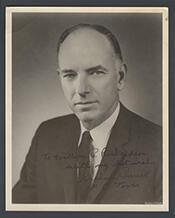
Here you will find contact information for Representative Graham Purcell, including email address, phone number, and mailing address.
| Name | Graham Purcell |
| Position | Representative |
| State | Texas |
| District | 13 |
| Party | Democratic |
| Status | Former Representative |
| Term Start | January 3, 1962 |
| Term End | January 3, 1973 |
| Terms Served | 6 |
| Born | May 5, 1919 |
| Gender | Male |
| Bioguide ID | P000569 |
About Representative Graham Purcell
Graham Boynton Purcell Jr. (May 5, 1919 – June 11, 2011) was a United States Representative from Texas’s 13th congressional district and a longtime public servant in North Texas. He was born in Archer City, Archer County, Texas, a rural community that later became part of the Wichita Falls metropolitan statistical area. Raised in Archer City, he attended local public schools before entering higher education. His early years in this predominantly agricultural region helped shape his later interest in rural and agricultural issues in Congress.
Purcell’s education was interrupted by World War II. He entered the United States Army in 1941 and served on active duty through 1946. Following his wartime service, he remained in the United States Army Reserve. After leaving active duty, he enrolled at the Agricultural and Mechanical College of Texas (now Texas A&M University), where he received a Bachelor of Science degree in 1946. He then pursued legal studies at Baylor Law School in Waco, Texas, earning his LL.B. in 1949. Upon admission to the bar, he began practicing law in Wichita Falls, establishing himself professionally in the same region where he had grown up.
Purcell’s legal career led him into the judiciary and then into elective office. In 1955 he was appointed and subsequently served as judge of the Eighty-ninth Judicial District Court of Texas, a position he held until 1962. During this period he gained a reputation for diligence and fairness on the bench. His growing prominence within the Democratic Party was reflected in his selection as a delegate to the 1960 and 1964 Democratic National Conventions, held in Los Angeles, California, and Atlantic City, New Jersey, respectively. At those conventions he participated in the nomination of the Kennedy–Johnson and Johnson–Humphrey presidential tickets, both of which carried Texas in the general elections.
Purcell entered Congress through a special election to the Eighty-seventh Congress, held to fill the vacancy created by the resignation of Representative Frank N. Ikard, a fellow Democrat from Texas’s 13th district. He took his seat on January 27, 1962, and was subsequently reelected to the five succeeding Congresses, serving continuously until January 3, 1973. During his tenure, he represented a largely rural and small-city constituency in North Texas, with Wichita Falls as a principal population center. In the 1966 general election, held the same year Republican John Tower won a second term to the United States Senate from Texas, Purcell successfully defended his seat against Republican challenger Dillard Carlisle “Bunny” Norwood (1913–1993) of Wichita Falls, underscoring his electoral strength in a district that was beginning to experience the broader partisan realignments of the era.
Purcell’s congressional service coincided with a period of significant national upheaval, including the civil rights movement and the escalation of the Vietnam War. On November 22, 1963, he was riding in the presidential motorcade in Dallas, Texas, in the third vehicle behind President John F. Kennedy when the President was assassinated. His presence in the motorcade placed him among the firsthand congressional witnesses to one of the most consequential events in modern American history. Throughout his time in the House, he was identified with the conservative wing of the Democratic Party typical of much of Texas at the time, and he focused on issues important to his district, including agriculture, rural development, and military installations in North Texas.
The 1970 Census and subsequent redistricting dramatically altered Purcell’s political fortunes. Although Texas gained an additional seat in the House of Representatives, the 13th District that he had long represented was dismantled. His home base of Wichita Falls was merged with much of the Panhandle-based 18th District represented by Republican Bob Price for the 1972 elections. The reconfigured district retained the numerical designation of the 13th, but geographically and politically it more closely resembled Price’s former district. As a result, Purcell retained only about one-third of his former constituents. Forced to campaign in largely unfamiliar territory against an incumbent Republican well known in the Panhandle, Purcell was defeated by approximately nine percentage points in the 1972 general election, ending his congressional career.
After leaving Congress, Purcell returned to private life in Wichita Falls, where he continued to be a respected figure in the community and in Texas Democratic circles. His long service was formally recognized by Congress in 1993, when House bill H.R. 2292 was enacted, designating the federal building in Wichita Falls as the Graham B. Purcell Jr. Post Office and Federal Building. He resided in Wichita Falls for the remainder of his life. Purcell died there on June 11, 2011, at the age of ninety-two, leaving a legacy as a World War II veteran, jurist, and six-term member of the United States House of Representatives from North Texas.