Representative Greg Laughlin
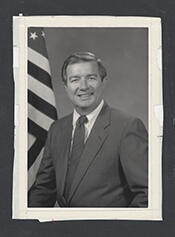
Here you will find contact information for Representative Greg Laughlin, including email address, phone number, and mailing address.
| Name | Greg Laughlin |
| Position | Representative |
| State | Texas |
| District | 14 |
| Party | Republican |
| Status | Former Representative |
| Term Start | January 3, 1989 |
| Term End | January 3, 1997 |
| Terms Served | 4 |
| Born | January 21, 1942 |
| Gender | Male |
| Bioguide ID | L000119 |
About Representative Greg Laughlin
Gregory Haines Laughlin (born January 21, 1942) is an American politician and attorney from Texas who served as a Representative from Texas in the United States Congress from 1989 to 1997. Over four terms in office, he contributed to the legislative process during a significant period in American history, participating in the democratic process and representing the interests of his constituents. Initially elected as a conservative Democrat and later serving as a Republican, he is a former member of the United States House of Representatives.
Laughlin was born in Bay City, Texas, and raised in West Columbia, Texas, where he has maintained a residence. Details of his early family life are not widely documented, but his upbringing in small-town Texas helped shape his political identity as a conservative Democrat with strong ties to his community. His early years in Brazoria County placed him in the heart of a region that would later form a substantial part of his political base.
Laughlin attended Texas A&M University, from which he graduated before beginning his professional and military careers. Following his university education, he entered the United States Army, serving on active duty from 1968 to 1970 during the Vietnam War era. After his active-duty service, he continued his military involvement as a reservist, ultimately rising to the rank of colonel in the U.S. Army Reserve. His military experience would later distinguish him in Congress, particularly during the Gulf War period.
After completing his active military service, Laughlin pursued a career in law in Texas. He served for four years as an assistant district attorney in Houston, gaining prosecutorial and courtroom experience in one of the state’s largest metropolitan areas. Following his tenure in the district attorney’s office, he returned to private practice, building a legal career that combined criminal and civil work. By the mid-1980s, he was an established attorney in Texas, which provided both professional credentials and community standing as he moved into electoral politics.
A conservative Democrat at the outset of his political career, Laughlin first ran for the United States House of Representatives in 1986. He sought election from a district in southeast Texas but narrowly lost to freshman Republican Mac Sweeney, a former aide in the Ronald Reagan White House. Undeterred, Laughlin mounted a rematch in 1988. In that campaign he successfully unseated Sweeney, winning election to the 101st Congress and taking office on January 3, 1989. He survived a bitter re-election campaign in the next cycle, overcoming controversy related to old allegations involving favoritism to a firm, and was returned to office by his constituents.
Laughlin’s service in Congress from 1989 to 1997 coincided with major national and international developments, including the end of the Cold War and the Gulf War. During Operation Desert Storm in 1991, he was called to active duty as a colonel in the U.S. Army Reserve, making him the only member of Congress to see active duty during that conflict. This dual role as legislator and military officer underscored his commitment to national defense and gave him a unique perspective among his colleagues. Throughout his early congressional tenure, he served as a Democrat, generally reflecting the conservative leanings of his district while participating in the broader legislative work of the House of Representatives.
The political landscape shifted dramatically after the 1994 midterm elections, when the Republican Party gained a majority in the House of Representatives for the first time in four decades. In this new environment, Republican leaders sought to attract conservative Democrats from traditionally Democratic regions. In 1995, House Republican leadership offered Laughlin a seat on the influential House Ways and Means Committee if he joined the GOP. On June 26, 1995, he formally switched parties and became a Republican. Laughlin stated that, as a Democrat, he had been forced to cast some difficult votes that did not fully align with his conservative views, and the party switch was presented as a reflection of his ideological orientation as well as the changing political character of his district.
In the 1996 election cycle, Laughlin sought re-election as a Republican. He received high-profile endorsements from leading Republican figures, including Texas Governor George W. Bush, Speaker of the House Newt Gingrich, and other party leaders from both inside and outside Texas. Despite this establishment support, he faced a strong primary challenge from former Texas Republican Congressman Ron Paul, who had been the Libertarian Party’s presidential candidate in 1988, as well as from Jim Deats, Laughlin’s Republican opponent from 1994, when Laughlin had still been a Democrat. In the three-way Republican primary, Laughlin finished first with 42 percent of the vote but failed to secure a majority, forcing a runoff with Paul. In the subsequent runoff election, Paul defeated Laughlin by a margin of 56 to 44 percent and went on to win the general election and the congressional seat. Paul would later seek the Republican presidential nomination in 2008 and 2012 and held the seat until his retirement in 2013, while Laughlin’s congressional service concluded on January 3, 1997.
Following his departure from Congress, Laughlin remained in Washington, D.C., and returned to the practice of law, focusing on public policy, energy, international trade, and tax law. He joined the prominent law and lobbying firm Patton Boggs, where he advised clients on legislative and regulatory matters, drawing on his congressional experience and committee work. Later, he moved to the firm of Pillsbury Winthrop Shaw Pittman, continuing his practice in similar areas. His post-congressional career also included international political consulting and election observation. At the request of Cameroonian President Paul Biya, Laughlin organized a bipartisan group of former members of Congress to monitor the 2004 presidential elections in Cameroon. After the vote, he was quoted by the BBC as saying, “we have never seen such a transparent way to show who got the vote,” a statement that contrasted sharply with the more critical assessment of a Commonwealth of Nations delegation led by former Canadian Prime Minister Joe Clark and by the Episcopal Conference of Cameroon.
In later years, Laughlin’s work extended into controversial areas of international technology and security. According to filings with the Foreign Agents Registration Act (FARA) unit of the U.S. Department of Justice, he was contracted to work with the Israeli spyware firm NSO Group. The company’s software, notably the Pegasus surveillance tool, was later implicated in the murder of Washington Post columnist Jamal Khashoggi and was reported to have been deployed against world leaders, journalists, dissidents, and human rights activists. This association drew scrutiny to Laughlin’s post-congressional activities and illustrated the complex and sometimes contentious nature of former lawmakers’ involvement in global consulting and lobbying. Throughout his varied career—as a soldier, prosecutor, legislator, and attorney—Laughlin remained a notable figure in late twentieth-century and early twenty-first-century American political life.