Representative Gregory McMahon
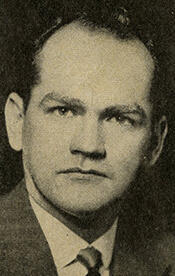
Here you will find contact information for Representative Gregory McMahon, including email address, phone number, and mailing address.
| Name | Gregory McMahon |
| Position | Representative |
| State | New York |
| District | 4 |
| Party | Republican |
| Status | Former Representative |
| Term Start | January 3, 1947 |
| Term End | January 3, 1949 |
| Terms Served | 1 |
| Born | March 19, 1915 |
| Gender | Male |
| Bioguide ID | M000560 |
About Representative Gregory McMahon
Gregory McMahon (March 19, 1915 – June 27, 1989) was a United States Representative from New York and a member of the Republican Party who served one term in Congress from 1947 to 1949. He was born in New York City, New York, where he attended local parochial schools before continuing his education in the city’s Catholic educational institutions. He graduated from St. John’s Prep School in Brooklyn in 1933, reflecting an early connection to the St. John’s academic community that would shape much of his later professional life.
Following his secondary education, McMahon enrolled at St. John’s University in New York City, from which he was graduated in 1938. Demonstrating a strong aptitude for finance and the law, he became a certified public accountant in 1939. He then pursued legal studies at St. John’s Law School from 1939 to 1941, further broadening his professional qualifications, although his emerging legal training was soon overtaken by the demands of military service during World War II.
Alongside his academic and professional preparation, McMahon began an early career in higher education. From 1939 to 1942, he taught at St. John’s College, contributing to the instruction of students in the period immediately preceding and during the early years of the United States’ involvement in World War II. His work as an educator coincided with his development as a practicing accountant, positioning him at the intersection of scholarship and applied financial expertise at a relatively young age.
With the onset of World War II, McMahon entered active military service. He served in the United States Navy as an ensign from December 1941 to October 1945. During his naval service he was assigned to duty in the Pacific, participating in the broader wartime operations of the U.S. Navy in that theater. His years in uniform coincided with the most intense phases of the conflict, and his service concluded shortly after the end of the war.
After returning to civilian life, McMahon turned to electoral politics. A Republican, he was elected to the Eightieth Congress as a Representative from New York, holding office from January 3, 1947, to January 3, 1949. His term in the House of Representatives occurred during a significant period in American history, marked by postwar reconstruction, the early Cold War, and major domestic debates over labor, economic policy, and the role of the federal government. As a member of the House of Representatives, Gregory McMahon contributed to the legislative process, participated in the democratic governance of the nation, and represented the interests of his New York constituents during this transitional era.
McMahon sought to continue his congressional career but was an unsuccessful candidate for reelection in 1948 to the Eighty-first Congress. After leaving office in January 1949, he resumed and expanded his professional work in the private sector. Drawing on his longstanding credentials as a certified public accountant, he established himself as an accountant and tax consultant, applying his financial and legal training to advisory and consulting roles.
In his later years, McMahon made his home in Garden City, New York, on Long Island. He remained a resident of Garden City until his death on June 27, 1989. His life reflected a combination of academic achievement, military service, professional expertise in accounting and taxation, and a period of federal legislative service during a formative moment in mid-twentieth-century American political history.