Representative Gustave Schleicher
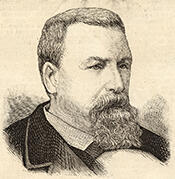
Here you will find contact information for Representative Gustave Schleicher, including email address, phone number, and mailing address.
| Name | Gustave Schleicher |
| Position | Representative |
| State | Texas |
| District | -1 |
| Party | Democratic |
| Status | Former Representative |
| Term Start | December 6, 1875 |
| Term End | March 3, 1881 |
| Terms Served | 3 |
| Born | November 19, 1823 |
| Gender | Male |
| Bioguide ID | S000129 |
About Representative Gustave Schleicher
Gustav Schleicher (sometimes spelled Gustave) (November 19, 1823 – January 10, 1879) was a German-born engineer, Texas legislator, Confederate Army veteran, and Democratic United States Representative from Texas. He served in the U.S. House of Representatives from 1875 until his death in 1879, completing two full terms and dying shortly before the commencement of his third. Over the course of three terms in office, he contributed to the legislative process during a significant period in American history, representing the interests of his Texas constituents and participating actively in the work of the House.
Schleicher was born on November 19, 1823, in Darmstadt, in the German principality of Hesse. He attended the University of Giessen (often referred to as Giessen University), where he studied engineering. Before emigrating, he assisted in the construction of some of the early railroads in Europe, gaining technical and practical experience that would later shape his career in Texas. His education and early professional work established him as a trained engineer at a time when railroads and infrastructure development were becoming central to economic expansion on both sides of the Atlantic.
In 1847, Schleicher joined a group of German intellectuals who immigrated to Texas and sought to establish a communal settlement under the Fisher–Miller Land Grant. Along with Hermann Spiess and Dr. Ferdinand Ludwig Herff, he helped found the commune of Bettina on the banks of the Llano River, named after the German literary figure and social visionary Bettina von Arnim. The community was intended, as later described by the Handbook of Texas, to demonstrate the truth of communist ideals and to offer a model for alleviating the social and political troubles then afflicting Europe, which had already produced sporadic revolutionary efforts and would culminate in the abortive German revolt of 1848. Schleicher soon became disillusioned with the experiment, reportedly remarking that “the bigger the men, the more they talked, the less they worked and the more they ate.” He left Bettina and moved to San Antonio, where he turned his attention to more conventional business and engineering pursuits.
In San Antonio, Schleicher helped organize the Guadalupe Bridge Company to construct a toll bridge across the Guadalupe River on the main road between San Antonio and New Braunfels, an important transportation link for the region. He was instrumental in forming the San Antonio and Mexican Gulf Railroad and began work on a railroad line from Port Lavaca to San Antonio in cooperation with General Joseph E. Johnston, who was then stationed in Texas. Schleicher became an American citizen in 1852 and that same year was elected to the Texas House of Representatives, serving one term in the Fifth Texas Legislature. From 1854 to 1861 he served as surveyor of the Bexar Land District, a vast jurisdiction extending from San Antonio toward El Paso. During this period he acquired extensive landholdings on the Edwards Plateau. In 1856 he married Elizabeth Tinsley Howard. Beginning in 1858, he and his brother‑in‑law, Heinrich Dresel, published the Texas Staats‑Zeitung, a German‑language newspaper in San Antonio. Schleicher also helped found the San Antonio Water Company in 1858 and was a cofounder of Alamo College in 1860, reflecting his growing prominence in civic and economic affairs.
Schleicher advanced in Texas politics when he was elected to the Texas Senate in 1859, representing the 31st District, which included Gillespie, Medina, and Uvalde counties west of San Antonio. Like most German immigrants in Texas, he opposed the state’s secession from the Union. Nevertheless, after Texas joined the Confederacy, he aligned himself with his adopted state and entered Confederate service. He became a captain in the Confederate Army and was placed in charge of the Corps of Engineers under General John B. Magruder. In this capacity he applied his engineering expertise to military works and fortifications, further solidifying his reputation as a skilled engineer and public servant.
After the Civil War, Schleicher returned to San Antonio, where he practiced law and resumed his involvement in railroad development. He was listed as one of the incorporators of the Columbus, San Antonio and Rio Grande Railroad and served as an engineer for the construction of the Gulf, Western Texas and Pacific Railway, a line running from Indianola, Texas, to Cuero, Texas. He is credited with founding the town of Cuero as a way station along this route and moved there in 1872. His postwar activities reflected a continued commitment to regional economic development through transportation and infrastructure projects, which would later inform his legislative interests in Congress.
In 1874, Schleicher was elected as a Democrat to the United States House of Representatives from Texas’s newly drawn 6th Congressional District. He took his seat in March 1875 and served continuously until his death in 1879, completing two full terms and being elected to a third. During his time in Congress, he served on the influential Committee on Ways and Means and the Committee on Foreign Affairs, and later became chairman of the House Committee on Canals and Railroads, a position that aligned closely with his long-standing professional focus on transportation and internal improvements. His service in Congress occurred during a significant period in American history, in the years following Reconstruction, and he participated actively in the democratic process, representing the interests of his Texas constituents and contributing to national debates. His support for the gold standard, however, provoked opposition within his own party, and he faced a strong primary challenge from John Ireland. Schleicher waged a bitter campaign but ultimately secured renomination and was reelected in 1878 to a third term.
Schleicher died in office on January 10, 1879, in the interval between his reelection and the start of the new congressional term, thus passing away two months before the commencement of his third term in Congress. His death prompted expressions of respect from colleagues on both sides of the aisle. A memorial address delivered by Republican floor leader James A. Garfield went beyond the customary courtesies extended to a deceased junior member of the opposition party and testified to the depth of esteem in which Schleicher was held. He was buried in the San Antonio National Cemetery. In recognition of his contributions to Texas, Schleicher County, Texas, was later named in his honor, reflecting his enduring legacy as an engineer, legislator, and congressman who helped shape the development of the state and its representation in the national government.