Senator Guy Cordon
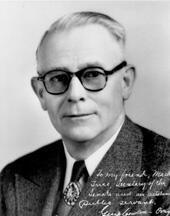
Here you will find contact information for Senator Guy Cordon, including email address, phone number, and mailing address.
| Name | Guy Cordon |
| Position | Senator |
| State | Oregon |
| Party | Republican |
| Status | Former Representative |
| Term Start | March 4, 1944 |
| Term End | January 3, 1955 |
| Terms Served | 2 |
| Born | April 24, 1890 |
| Gender | Male |
| Bioguide ID | C000774 |
About Senator Guy Cordon
Guy F. Cordon (April 24, 1890 – June 8, 1969) was an American author, politician, and lawyer from the state of Oregon who served as a United States Senator from Oregon from 1944 to 1955. A member of the Republican Party, he was appointed to the Senate during World War II and subsequently elected to two terms, contributing to the legislative process during a significant period in American history. Over the course of his public career he held a series of local and federal offices, including district attorney of Douglas County, Oregon, and chairman of the Senate Committee on Interior and Insular Affairs.
Cordon was born in Cuero, DeWitt County, Texas, on April 24, 1890. In 1896 he moved with his family to Roseburg, Douglas County, Oregon, where he attended the public schools. As a young man he entered local government service; in 1909, at the age of nineteen, he became deputy tax assessor of Douglas County, a position he held until 1916. He married Ana Allen in 1914, and the couple had two children. During World War I he enlisted in the United States Army and served in the artillery, interrupting his early career in county government for military service.
Following his wartime service, Cordon returned to Douglas County and in 1917 became the county tax assessor, serving in that capacity until 1919. During this period he studied law, and in 1920 he passed the bar, beginning a legal career that would underpin his later political life. In 1923 he was elected district attorney of Douglas County in southern Oregon, a post he held until 1935. After leaving the district attorney’s office he continued to practice law in Roseburg. He also became counsel for a group of eighteen Oregon counties engaged in litigation against the federal government arising from the Oregon land fraud scandal and disputes over land grants to the Oregon and California Railroad, work that brought him into sustained contact with federal land and resource policy.
Cordon’s prominence in legal and political circles in Oregon led to his appointment to the United States Senate. On March 4, 1944, Governor Earl Snell appointed him to fill the vacancy caused by the death of Senator Charles L. McNary. Later that year, in the November 1944 special election, Cordon was elected to complete McNary’s unexpired term, receiving approximately 57 percent of the vote against Democratic nominee Willis Mahoney; in that same election Wayne Morse won his first term to the Senate from Oregon. Cordon secured a full six-year term in 1948, winning about 60 percent of the vote against Democrat Manley J. Wilson. His Senate service extended from March 4, 1944, to January 3, 1955, encompassing the final phase of World War II, the early Cold War, and the beginning of the postwar expansion of federal domestic programs.
During his tenure in Congress, Cordon participated actively in the legislative process and represented the interests of his Oregon constituents, particularly on issues involving public lands and interior affairs. He proposed a procedural reform that became part of the Standing Rules of the Senate: the requirement that committee reports specify how provisions in a bill would change existing law. This reform, adopted as Rule XXVI, part 12, became known as the “Cordon Rule” and was intended to clarify the impact of proposed legislation for senators and the public. Cordon served as chairman of the Senate Committee on Interior and Insular Affairs from 1954 until his term expired in 1955, a position from which he influenced policy on natural resources, public lands, and U.S. territories. In that capacity he traveled to Hawaii to conduct hearings on potential statehood for the then-territory, several years before Hawaii’s admission to the Union in 1959. In the context of the early Cold War and the rise of anti-Communist investigations, Cordon was a supporter of Senator Joseph McCarthy and viewed the Democratic Party as insufficiently firm in opposing Communism.
The 1954 elections were difficult for Republicans nationally, and Cordon was narrowly defeated in his bid for another term. In that election he lost to Democrat Richard L. Neuberger by a margin of 50.2 percent to 49.8 percent, ending his Senate service at the close of his term on January 3, 1955. After leaving Congress, Cordon remained in public life through his legal work and writing. During the early 1950s, future science fiction author Frank Herbert worked as one of Cordon’s speechwriters, an association that later drew attention because of Herbert’s subsequent literary prominence.
Following his departure from the Senate, Cordon practiced law in Washington, D.C., from 1955 until his retirement in 1962. He then lived in retirement during the final years of his life. Guy F. Cordon died in Washington, D.C., on June 8, 1969, at the age of seventy-nine. His remains were returned to Oregon, and he was buried in Roseburg Memorial Gardens in Roseburg, symbolically closing a career that had begun in local government in Douglas County and extended to more than a decade of service in the United States Senate.