Representative Guy Molinari
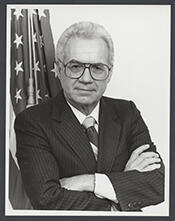
Here you will find contact information for Representative Guy Molinari, including email address, phone number, and mailing address.
| Name | Guy Molinari |
| Position | Representative |
| State | New York |
| District | 14 |
| Party | Republican |
| Status | Former Representative |
| Term Start | January 5, 1981 |
| Term End | January 3, 1991 |
| Terms Served | 5 |
| Born | November 23, 1928 |
| Gender | Male |
| Bioguide ID | M000842 |
About Representative Guy Molinari
Gaetano Victor Molinari, commonly known as Guy Victor Molinari, was born on November 23, 1928, in New York City. He grew up in the Staten Island borough of New York, a community that would remain the focal point of his personal life and political career. Of Italian-American heritage, he came of age in the mid-twentieth century in a city undergoing rapid demographic and economic change, experiences that helped shape his later emphasis on local representation and constituent service.
Molinari pursued a legal education and became an attorney, establishing the professional foundation that preceded his entry into public life. Trained in the law, he developed an understanding of legislative and governmental processes that would inform his work as a legislator at both the state and federal levels. His legal background contributed to his reputation as a capable advocate for his district and as a figure who could navigate the complexities of New York’s political landscape.
Before his service in Congress, Molinari built his political career in state government. A member of the Republican Party, he was elected to the New York State Assembly in 1974 and served from 1975 to 1980. During this period he sat in the 181st, 182nd, and 183rd New York State Legislatures, representing Staten Island and participating in the development of state policy during a time of fiscal strain and urban challenges in New York. He was also active in party affairs, serving as a delegate to the New York State Republican conventions in 1979 and to the Republican National Conventions in 1980 and 1984, thereby helping to shape the party’s direction at both the state and national levels.
In 1980, Molinari was elected to the United States House of Representatives, unseating nine-term Democratic incumbent John M. Murphy. The congressional district he first represented included all of Staten Island and most of Lower Manhattan, giving him responsibility for a diverse constituency spanning residential neighborhoods and key commercial areas of New York City. Following redistricting in 1982, his district lost its share of Manhattan and was merged with a Brooklyn-based district held by four-term Democrat Leo Zeferetti. Molinari defeated Zeferetti with 57 percent of the vote, consolidating Republican strength on Staten Island. He was reelected to the three succeeding Congresses with minimal opposition.
Guy Victor Molinari served as a Representative from New York in the United States Congress from January 3, 1981, until his resignation on December 31, 1989, completing what is described as five terms in office and encompassing four full terms in the House. A Republican member of the House of Representatives, he represented Staten Island and participated in the legislative process during a significant period in American history, including the Reagan administration and the end of the Cold War. In Congress he took part in the democratic process by advocating for the interests of his constituents, focusing on issues important to Staten Island and New York City, and contributing to national debates on policy and governance. Upon his resignation from Congress at the end of 1989 to assume a local executive office, he was succeeded in the House by his daughter, Susan Molinari, who also served on the New York City Council and continued the family’s congressional representation of Staten Island.
After leaving Congress, Molinari transitioned to municipal leadership as Staten Island Borough President, a position he held for 12 years. He served as Borough President from January 1, 1990, to December 31, 2001. In this role he became one of the most prominent political figures on Staten Island, advocating for improved transportation, local services, and greater recognition of the borough’s distinct needs within New York City. His tenure coincided with major citywide developments and debates over land use, infrastructure, and quality of life, and he used the borough presidency to press for policies he believed would benefit Staten Island residents.
Molinari remained an influential and sometimes controversial figure in New York politics during and after his borough presidency. In 1994, a week before the statewide elections, he publicly asserted that Karen Burstein, the Democratic nominee for New York Attorney General, was not qualified to serve as attorney general because she was a lesbian. His remarks drew widespread criticism and were described by The New York Times as “gutter politics.” Nonetheless, in the context of a strong national Republican showing and George Pataki’s victory in the governor’s race, Republican candidate Dennis Vacco narrowly defeated Burstein in the attorney general contest, an outcome observers linked in part to the late-campaign controversy. In 1995, Molinari sought to extend his influence in local law enforcement by running for Richmond County District Attorney, but he was defeated by the Democratic incumbent, William L. Murphy.
In his later years, Molinari remained a notable elder statesman of Staten Island and New York Republican politics, recognized for his long record of public service at the state, federal, and municipal levels. His family’s political legacy continued through his daughter, Susan Molinari, who served in Congress and on the New York City Council. Gaetano Victor “Guy” Molinari died on July 25, 2018, leaving behind a decades-long record of engagement in public life and a prominent place in the political history of Staten Island and New York City.